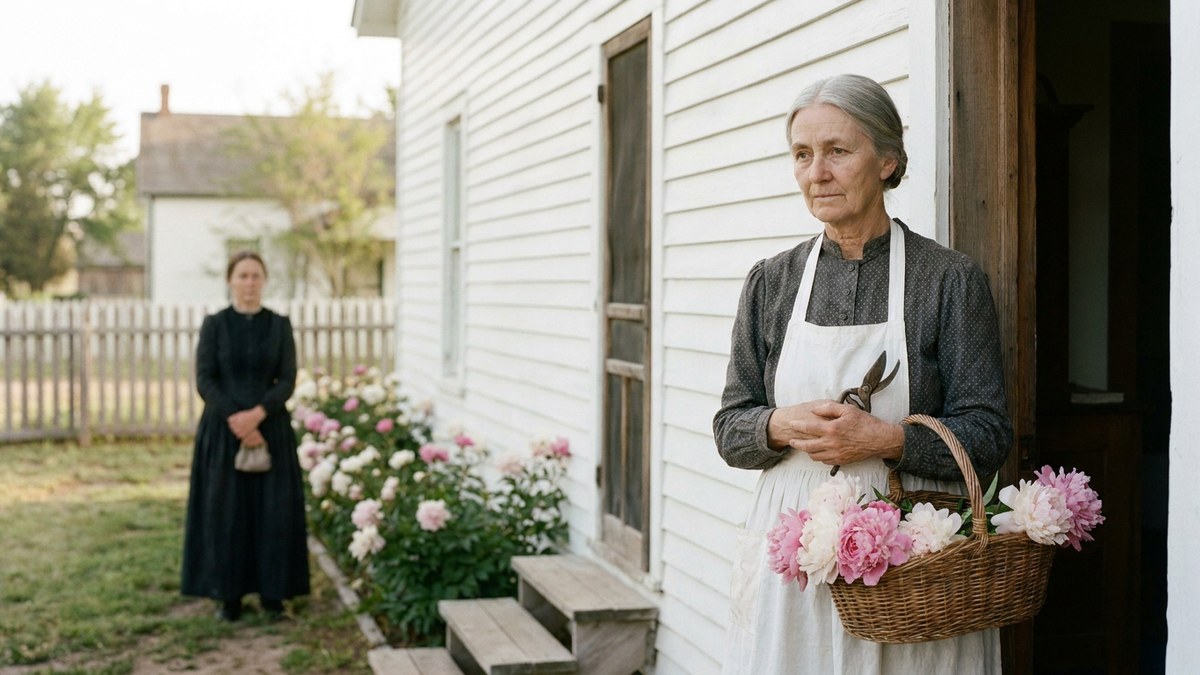
Ruth read it standing on the porch, with Lettie waiting on the step below.
I have found the walnut tree on the Wire Road and the board just as you wrote. I have brought my Daniel home to Kansas, to Cottonwood Ford, where he can lie near his father one day. You did not have to do any of it. Whoever you are, I will pray for you every night of my life.
She had kept that promise. Ten years. Every night.
For seven of those years, the man she prayed for had shod her mare.
"He never meant to come here," Lettie said. "We were bound for Texas in '69. Our wagon broke an axle at the ford, and while he was fixing it, he heard your name at the store. He stood in the road a long time. Then he said, Lettie, we're staying."
"He never said a word to me," Ruth said. "Not one."
"He said you'd lost enough without having to say good morning to the man who put your boy in the ground." Lettie looked down. "He said telling you would be like asking to be thanked."
Ruth folded the letter along its old creases.
"On Thursday I told you the peonies were all promised," she said. "That wasn't so."
"I know it," Lettie said gently. "Good night, Mrs. Calder."
When Lettie had gone, Ruth went into the parlor and lit the lamp and looked at the board.
The square, deep letters. The little curl at the foot of the D.
She thought of the iron letters over the cemetery gate that she had walked under every week for four years. FORD.
She did not need to go and look. She went anyway, in the dark, with a lantern, and held it up under the arch.
The D in FORD had a little curl at its foot.
Decoration Day began at two o'clock with the cornet band at the church.
They marched to the cemetery in the warm afternoon, the Grand Army men first in their old blue coats, then the schoolchildren with armfuls of flowers, then everybody else. The Major spoke at the flagpole. The children sang. Then the families went out among the graves, and the band played softly, and the flowers went down.
Ruth's six baskets went on the Union graves, as they had every year.
She carried the seventh herself. It was the last of them. She had cut the bushes bare that morning to fill it.
She knelt at Daniel's grave and laid half of the peonies on it. Then she stood up, with her knees aching, and picked up the basket.
She walked across the cemetery.
Past the flagpole. Past the Major. Past the band, which stopped playing, one horn at a time. Somewhere behind her a child asked a question and was hushed.
The south corner was very quiet. The grass was longer there. Silas Ralls's grave was still raw at the edges, and there was a hole at the head of it where the rose had been.
Ruth knelt.
She laid the peonies down. Pink and white. They smelled like spice and rain.
She did not say anything. She had said it already, every night, for ten years.
When she was done with Silas, there were enough left in the basket for the other four. She gave each of them the same.
Lettie came across the grass with her three children. The children stood close to their mother and stared at the flowers.
Then someone else came.
It was Harley Pickering, the Major's grandson, fourteen years old, walking stiff as a fence post. Ruth looked at his boots before she looked at his face. There was a nail missing from the left heel.
He was carrying the wild rose, its roots still wrapped in Ruth's blue apron.
That morning, before the band, she had walked over to the Pickering house and left it on the Major's porch in a bucket of water. She had not left a note. The Major had always known his grandson's boots better than anyone.
Harley knelt at the head of the grave. He did not look at anybody. He dug the hole out with his bare hands and set the rose in it and pressed the dirt down hard around the roots.
Across the cemetery, by the flagpole, Major Pickering stood with his hands at his sides.
Then he took off his hat.
At the gate afterward, under the iron arch, the Major stopped beside her.
"Ruth," he said. "Why?"
Lettie was a few steps behind them with her children. Ruth did not look back at her.
There were a great many things she could have told him. About a walnut tree. About a letter in pencil. About a man who stood in the road at the ford and said, Lettie, we're staying.
They were not hers to tell. Silas had kept them for seven years. She could keep them for the rest of hers.
"He shod my mare for seven years, Thad," she said. "He never once charged me a penny more than the work was worth."
The Major nodded slowly. Then he put his hat back on and went home.
That evening Ruth stood in her yard and looked at the peony bushes.
They were cut bare to the leaves. Not one bloom left on them.
They would bloom again next May. She had already decided where half of it would go.
> What really happened: On May 5, 1868, General John A. Logan, commander of the Grand Army of the Republic, issued General Order No. 11 naming May 30 as a day for decorating the graves of Union soldiers, and towns across the North held the first Decoration Day that month. At the Battle of Wilson's Creek, Missouri, on August 10, 1861, the First Kansas Infantry suffered 284 casualties among its roughly 800 men, and most of the Union dead were buried in unmarked mass graves on the field. In 1867 they were moved to the new Springfield National Cemetery, where only a handful could be identified. Sources: National Park Service; Library of Congress.