The man from the Pension Bureau set down his pen and said, "Mrs. Strand, there was no wedding."
Abigail Strand sat across the table from him in the front room of her own sod house in Dakota Territory, in June 1884, with her hands folded in her lap. She was sixty-two. She had been a widow for nineteen months.
"There was," she said. "On May 17, 1863. In Mississippi."
"In an army camp."
"Under a sycamore tree by the hospital tents. The regiment's chaplain married us."
Mr. Carver Gaines, Special Examiner, looked down at his papers. He was a thin, careful man in a gray suit, and he had driven out from the railroad in a hired buggy that morning with a leather case full of other people's lives.
"The chaplain sent a record to the county clerk in Ohio," he said. "That courthouse burned in 1879. There is no record. There is no license. There is only your word."
"My word is good, Mr. Gaines."
"Madam, I found forty false widows in this district last year." He did not say it unkindly. He said it the way a man says the price of wheat. "One woman drew pensions on three husbands. Army camps were full of women who called themselves wives."
Abigail felt the heat come up in her face. She did not let it reach her voice.
"I was a nurse in that hospital for two years," she said. "I was not a camp follower."
"Then prove it." He closed his case. "I leave for Yankton on the thirtieth. If I have no proof of marriage by then, I will report this claim as a fraud."
When he had gone, she sat at the table a long time with the empty teacups.
Tom's pension had stopped the day he died. The doctor in town had written it plain on the paper: the old wound in his lung from Vicksburg had killed him at last, twenty years late. The law said his widow was owed a pension for that. Eight dollars a month.
Eight dollars was the difference between keeping the claim and selling it.
She had a horse, an old bay gelding named Colonel. She had forty-one dollars in a coffee can. She had fourteen days.
And somewhere, if he was still alive, she had a chaplain.
His name was Ezra Pell.
She remembered him exactly. A long, stooped Methodist with a voice too big for his body, who came into the hospital tents every evening after supper and sat with the worst cases. He carried a little black pocket book, and every night before he left, he sat on an upturned box by the lantern and wrote in it with a pencil stub, small and close, until the pencil was too short to hold.
"What do you write, Chaplain?" she had asked him once.
"Everything," he had said. "The Lord keeps His own books. I keep mine."
After the war, he had sent a Christmas letter to the regiment's old soldiers for a few years. The last one had come to Tom in 1877, from a church on the Nebraska line. Abigail found it in Tom's tin box, soft and yellow. Grace Methodist Church, Niobrara Valley. The return said nothing more.
The railroad did not go anywhere near it. By the old freight road, it was a hundred miles. Two hundred there and back.
She packed her carpetbag that night.
Her neighbor, Lute Halvorsen, came over at dawn when he saw her saddling Colonel.
"You can't ride two hundred miles, Mrs. Strand."
"I rode farther than that in Mississippi," she said. "In a hospital wagon with no springs."
"That was twenty years ago."
"Then it's a good thing I've had twenty years to rest."
Lute shook his head, the way men did when they had decided a woman was being foolish and did not want to say so. Then he went and got his own good saddle blanket and put it under hers.
She rode thirty miles the first day and twenty-six the second. She slept the first night in a homesteader's soddy and the second under a wagon at a ford, with Colonel's reins tied to her wrist.
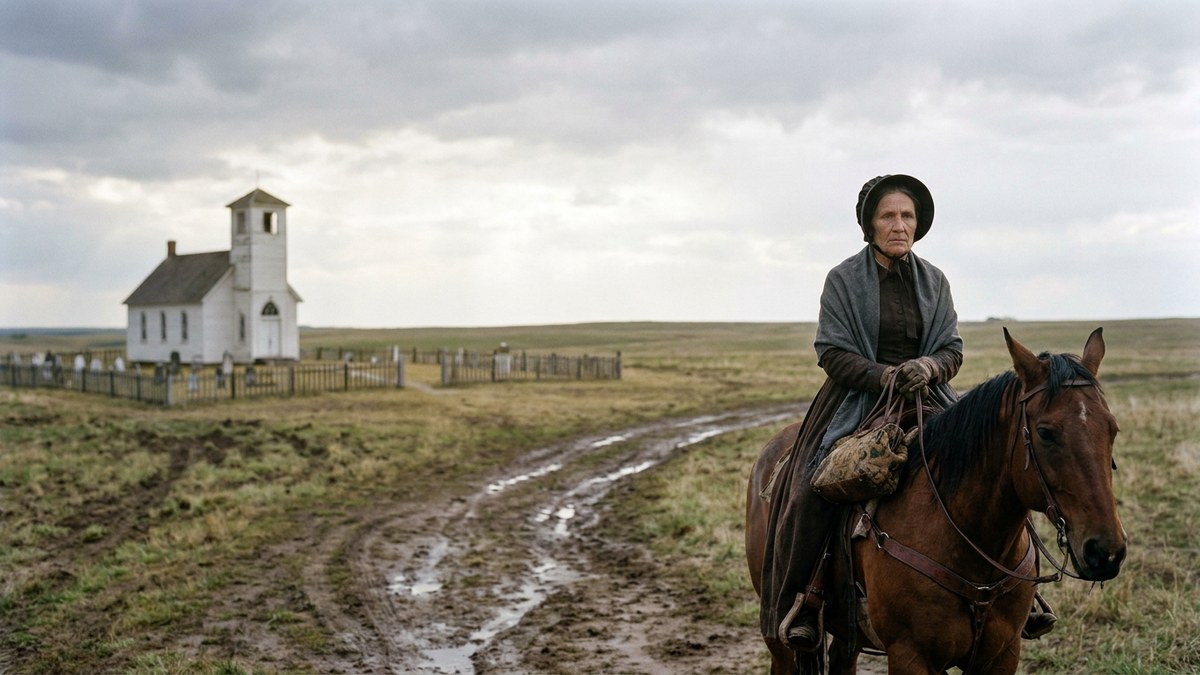
On the third day it rained, cold and steady, out of a sky the color of a pewter plate. The freight road turned to gumbo. Colonel picked his way through it with his head down, and Abigail sat on him with the rain running off her hat brim and down the back of her collar, and thought about Tom.
He had been a sergeant then. Thirty-four, with a laugh she could hear across the whole camp. He had been brought in with a ball in his shoulder in April 1863, and he had asked her to marry him on the fourth day, flat on his back on a cot, with his arm strapped to his chest.
"You're delirious," she had said.
"I'm not," he had said. "I'm only lying down."
She had said no three times. The fourth time, in May, she said yes. They had two days. Then he went back to his regiment outside Vicksburg, and she did not see him again for fourteen months.
On the fourth afternoon, she came over a rise and saw the church.
It stood alone on the open prairie above the Niobrara bottoms, small and white, with a square bell tower and no bell. There was no town. There was a parsonage behind it, and a well, and a fence around a little graveyard.
A woman was hanging wash in the yard. She shaded her eyes and watched Abigail ride in.
"I'm looking for the Reverend Ezra Pell," Abigail said. Her voice came out hoarse from four days of rain.
The woman's hands stopped on the clothesline.
"I'm his daughter," she said. "He's inside. But ma’am, I should tell you. Papa doesn't know anybody anymore."
She led Abigail into the parsonage kitchen. By the stove, in a rocking chair, sat a very old man with a blanket over his knees and big, empty hands.
"Papa," the daughter said gently. "This lady was in the war."
Ezra Pell looked up at Abigail. His eyes were pale and kind and perfectly blank.
"How do you do," he said. "Have we met?"