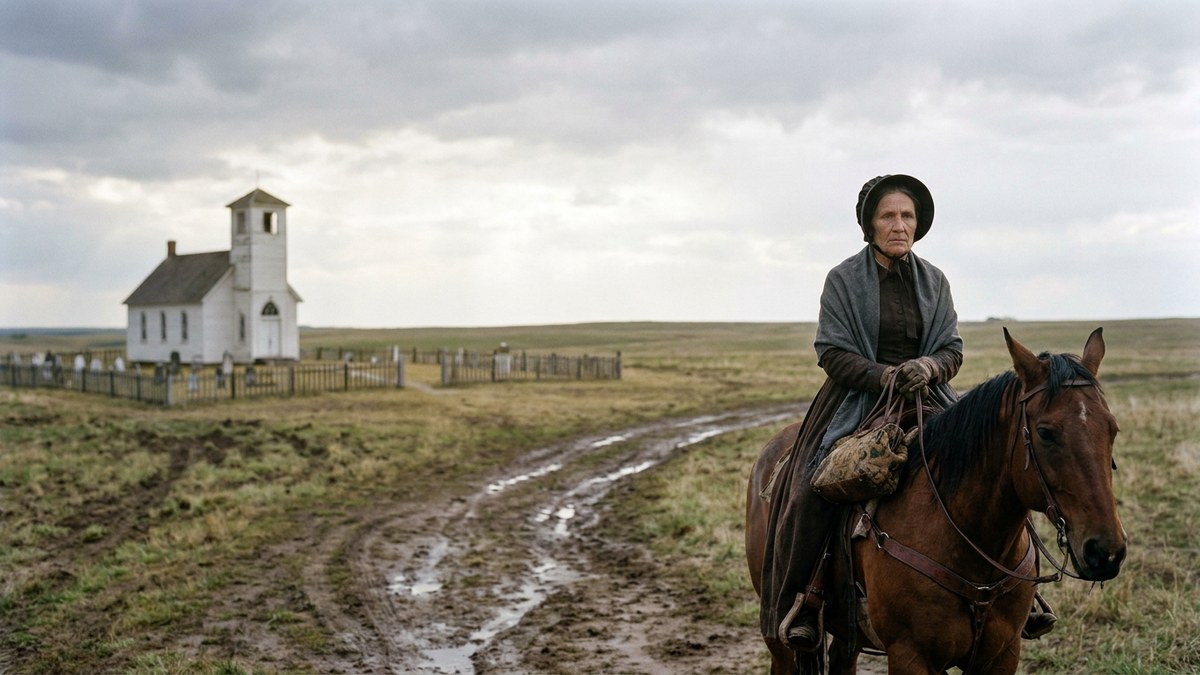
Abigail sat down across from him because her legs would not hold her any longer.
"Chaplain," she said. "It's Abigail Rowe. The nurse. From the hospital at Milliken's Bend, and then at Grand Gulf."
"Grand Gulf," he said, pleasantly, as if it were the name of a hymn he had once liked.
"You married me," she said. "To Sergeant Tom Strand. Under the sycamore."
The old man smiled at her and nodded, and then he looked out the window at the wash on the line.
The daughter set a cup of coffee in front of Abigail and put a hand on her shoulder. "He has good days," she said. "Not many anymore."
Abigail held the cup and did not drink it. She had nine days left. She had ridden a hundred miles to this kitchen. The man who had married her was sitting three feet away, and he was not there at all.
She would have cried then, if she had been a crying woman. Instead she looked at his hands.
They lay on the blanket, long and spotted, and the first two fingers of the right hand were bent a little, the way a man's fingers bend after a lifetime of holding a pencil stub too short to hold.
"Miss Pell," Abigail said. "Your father kept a little black book in the war. He wrote in it every night."
The daughter looked surprised. "He kept those all his life. One every year. They're in the trunk upstairs. Nobody's opened it since Mama died."
"Will you let me look?"
The trunk was under the eaves, and it smelled of cedar and old paper.
There were forty-one little black books inside, tied in bundles with string, each one marked on the spine in ink with a year. 1859. 1860. 1861.
1863.
Abigail sat on the floor under the slanting roof with the book in her lap, and turned the pages by the light from the little window. The writing was tiny and close, in faded pencil. Weather. Deaths. Hymns. The names of boys who had asked him to write their mothers.
April 22. Sgt. Strand, Co. B, shoulder. Asks for Miss Rowe again.
May 3. Strand has proposed a third time. Miss Rowe has refused a third time. I believe she is weakening.
Abigail laughed out loud, alone in the attic, and then she put her hand over her mouth.
May 17. Fair and hot. Married this day, under the big sycamore by the hospital tents, Sergeant Thomas Strand, Co. B, to Miss Abigail Rowe, nurse, of Ohio. Witnesses Capt. J. Durrell and Mrs. Sarah Kemp, matron. The bride had blood on her apron and would not stop to change it. Hymn, "How Firm a Foundation." God keep them both.
The daughter took her into town in the wagon the next morning, eleven miles, with the book wrapped in a clean dish towel.
The notary was the storekeeper. He read the entry, and looked at the date on the spine, and had the daughter swear that it was her father's own hand and that the book had been in his trunk since the war. Then he copied the page out fair, and Abigail signed a statement of her own beneath it, and he pressed his seal into both.
"Keep the book," the daughter said, when Abigail tried to give it back. "Send it home when you're done with it. Papa would want it used."
She rode home faster than she had come. Colonel seemed to know.
She came into town on the afternoon of the twenty-ninth, mud to the stirrups, and found Mr. Gaines at the hotel, packing his leather case for the morning train.
She laid the dish towel on the table and unfolded it.
He read the notary's copy first. Then he read the page itself in the little black book, slowly, holding it close to the window. He read it twice.
When he looked up, his face had changed.
"The bride had blood on her apron," he said, "and would not stop to change it."
"There were nine men waiting on me in the tent," Abigail said. "I had promised them I'd be quick."
Mr. Gaines set the book down very carefully, the way a man sets down a full cup.
"Mrs. Strand," he said. "I owe you an apology. I have been at this work four years. I have seen so many lies that I stopped knowing what the truth looks like when it sits across a table from me."
"It looks tired, mostly," Abigail said. "And it wants its supper."
He did not just file her claim. He wrote a letter of his own to go with it. She never saw the letter, but the clerk at the land office told her later that the man from the Pension Bureau had stayed up half the night writing it, and had changed his train.
In October, the certificate came. Eight dollars a month, and the back pay owed from the day Tom died.
The first thing Abigail did was send the little black book home to the Niobrara, wrapped in oilcloth, with a letter to the daughter and a dollar for the postage.
The second thing she did was take Lute Halvorsen's saddle blanket back to him, washed.
The next spring, a parcel came for her from Nebraska.
Inside was a short note from the daughter. Papa passed in March, it said. Easy, in his chair. Before he went, he had one good day. I read him your letter. He laughed and said, I told you she was weakening.
Under the note, wrapped in tissue, was one dried leaf, big and brown and five-pointed.
The daughter had found it pressed in the back of the 1863 book, against the page for May 17. Abigail had not noticed it there. She had been reading the words.
She put it in Tom's tin box, on top of the pension certificate, and closed the lid.
> What really happened: To receive a pension, a Union soldier's widow had to prove her marriage, usually with a copy of the county record, a church record, or a sworn statement from the minister or a witness who saw the wedding. When records had burned or never existed, widows gathered affidavits from anyone who could swear to the marriage, and pages from family Bibles were often sent in as proof. From 1881, the Pension Bureau sent special examiners into the field to take testimony and root out fraud. Sources: National Archives.