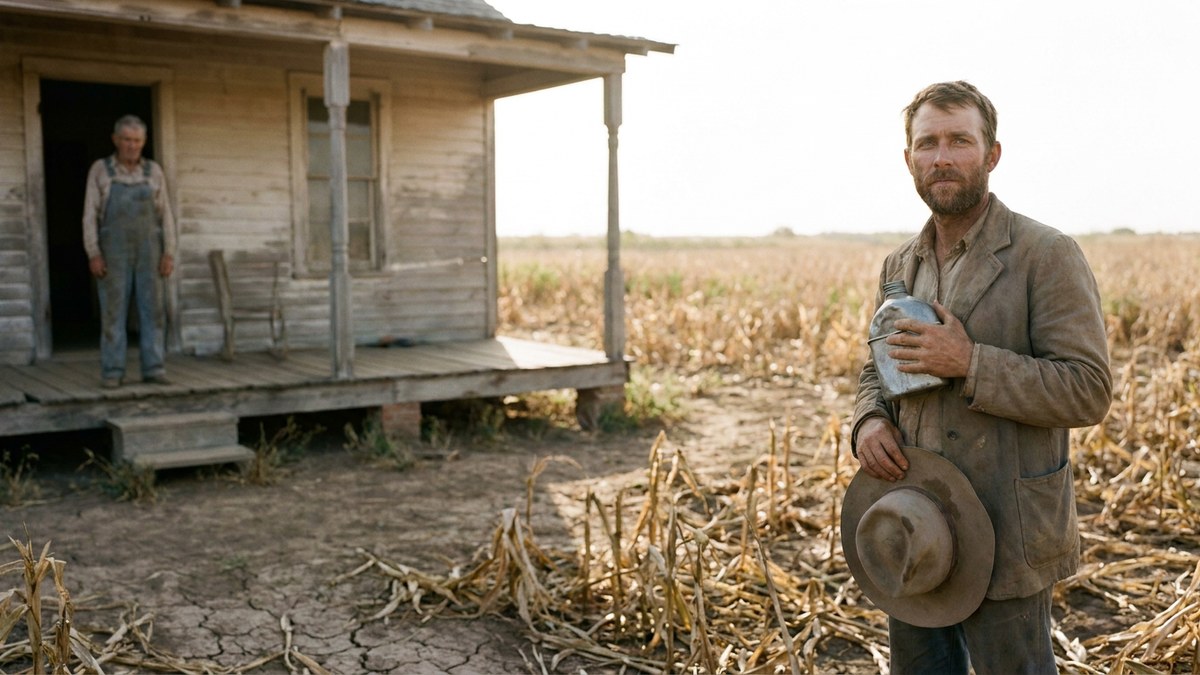
The old man in the doorway looked at the canteen in Owen Tibbs's hand and said, "Never saw it before in my life."
Owen had ridden three days to hear him say it. It was September 1886, in Coleman County, Texas, and it had not rained there in fourteen months.
"It has your initials scratched on it," Owen said. "J.C. And the county. I've carried it twenty-two years, Mr. Crabtree."
"Lots of men named J.C. in Texas."
The old man was seventy, maybe more, tall and stooped, with a white beard stained yellow at the mouth from his pipe. He kept his right hand in the pocket of his overalls. Behind him the house was two rooms of unpainted boards gone silver in the sun, and the yard was bare dirt, and the dirt was cracked in plates as big as a man's hand.
"You were at Mansfield," Owen said. "In Louisiana. April 8, 1864."
"Mister," said Josiah Crabtree, "I'll thank you to get off my porch."
Owen had been thirteen at Mansfield, a drummer boy in an Illinois regiment.
He remembered the pines. He remembered the afternoon going wrong all at once, the whole Union line breaking and running back down the road through the woods, wagons overturned, mules screaming. He remembered losing his company in the smoke and rolling into a ravine full of dead leaves with his drum still strapped to him, and lying there with his face in the leaves.
And he remembered the Texan.
A big man on a gray horse came down into the ravine and saw him. The man raised his carbine. Owen looked up the barrel of it, and the man looked back down at him, and for a long moment neither of them breathed.
Then the man lowered the carbine. He unslung his own canteen and tossed it into the leaves beside Owen's head.
"Go home, son," he said. He pointed through the pines. "Your people are that way. Keep low."
Owen kept low. He made it back. He never saw the man's face clearly, only the beard, and the gray horse, and the canteen in the leaves, with J.C. COLEMAN CO. TEX. scratched into the tin.
Now he was thirty-five, a well driller from Illinois with a wife and two daughters and a horse-powered drilling rig he had shipped to Texas on the railroad in pieces. There was work for a well man in a drought. More than he could do.
He had come to Coleman County to say one thing. He had not said it yet.
He went into town instead, to Talbot's store, and asked about Josiah Crabtree.
"Old Joe?" Talbot laughed. He was a round, cheerful man who kept the post office in the back of the store. "He's about done. Wife's dead, son's dead, he's got a grandboy of twelve and a farm with no water on it. His tank went dry in June. His note's due the first of October. Two hundred and eighty dollars."
"Who holds the note?"
"I do," Talbot said, not unkindly. "And I can't carry it, mister. Half the county owes me. I'm about broke myself."
Owen bought a sack of coffee he didn't need.
"There's a story about old Joe," Talbot said, wrapping it. "He tells it when he's had a drink, which isn't often. Says he let a little Yankee drummer boy go at Mansfield, and a Yankee picket shot him through the hand for his trouble. That's why he can't hold a plow right. Nobody believes it. Old soldiers tell all kinds of stories."
Owen stood very still with the coffee in his arms.
He had heard a shot behind him, that day in the pines, while he ran. He had thought it was meant for him.
He went back out to the farm the next morning with his rig.
It took him half the day to set it up beside the dead tank: the tall wooden derrick, the heavy iron bit on its cable, the horse power that walked in a circle and lifted the bit and dropped it, lifted and dropped it, pounding down through the dirt.
The grandson came out first. Benny was skinny and brown, barefoot, with his grandfather's long jaw. He stood a little way off and watched the bit go down.
"What are you doing?"
"Looking for water," Owen said.
"There's no water. Grandpa says there's no water in this whole county."
"There's water everywhere," Owen said. "Most places it's just a long way down."
Benny came a step closer. Then another. By noon he was leading the horse around the circle himself, and asking how deep, and how deep now.
The bit went down forty feet the first day. Sixty by the second noon.
Josiah Crabtree did not come out of the house.
On the second afternoon, the bit struck rock at seventy-one feet. Owen felt it in the cable, a hard, dead ring that came up through his hands.
He stopped the horse and stood looking at the derrick. Rock meant days. It meant changing the bit and grinding through it an inch at a time, and the first of October was twelve days off.
He heard the screen door slap.
Josiah came across the yard, slow and stiff, with an old cavalry carbine held in his left hand. He stopped ten feet from Owen. Benny let go of the horse.
"Grandpa," the boy said.
The old man raised the carbine. He did it one-handed, with the barrel resting across his scarred right wrist, and he pointed it at Owen's chest.
"I let you go once," Josiah Crabtree said. "Don't make me sorry for it."