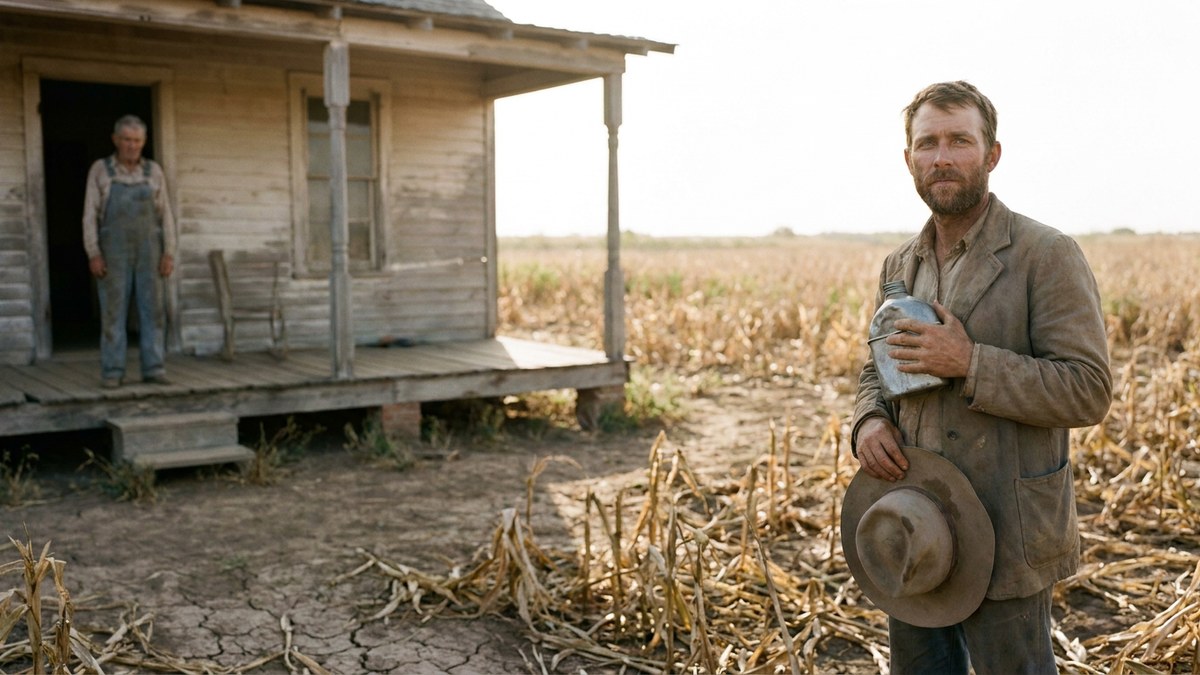
Owen did not move.
He was standing just as he had in the ravine, looking up a barrel at the same white-bearded face. He was thirty-five now, and he was not afraid in the same way. But his hands were cold.
"You did let me go," he said. "I never thanked you. I've been trying to for twenty-two years."
"I don't want thanking."
"I know it. I see that now."
Owen took the canteen off his shoulder and hung it on a peg of the derrick, where the old man could see it.
The carbine stayed where it was.
"Mister Crabtree," Owen said. "What are you afraid of?"
Josiah's face worked under the beard.
"I am not afraid of you," he said. "I'm afraid of being bought. You ride in here with your Yankee money and your Yankee machine, and you dig me a well and pay my note, and then what was it? That day in the pines. It's the one thing I did in four years of that war that I'm not ashamed of. I'll not have it turned into a bill paid."
He lowered the carbine a little.
"A man doesn't sell the one good thing he ever did," he said.
Benny stood by the horse with both hands over his mouth.
Owen nodded slowly.
"All right," he said. "Then I won't pay you for it. I'll ask you for something."
"What?"
"Let me finish this well. And let the boy work the rig with me. All of it, the bit and the cable and the horse power and the casing. When it's done, he'll know how to drill a well. There's not a farmer in this county who couldn't use a boy like that."
Josiah looked at Benny.
"He's twelve," Owen said. "I was thirteen."
The old man stood a while with the carbine pointed at the dirt. A hot wind came across the yard and rattled the dry cornstalks against the fence.
"You'll eat at my table," Josiah said at last. "I'll not have a man work my place and eat cold beans by himself. And the boy's in bed by nine."
He went back into the house. The screen door slapped behind him.
It took nine days to grind through the rock.
Owen changed the bit three times. Benny learned to dress it at the little forge Owen set up by the tank, to heat the iron cherry red and draw the edge out with a hammer. He learned to read the cable with his hands, the dull ring of rock, the soft thud of clay. He blistered both palms and did not say a word about it.
At supper Josiah said very little. He ate with his left hand. His right lay on the table beside his plate, the fingers drawn in and stiff, and a white scar ran across the back of it, as wide as a pencil.
On the sixth night, he spoke without looking up.
"The picket was a boy, too," he said. "Couldn't have been more than sixteen. He saw a Rebel on a gray horse ride down into a ravine after one of his drummers, and he did what anybody would. He was a good shot." He moved the fingers a little. "I've thought about him a good deal."
"So have I," Owen said. "I just didn't know it was him I was thinking about."
On the ninth afternoon, at a hundred and sixty-four feet, the bit went through the rock and dropped.
The cable went slack in Owen's hands. Then it went heavy and wet.
When they bailed it up, the bailer came out of the hole full of water. It was gray with mud at first, and then it was clear. It was cold. It ran over the edge of the bailer and down Benny's bare arms and onto the cracked dirt, and the dirt drank it and went dark.
Benny made a sound that was not a word.
Josiah Crabtree had come out on the porch. He stood with his good hand on the post and looked at the wet ground. He did not come any closer. He did not need to.
Owen put in the casing and a secondhand windmill he bought from a widow in Santa Anna. By the first of October, Josiah's last four cows were drinking from a trough, and there was water for the garden.
On the thirtieth of September, Owen rode into town alone.
He paid Talbot two hundred and eighty dollars in gold at the post office window in the back of the store. Then he made Talbot put his hand on the counter Bible and swear never to say who had paid it.
"What do I tell him?" Talbot asked.
"Tell him the note's been settled," Owen said. "Tell him it was a debt from 1864, and the man who owed it is satisfied."
Owen left the next morning before light, with his rig broken down on two wagons.
He did not say goodbye at the house. He had said it at supper, as well as two men like that could say it, which was with very few words and a long handshake, left-handed.
At the gate he looked back once.
The windmill was turning in the dark, slow and steady, and the old canteen still hung on its peg at the top of the well pipe, where Benny had insisted it stay.
Josiah never asked him about the note. Owen never told him. In the spring, a letter came to Illinois in a boy's careful printing. It said they had drilled a well for the Baylors down the creek, and the Baylors had paid them in a pig.
> What really happened: At the Battle of Mansfield, Louisiana, on April 8, 1864, Confederate forces under Richard Taylor, many of them Texans, routed a much larger Union column in the Red River Campaign, killing or wounding about 700 men and capturing 1,500. After the war, many veterans of both armies settled side by side in Texas and the West. A severe drought struck west-central Texas in 1885 and 1886, and in February 1887 President Grover Cleveland vetoed the Texas Seed Bill, a small federal grant of seed grain for the drought counties. Sources: Texas State Historical Association; The American Presidency Project.