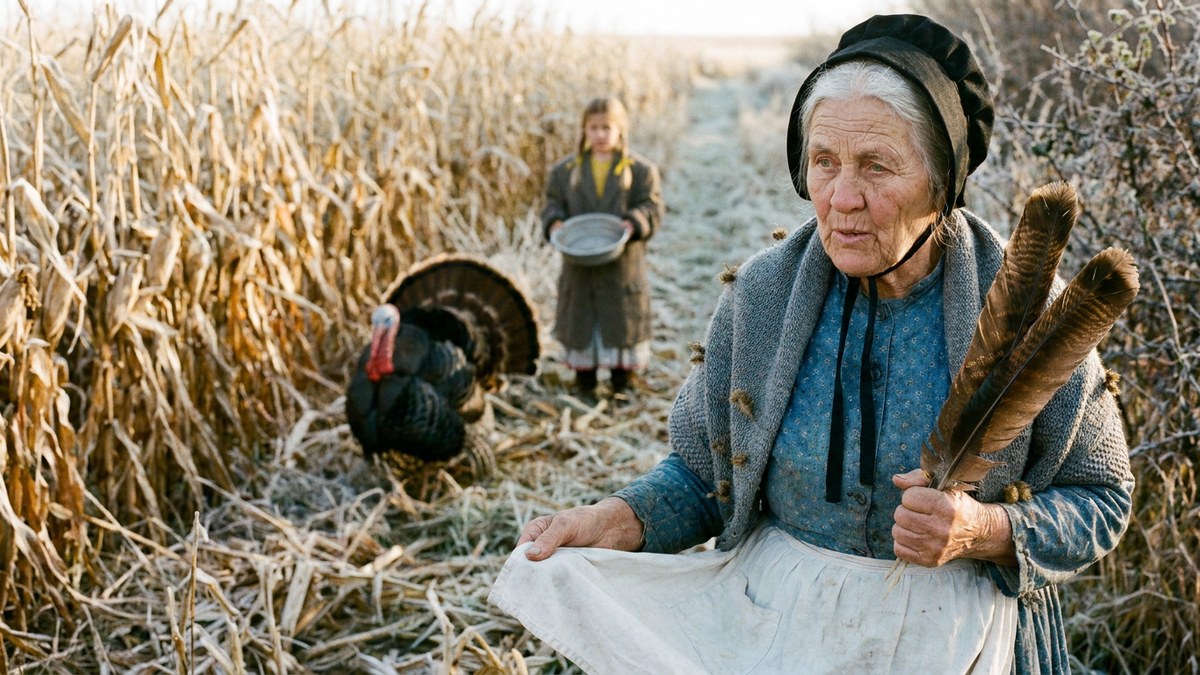
At nine o'clock on Thanksgiving morning, 1878, the only turkey Lucinda Haas owned went straight up over the hedge and into the Wendts' yard.
She stood in the frost with the hatchet in one hand and a fistful of tail feathers in the other, and watched him go.
"Grandma," said Peter, who was ten. "That's Wendt's."
"I know whose it is," Lucinda said.
Behind her, in the kitchen of the sod house, her daughter-in-law Ella had two dried-apple pies cooling on the sill and a pan of cornbread in the oven. The table was set for four. There was nothing in the middle of it.
Lucinda was sixty-seven. She had raised that turkey from a poult the size of her fist, and fed him cracked corn all summer, and named him General Grant, because he walked like he had won something.
"You never chase a turkey," she had told the children back in August, when he got out of the pen the first time. "You'll run all day and he'll laugh at you. You wait for him to go to bed."
"Turkeys go to bed?"
"At sundown they fly up in a tree to roost. Then they sit tight and sleep, and you can walk right up and lift them off the branch like a hat off a peg."
That had been in August. General Grant had come home on his own that time, at dusk, and flown up onto the henhouse.
This was Thanksgiving, and he had gone over the hedge.
The hedge was Osage orange, thick and thorny and six feet high, and Lucinda's husband had planted it in 1871 along the line between the two claims. For four years after that, the Haases and the Wendts had traded seed and borrowed tools and sat together at church.
Then came October 1875.
Gus Wendt had plowed a firebreak along the west side of his place, a wide strip of bare turned dirt, and on a still afternoon he had set fire to the grass beyond it to widen the break. Everybody did that in the fall. It was how you kept a prairie fire from reaching your house.
The wind came up out of the west at four o'clock.
The fire jumped the break, crossed the corner of Wendt's pasture, and went through the hedge and into the Haas haystacks. Two stacks and the cow shed burned to the ground. Lucinda's husband was dead by then. Lucinda's son, Ella's husband, stood in the smoke and swore at Gus Wendt across the hedge, and Gus Wendt swore back in German.
There was a lawsuit at the county seat in the spring. The jury said the wind was an act of God. Gus Wendt paid nothing.
Lucinda's son died the next winter of a fever. Gus Wendt did not come to the funeral.
Nobody had crossed the hedge since.
"We could just eat the cornbread," said Rose, who was eight.
"We are not eating cornbread for Thanksgiving," Lucinda said. "Mr. Lincoln did not make it a national holiday so the Haas family could eat cornbread."
She put down the hatchet.
"Ella, keep the oven hot."
"Mother Haas," Ella said from the doorway. "You can't go over there."
"I'm not going over there," Lucinda said. "I'm going after my turkey. The turkey went over there."
There was a gap at the bottom of the hedge where the dogs went through. Lucinda got down on her knees in the frost and looked at it. Then she looked at the children.
"Not a word," she said. "To anybody. Ever."
She went through on her hands and knees, with her skirt bunched up in one fist, and came out on the other side with thorns in her shawl and her bonnet knocked crooked.
It was the first time in three years she had seen the Wendt place up close. It looked smaller than she remembered. The house needed whitewash. One shirt hung frozen stiff on the clothesline, and a cow was bawling in the barn to be milked, late. There was no smoke from the chimney, on Thanksgiving morning, in the cold.
The children came through the gap behind her before she could stop them.
General Grant was in the Wendt cornfield, stalking down a row of dry stalks as if he owned it, picking at the fallen ears.
Lucinda did not run. She walked toward him slowly, holding out her apron, clucking low in her throat.
He looked at her with one eye. Then he trotted off down the row.
"Peter," she said quietly. "Go around the end. Rose, stay here and spread your arms. Don't yell."
Peter went around. Rose spread her arms. Lucinda came on down the row, clucking.
General Grant stopped at the end of the row and turned around, and found himself face to face with a girl Lucinda had never seen before.
She was about nine, with yellow braids and a coat too big for her, and she was holding a dishpan of corn. She threw a handful of it on the ground. General Grant went for it at once.
The girl dropped the pan, flung herself on him, and wrapped both arms around his neck.
"Got him," she said.
And behind her, from the corner of the barn, came Gus Wendt with a wire rabbit snare in his fist, gray and bent and furious, his breath smoking in the cold.
"That bird," he said, "is on my land."