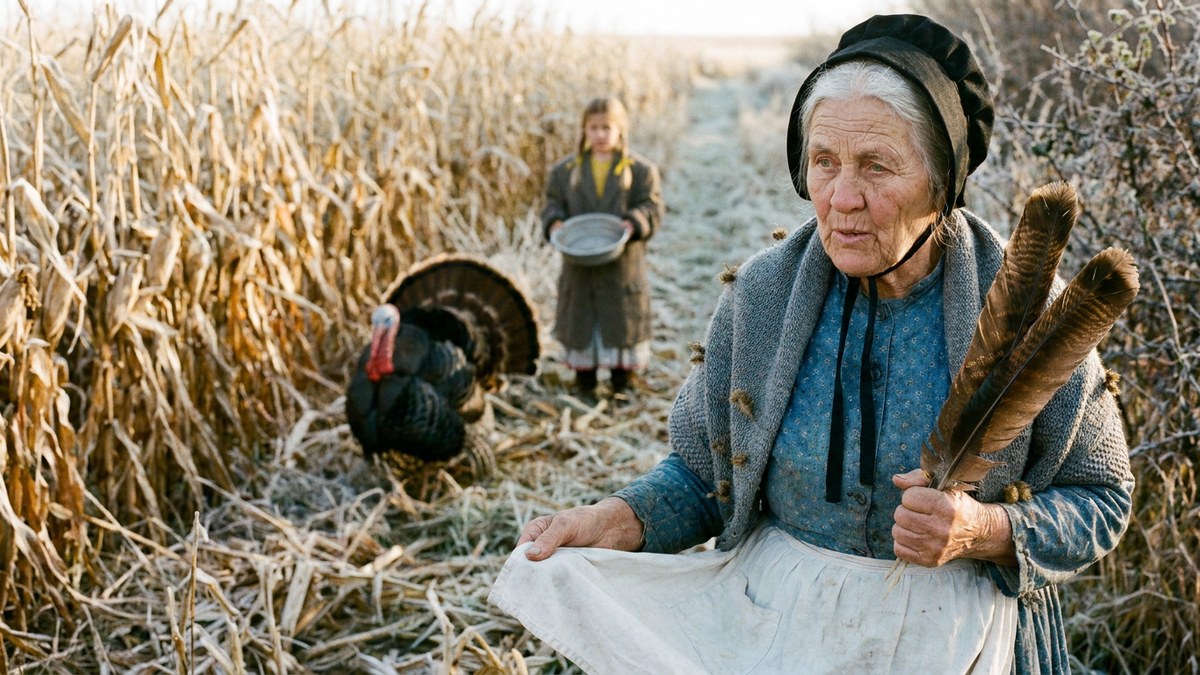
Lucinda straightened her bonnet.
"That bird is mine, Mr. Wendt. Your granddaughter is holding him."
Gus Wendt looked down at the snare in his fist as if he had forgotten it was there.
"I was setting snares for rabbits," he said. "For Liesl's dinner."
Lucinda looked at the house with no smoke. She looked at the girl's coat, which was a man's coat with the sleeves rolled four times.
"Where is Mrs. Wendt?" she asked.
Gus did not answer right away.
"April," he said. "Her heart."
Lucinda had not known. Nobody had told her, because nobody told anybody anything across that hedge.
That was when General Grant got loose.
He twisted out of Liesl's arms with a great beat of wings that knocked her flat on her back in the corn stubble, and went off across the Wendt pasture at a dead run, gobbling.
Everybody went after him.
Peter and Rose went first, and Liesl was up and after them. Lucinda came behind with her skirts in her fists. And Gus Wendt, seventy years old, came after all of them with the rabbit snare still in his fist, shouting in German, which Lucinda took to be instructions.
They chased that turkey across the pasture and through the plum thicket along the creek. They chased him over the frozen creek and back across it. Peter went through the ice up to his knees and came out laughing. Rose lost a shoe. Liesl caught General Grant twice and lost him twice.
At one o'clock Ella came through the hedge gap with a basket of cornbread and a jug of coffee, because she said if the whole family was going to be lunatics, they could at least be fed lunatics.
At three o'clock Lucinda sat down on a stump with a stitch in her side and laughed until she had to wipe her eyes.
At four o'clock General Grant was standing on top of the Wendts' woodpile, looking at all of them with great contempt.
"All right," Lucinda said. "That's enough. Everybody sit down."
"He'll get away," said Liesl.
"He'll go to bed," said Lucinda. "Watch."
So they sat. Two old people on two upturned buckets, three children on the chopping block, and Ella with her shawl around her shoulders against the side of the barn.
The sun went down red behind the hedge. The cold came up out of the ground.
General Grant looked around. He fluffed his feathers. Then he hopped down off the woodpile, walked across the yard to the big cottonwood by the Wendts' well, and flew up into it in three clumsy beats, to the lowest branch, and settled there with his head tucked down.
"Now we wait till dark," Lucinda said.
They waited.
Gus Wendt sat on his bucket with his hands on his knees and looked at the hedge.
"That fire," he said. He said it to the hedge, not to her. "I plowed that break to keep the fire off your place, Mrs. Haas. Not mine. My place was safe already. Your stacks were close to the line, and your man was gone, and your boy was gone to town. I thought, I will make a wide break for them."
Lucinda turned her head.
"The wind came up," Gus said. "I stood in my field and watched it go through your hedge. And then your boy said what he said, and I said what I said. And then the jury said God did it. And I did not pay, because to pay would say I did it on purpose. I did not do it on purpose."
"You didn't come to his funeral," Lucinda said.
"I stood at the back of the cemetery," Gus said. "Behind the cedar. I did not think you would want me closer."
The children were very quiet on the chopping block.
Lucinda looked at the hedge, black against the last of the light. Her husband had planted it to mark a line. He had never meant it for a wall.
"Well," she said. "I suppose that was a foolish thing for both of us."
When it was full dark, she got up off her bucket and walked across the yard to the cottonwood.
General Grant sat on the low branch, a dark lump against the stars. She reached up with both hands, slow and steady, and lifted him off the branch like a hat off a peg.
He did not even wake up.
They ate at nine o'clock that night, at the Wendt table, because it was bigger.
Ella carried both pies through the hedge gap. Gus Wendt brought up a crock of his late wife's red cabbage from the cellar, and Liesl set the table with a cloth that had not been out since April. Peter's trousers dried by the stove. Rose found her shoe.
General Grant was very good. Everybody said so.
Before they ate, Gus Wendt asked Lucinda if she would say the grace, because his English was not good enough for it. She said it. Then he said one of his own in German, and nobody understood a word of it, and everybody said amen.
In the spring, Gus Wendt came over with a spade and cut a gate in the Osage hedge, right where the dog gap had been. He hung it himself, on two good iron hinges.
It was never once latched.
> What really happened: On October 3, 1863, President Abraham Lincoln proclaimed the last Thursday of November a national day of thanksgiving, and presidents kept up the custom every year after; in 1878 it fell on November 28. On the Nebraska prairie, settlers guarded their homes against fall prairie fires by plowing wide strips of bare ground called firebreaks or fireguards and sometimes burning the grass beyond them, and a sudden change of wind could send a fire across the line. Many farmers planted thorny Osage orange hedges as living fences. Sources: The American Presidency Project; Nebraska State Historical Society.