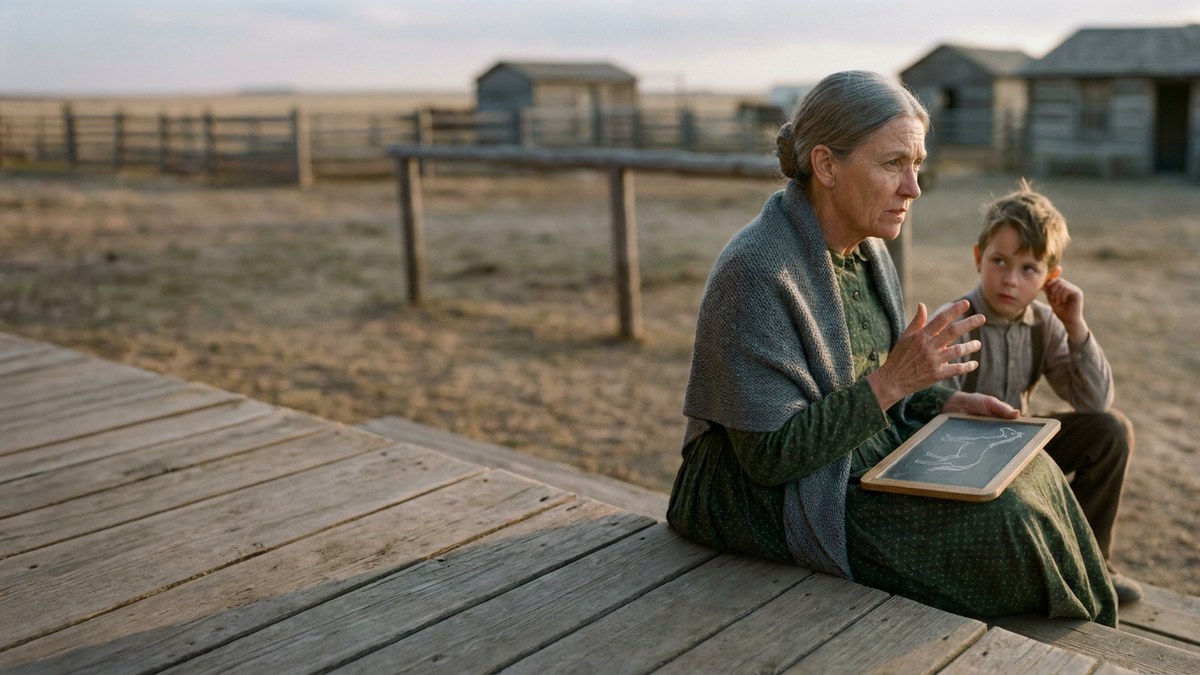
The only person who saw the bank robber's face was a nine-year-old boy who could not hear, and nobody in Prairie Hill, Kansas, knew how to ask him what he saw.
It was a Tuesday in late May, 1886. The robbery took four minutes.
A man in a long yellow slicker and a flour sack hood walked into the Farmers' Bank at noon, when the cashier was alone. He held a pistol low and talked in a rough Texas drawl. He took eleven hundred dollars in new bank notes and rode west out of town at a lope.
Nobody was hurt. By one o'clock the sheriff had a suspect in the jail.
Lavinia Hart heard about it in the dry goods store, where she had gone for thread.
She was sixty-two and had lived in Prairie Hill only since March, when she came to keep house for her widowed son. Before that, for fourteen years, she had taught at the state school for the deaf at Olathe.
"They've got a Texas cowhand at the jail," said Mrs. Bauer at the counter. "Rode in this morning. Talks just like the robber, the cashier says."
"Did anyone see the robber's face?"
"Only the Dunbar boy," Mrs. Bauer said. "He was sitting on the bank steps waiting for his pa. But he's deaf and dumb, poor thing. Simple. Can't tell anybody anything."
Lavinia set down the thread.
"Deaf," she said. "Or simple?"
Mrs. Bauer looked at her as if she had said something in a foreign tongue.
She found the boy at the livery corral, where his father worked as a hostler.
Eli Dunbar was small for nine, with a cowlick and sharp gray eyes that never stopped moving. He had lost his hearing to scarlet fever at three. He had never been to school. His mother had died the year before, and his father worked from dark to dark.
Eli was sitting on the top rail of the corral, watching the street.
Lavinia stood below him where he could see her whole face. She smiled. She touched her chest, then gave the small salute from the forehead she had used ten thousand times at Olathe, for hello.
Eli stared at her hands.
He did not know the sign. A child with no school had no signs but the ones his own family made up at home.
But he had seen her hands move with meaning, and something in his face changed. He looked at her the way a man lost on the prairie looks at a road.
It took her the rest of the afternoon to learn a little of his language.
It was a good language. At Olathe she had seen many children arrive with a hundred home signs of their own, clever and exact. Eli had a sign for his father, a hand pulling a rope. A sign for his dead mother, a soft stroke of his own hair.
And he had a sign for nearly every person in Prairie Hill.
He showed her as they walked down the street. The preacher, a fist thumped on a flat palm. The blacksmith, a hammer. Mrs. Bauer, a pinch of thread off her sleeve, which made Lavinia laugh out loud. The sheriff, two fingers tapping a star on his chest.
He made each sign the way the person moved. He had been watching this town for six years, Lavinia thought, because watching was all he had.
At the jail, Sheriff Ben Ashby did not want to listen.
The harness maker was just leaving as she came in, a broad man in a leather apron, telling the sheriff he hoped the Texan got what was coming. He tugged at his ear as he said it, and held the door for her.
Ashby was fifty-five, a slow, fair man who had been sheriff for eleven years, and he was tired. He had a prisoner, Tomás Reyes, twenty-four, a vaquero from San Antonio who had ridden in at ten that morning looking for work with a trail outfit. Reyes had a yellow slicker tied behind his saddle. Half the cowhands in Kansas did.
"The cashier heard a Texas voice," Ashby said. "Reyes has one. He's got the slicker. The circuit judge comes through on Friday, and the judge can sort it out."
"Reyes had no money on him," Lavinia said.
"He had all afternoon to bury it."
"He was at the livery from eleven to one, asking for work. Eli's father says so."
Ashby rubbed his eyes. "I'm sorry. I can't hang a case on what a little deaf boy might mean with his hands."
"Nobody's asking you to hang anything," Lavinia said. "I'm asking you to let me ask him."
Through the cell door, Tomás Reyes watched her, both hands on the bars, very still.
That evening she sat with Eli on the livery steps and asked him, as plainly as she could, with her hands and her face and a slate she drew pictures on.
The bank. The man in the slicker. Did you see his face?
Eli nodded hard.
He made a sack over his head with his hands, and then he pulled it off.
The robber had lifted the hood, Lavinia understood, outside, at the hitching rail, for one moment, to wipe the sweat off his face before he got on his horse.
Who? she asked. Show me.
Eli lifted his left hand. He took his own earlobe between his thumb and forefinger and gave it two small tugs.
Lavinia did not know the sign. It was not one he had shown her that afternoon.
Before she could ask him again, his father came out of the barn and saw the slate.
Rob Dunbar was a thin, frightened man who had lost his wife and could not afford to lose anything else. He took the slate out of her hands.
"Ma'am, no," he said. "Please. You don't know this town. I've got a roof over us and a job, and I can't have Eli pointing at people."
He took the boy inside and shut the door.
At two o'clock in the morning, someone pounded on her son's kitchen door.
Lavinia came down in her wrapper with a lamp. Eli stood on the step in his nightshirt, barefoot, breathing hard. He grabbed her hand and pulled.
He made the sign for money. Then a sign she did not know, both hands pinching and pulling, over and over, like stitching.
He pulled her down the dark street, past the bank, past the church, to a shop with its shutters closed and a thin line of lamplight under the door.
Eli put his eye to the crack in the shutter. Then he made room for her.
Inside, a man sat at a workbench with a saddle across his knees and the leather of the seat peeled back. Beside him lay a stack of crisp new bank notes. He was sewing them into the saddle, one bundle at a time.
He looked up suddenly, as if he had felt the lamplight change. He looked straight at the shutter.