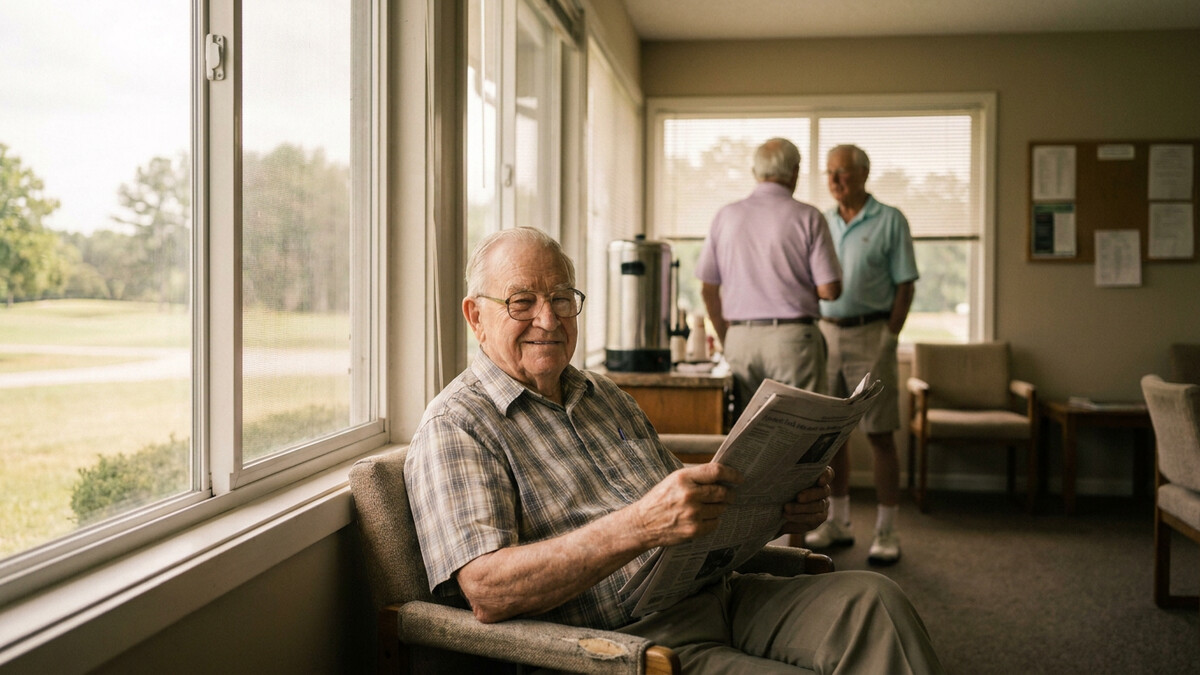
For eleven years, the residents of Palmetto Shores called Morris Feldman "Deaf Morris" to his face, because he could not hear them do it, and on the Tuesday he got his new hearing aids, the first thing he heard clearly in the clubhouse was two men planning to rob his neighbors.
He was sitting in his usual chair by the window, behind his newspaper, waiting for the shuffleboard schedule. The two men were at a table by the coffee urn, twenty feet away, talking low.
"Friday," one of them said. "The luncheon. We get forty signatures, minimum. The old ladies sign anything if you give them chicken salad."
"And the checks?"
"Made out to the fund. We cash them Monday. By Wednesday, we're in Georgia."
Morris lowered his newspaper about one inch.
The man by the coffee urn glanced over at him, saw who it was, and laughed.
"Relax," he said to his partner. "That's Deaf Morris. He couldn't hear a bomb go off."
Morris was eighty-one. He had been a machinist in Dayton, Ohio, for forty-three years, at a plant that made parts for jet engines. He had stood next to a punch press for most of those years, and the press had taken most of his hearing, a little bit every day, until by the time he retired, he was reading lips.
He and his wife, Ruth, had moved to Palmetto Shores in 2015. It was a retirement community of about four hundred people outside Lakeland, Florida, with a pool, a golf course, a clubhouse, and an activities calendar that was mostly bingo. Ruth had died in 2021.
Since then, Morris had mostly kept to himself. It was easier than asking people to repeat things.
Last month, his daughter in Cincinnati had finally talked him into new hearing aids. Expensive ones. The audiologist had set them up on Monday.
Tuesday morning, Morris walked into the clubhouse and heard the air conditioner for the first time in years. He heard the ice machine. He heard a woman laughing across the room.
He heard everything.
Including the two men by the coffee urn.
He knew who they were. He had read their lips enough times.
The tall one with the white golf shirt and the good teeth was Larry Bonner. He had moved into Palmetto Shores eight months ago and had been elected to the residents' council in four. He organized the Friday luncheons. He was popular. He called every woman in the community "sweetheart."
The heavyset one was Doug Kincaid. He had moved in two months after Larry. They were "old friends from Atlanta," they said.
For the last three months, Larry had been talking up something called the Palmetto Shores Community Improvement Fund. A new pool heater. A new roof on the clubhouse. A walking path around the lake with benches. He had brought in drawings. He said if every resident chipped in a thousand dollars, the fund would be matched by a "development partner" and the work would start in January.
Friday's luncheon was where residents would sign up and write their checks.
Morris folded his newspaper and sat very still.
He had heard what he had heard. He was sure of it. But he also knew exactly what would happen if Deaf Morris stood up in the clubhouse and accused the most popular man on the residents' council of being a crook.
Not one person would believe him. They would think he had heard it wrong. They always thought he heard everything wrong.
So Morris did what he had done on the shop floor for forty-three years when he found a part that did not match the drawing.
He wrote it down.
He went home and got out the small spiral notebook he had carried in his shirt pocket since 1971, the kind every machinist carried, for measurements. He wrote down the date, the time, and every word he had heard, as close as he could remember.
Then he went back to the clubhouse that afternoon and sat in his chair by the window with his newspaper, and he listened.
He did it on Wednesday too. And Thursday morning.
He did not take out his hearing aids. He did not tell anybody he had them. He let his hair grow a little over his ears, and he kept his newspaper up, and when anybody spoke to him, he said "What?" loudly, the way he always had.
By Thursday afternoon, he had six pages in the spiral notebook.
He knew the "development partner" did not exist. He knew the drawings had been printed off the internet, from a project in Arizona. He knew Larry and Doug had done this before, in a community outside Savannah, and that Doug's real name was not Kincaid.
And he knew that they planned to collect the checks Friday, deposit them in an account at a bank in Tampa on Monday, and be gone by Wednesday.
On Thursday evening, Morris called the Lakeland police non-emergency line.
He explained it. All of it. Slowly and clearly. The young officer on the phone was polite.
"Sir, so you overheard this conversation? In the clubhouse?"
"Yes."
"And you're hearing impaired?"
"I was," Morris said. "Now I have new hearing aids."
There was a pause on the line.
"Sir, I'll make a report," the officer said. "But I can't arrest anyone for a conversation. Until they actually take money under false pretenses, there's no crime. If someone writes them a check tomorrow and it turns out to be fraud, the residents can file a complaint."
"By then," Morris said, "they'll be in Georgia."
"I understand, sir. I'll make the report."
Morris hung up.
He sat at his kitchen table for a long time, looking at his spiral notebook.
Then he got up, took a shower, put on a clean shirt, and walked over to the clubhouse at seven o'clock, where the Thursday night bridge game was just getting started.
He was going to tell Bea Gutierrez. Bea ran the bridge club, and the garden club, and the welcome committee, and she had been a high school principal in Tampa for twenty years. If anybody in Palmetto Shores could get people to listen, it was Bea.
He found her at the corner table with three other women, shuffling cards.
"Bea," he said quietly. "I need to talk to you. It's important."
Bea looked up and smiled kindly, the way people smiled at Deaf Morris.
"Morris, honey, can it wait till after this hand?"
And then Morris heard a chair scrape behind him.
He turned around.
Larry Bonner was standing two feet away, holding a cup of coffee, with his good teeth showing in a smile that did not reach his eyes.
"Morris," Larry said pleasantly, loud and slow, the way people talked to him. "I didn't know you could hear well enough to play bridge. Did you get yourself some new hearing aids?"