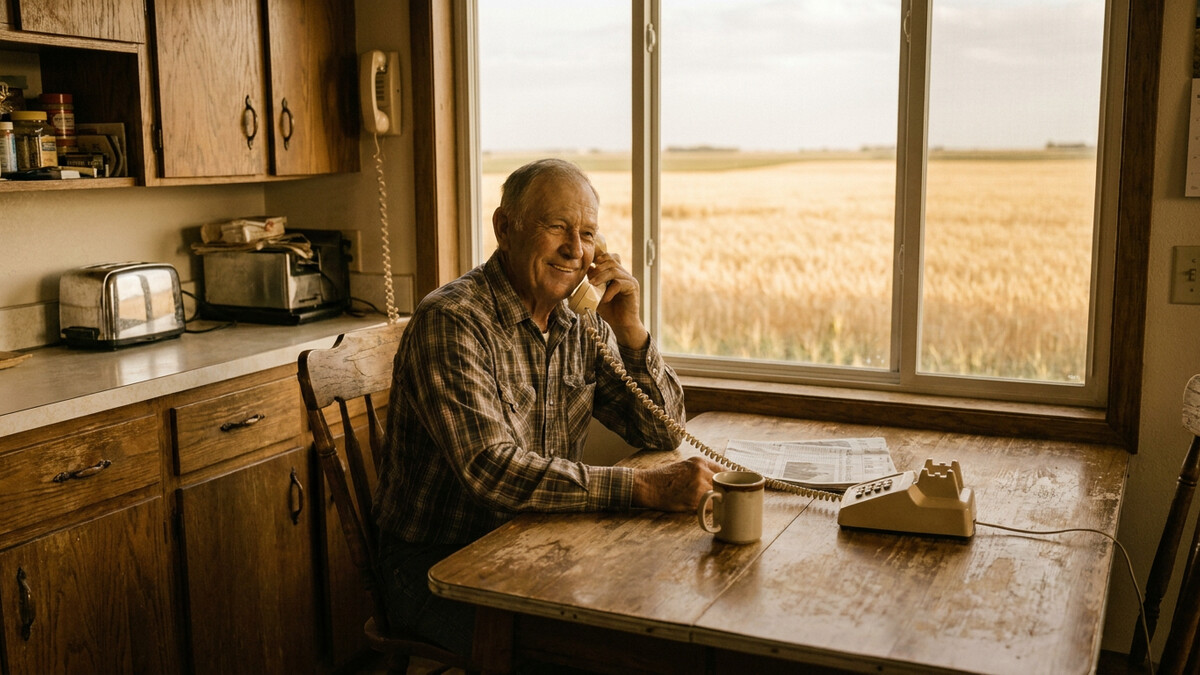
Calvin sat very straight at his kitchen table.
"Miss Whitcomb," he said. "Is your mother all right?"
"Answer my question first, please."
So he did. He told her everything. The wrong number. The forty minutes. A year of Sundays. The flour and the bread. The diner in Effingham.
He did not leave anything out. He had never been any good at leaving things out.
Stacy Whitcomb listened without interrupting. When he finished, there was a long silence on the line.
"Mr. Oakes," she said finally. "I'm a nurse. I see what happens to old people who get taken in by strangers. My mother is the most trusting woman in Pennsylvania. When I found a box from Kansas in her pantry, I almost called the police."
"I understand."
"I ran your name," Stacy said. "Ellis County, Kansas. Fourteen hundred acres. Married fifty-one years. Your wife's obituary was in the Hays paper." She paused. "And my mother says in a whole year, you never once asked her for anything except her address. For flour."
"That's right."
"Mr. Oakes." Stacy's voice changed. It was not cold anymore. It was tired. "My mother isn't answering the phone because she's ashamed. She didn't want me to call you. I'm calling anyway."
"Ashamed of what?" Calvin asked.
"She can't drive to Illinois," Stacy said quietly. "She can't drive anywhere. She hasn't driven in two years."
Calvin did not understand.
"My mother has macular degeneration," Stacy said. "Both eyes. It's been getting worse for three years. She can see shapes and light. She can't read. She can't recognize a face across a room. She dials the phone by feel. The bread she baked you, she baked by feel, the way she's baked it for fifty years."
Calvin closed his eyes.
"She never told me," he said.
"She never told you because she was afraid," Stacy said. "She said if you knew, you'd feel sorry for her. And she didn't want to be somebody a man felt sorry for. She said, Stacy, for one hour every Sunday, I'm just a woman on the phone. I'm not a blind old widow. I'm just Lorna."
The kitchen was very quiet.
"So when you asked her to drive to Illinois," Stacy said, "she didn't know what to say. So she stopped answering."
Calvin sat at his kitchen table for a long time after Stacy hung up.
He looked at the bag of flour on the counter. At the dish towel Lorna had wrapped the bread in, which he had washed and folded and never sent back.
Then he went to the hall closet and got down his suitcase.
Ryan found him in the driveway at five o'clock the next morning, loading the suitcase into the back of his pickup.
"Dad. Where are you going?"
"Pennsylvania," Calvin said.
"Pennsylvania? That's a thousand miles."
"Twelve hundred," Calvin said. "I looked."
Ryan stared at him. Calvin told him. All of it. Stacy. The eyes. The bread made by feel.
Ryan did not say anything for a long time. He stood in the driveway in his work clothes with the sun coming up red over the wheat stubble.
Then he went back in the house. When he came out, he had a duffel bag and his own truck keys.
"I'm driving," he said. "You're seventy-four. And I want to meet the woman who made you laugh."
They drove for two days. Interstate 70 across Missouri and Illinois and Indiana and Ohio, then north into the hills of Pennsylvania, on roads that got smaller and smaller until they were driving between stone walls and red barns and maple trees going orange.
They stopped at the diner in Effingham for lunch. Calvin ate a piece of pie at the counter and looked at the empty booth by the window for a while.
On the afternoon of the second day, Ryan turned onto a gravel lane outside Tioga Falls, between two old stone gateposts, and drove up to a white farmhouse with a big red barn behind it and swallows going in and out of the hay door.
There was a woman sitting on the front porch in a rocking chair, with a cat in her lap.
Calvin got out of the truck. He stood at the bottom of the porch steps.
The woman turned her head toward the sound of the truck door. She was small and gray-haired, in a blue cardigan, with a dish towel over her shoulder. She looked toward him, and past him, the way people do when they cannot quite see.
"Stacy?" she said. "Is that you?"
Calvin took off his cap.
"No, ma'am," he said. "I'm sorry. I was trying to reach Phyllis Becker."
Lorna Whitcomb went perfectly still in the rocking chair.
The cat jumped off her lap. Her hand went to her mouth.
"Calvin," she whispered.
"Yes, ma'am."
"You drove here."
"My son drove," Calvin said. "I just complained about the roads."
Lorna started to laugh. Then she started to cry. Then she was doing both at once, sitting in the rocking chair with her hands over her face, and Calvin climbed the porch steps and knelt down beside her chair, slowly, because his knees were seventy-four years old.
She reached out. Her hands found his face. She touched his cheek, his nose, the brim of the cap in his hands.
"You're taller than I thought," she said.
"You're prettier than I thought," Calvin said. "And I thought you were pretty."
Behind them, a car pulled into the lane. A woman in scrubs got out and stood by the gatepost, watching.
Ryan Oakes walked down to meet her.
"You must be Stacy," he said. "I'm Ryan. I'm the son who told him you were probably a scammer."
Stacy Whitcomb looked at him. Then she looked up at the porch, where her mother was holding a farmer's face in her hands and laughing.
"I'm the daughter who almost called the police," she said.
They stood by the gatepost for a while, the two of them, saying nothing at all.
Calvin stayed a week. He helped Lorna in the garden. He fixed the porch railing. He read her the newspaper every morning at the kitchen table, every page, even the obituaries, because she had not been able to read it in two years.
On the last night, they sat on the porch together in the dark with the swallows settling in the barn.
"Calvin," Lorna said. "Will you still call on Sundays? When you're home?"
"Every Sunday," Calvin said.
"Same time?"
"Same time."
She was quiet for a moment.
"Dial it wrong," she said. "So it feels the same."