"Give me one minute, Bert," Royce said.
He picked up his tub and stepped out of the line.
Bert Collier watched him go with his eyebrows up. A few of the anglers behind him grumbled.
Royce didn't hurry. He carried the tub of water across the parking lot, past the tent and the trucks and the boat trailers, down the concrete ramp to the edge of the lake, where the water was clear and green over the gravel.
He set the tub down. He knelt on the wet concrete, which his knees would make him pay for later, and he opened the mesh bag.
The big female was still lively. He'd taken good care of her. He wet his hands in the lake and lifted her out, one hand under her belly and the other holding her lower lip, gently, the way he'd shown a thousand kids at a thousand fishing clinics in thirty-four years as a warden.
She was so heavy. So beautiful. Forty years of waiting.
He looked at her for a long moment.
"Well, old girl," he said quietly. "I guess you've got somewhere better to be."
He lowered her into the lake and held her there, facing into the little bit of current along the ramp, moving her slowly forward and back so the water would run over her gills. He held her until she was ready. He always held them until they were ready.
Then he felt her tail kick against his palm, strong, and he opened his hands.
She hung there in the green water for a second, three feet from the ramp, looking at nothing. Then she flicked once and was gone, down into the deep water off the point.
Royce knelt there a little while longer. Then he got up, slowly, and carried his tub back up the ramp.
He put four fish on the scale.
"Twelve pounds, six ounces," Bert Collier said into the microphone, reading the number. Then he looked up from the scale at Royce, and his eyes narrowed. He'd been a deputy for twenty-six years. He'd seen the bag in line. He'd seen Royce walk to the water.
He took the microphone away from his mouth.
"Royce," he said quietly. "Where's the big one?"
"Turned her loose," Royce said. "She had some growing left to do."
Bert looked at him for a long time. Then he looked down the line, at the skinny boy in the camouflage cap holding his little sister's hand.
He didn't say anything. He just nodded, very slowly, and wrote 12-6 on his clipboard, and put the microphone back up to his mouth.
"Royce Tillman, twelve pounds six ounces. Thank you, Royce. Next angler."
The last six anglers came in short.
At 3:40, Bert Collier stood up on the little stage under the tent and announced the winner of the Ozark Lake Classic. Jesse Coombs, age fifteen, of Midway, Arkansas, eighteen pounds, twelve ounces. The youngest champion in the history of the tournament.
The boy didn't move at first. He just stood there. Then his little sister screamed so loud that people in the parking lot turned around, and his uncle picked him up off the ground in a bear hug, and Jesse Coombs started to cry in front of a hundred and forty fishermen and didn't even try to hide it.
He walked up to the stage with his cap in his hand. Bert gave him the trophy shaped like a jumping bass and a big cardboard check for five thousand dollars, and the crowd clapped and whistled.
Royce stood at the back by his truck and clapped with them.
June asked him about it at supper.
She'd already heard. Bert's wife had called before Royce even got home. June set down a plate of fried catfish in front of him and sat down across the table and folded her arms.
"Royce Tillman," she said. "Did you turn loose a seven-pound bass at the weigh-in?"
"I might have."
"Forty years." She shook her head. "Forty years you've been telling me about that trophy."
"I know it."
"Why?"
He told her about the boy, and the little sister, and the electric bill, and the medicine. June listened without saying a word. When he was done, she got up from her chair and came around the table and kissed him on top of his head, the way she used to when they were young.
"You old fool," she said. Her voice wasn't steady. "You wonderful old fool."
"Don't tell him, June," Royce said. "Ever. A boy ought to think he won it."
That night, Royce took out the spiral notebook where he'd logged every tournament he'd ever fished since 1987. He wrote the date, and the lake, and the weather. Then, in his careful warden's printing, he wrote: Big female, 7 lb 2 oz, north arm point, green pumpkin jig.
Turned her loose before weigh-in. The Coombs boy needed it more than I needed a trophy.
He never fished the Classic again. He said his knees were too bad. June knew better.
Royce Tillman died eleven years later, in the spring, at eighty-nine. They buried him in the little cemetery above the lake, where he could see the water.
A lot of people came. Old wardens, old deputies, old fishermen, kids from his fishing clinics who were grown now with kids of their own. A tall young man in the green uniform of the Arkansas Game and Fish Commission stood near the back, holding his hat.
June found him after the service.
"Jesse Coombs," she said.
"Yes, ma'am." He was twenty-six now, broad-shouldered, a wildlife officer working the same two counties Royce had worked for thirty-four years. "Mr. Tillman used to let me fish off his dock after that tournament. He taught me more about this lake than anybody I ever met. He wrote the letter that got me into the academy." His voice caught. "I wanted to pay my respects."
June looked at him for a long moment. Then she opened her purse and took out a spiral notebook.
"He made me promise I'd never tell you," she said. "As long as he was alive." She held the notebook out. "He didn't say anything about after."
Jesse opened it to the page she'd marked with a ribbon. He read the entry once. Then he read it again, standing in the cemetery above the lake, and his face crumpled, and June put her arms around him like he was still fifteen.
Jesse and his wife had a baby boy the next March. They named him Royce.
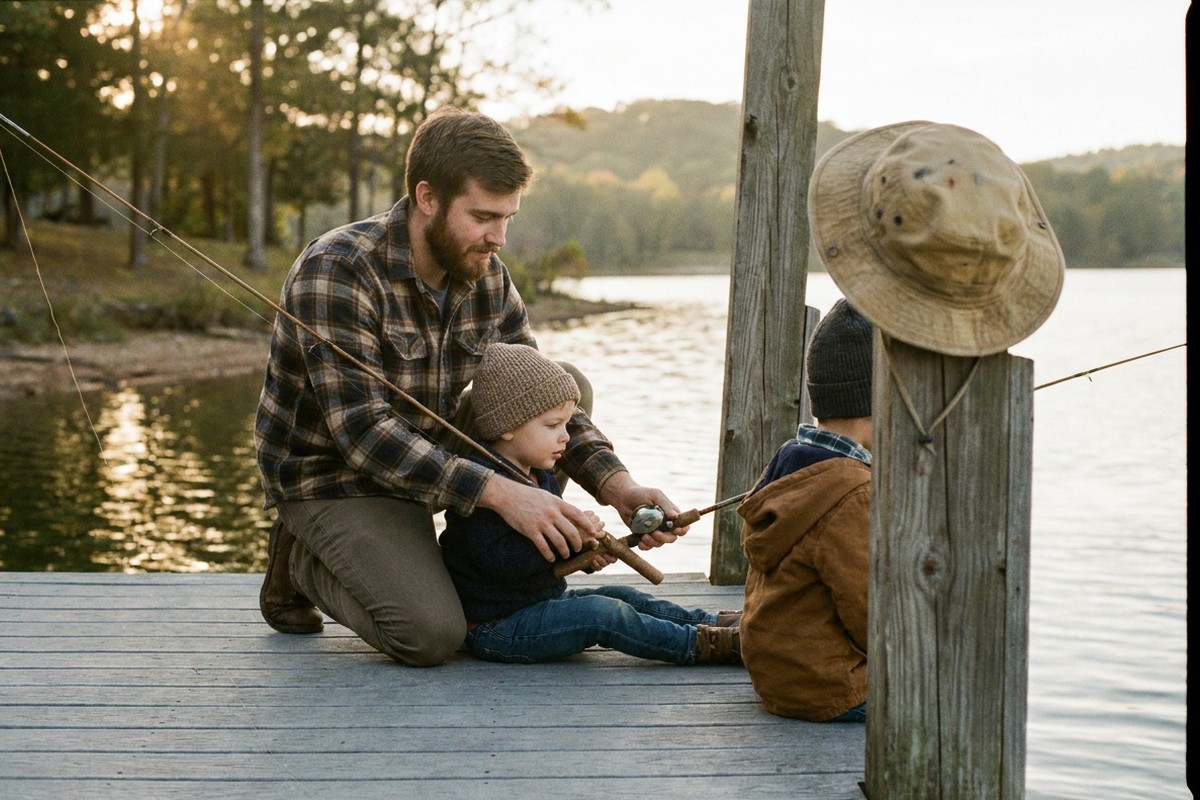
The first time the boy was old enough to hold a rod, Jesse took him down to the old dock below the Tillman house, where June still lived and still sat on the porch swing every evening. He knelt behind his son on the gray boards and showed him how to cast, the way Royce had shown him.
On the post at the end of the dock, where June had hung it the week after the funeral, there was an old fishing hat, faded tan, with a jig hooked in the band.
The boy cast. The line went out over the water.
"That's it," Jesse said softly. "Now you wait. And if you catch a big one, we'll see if she's got some growing left to do."