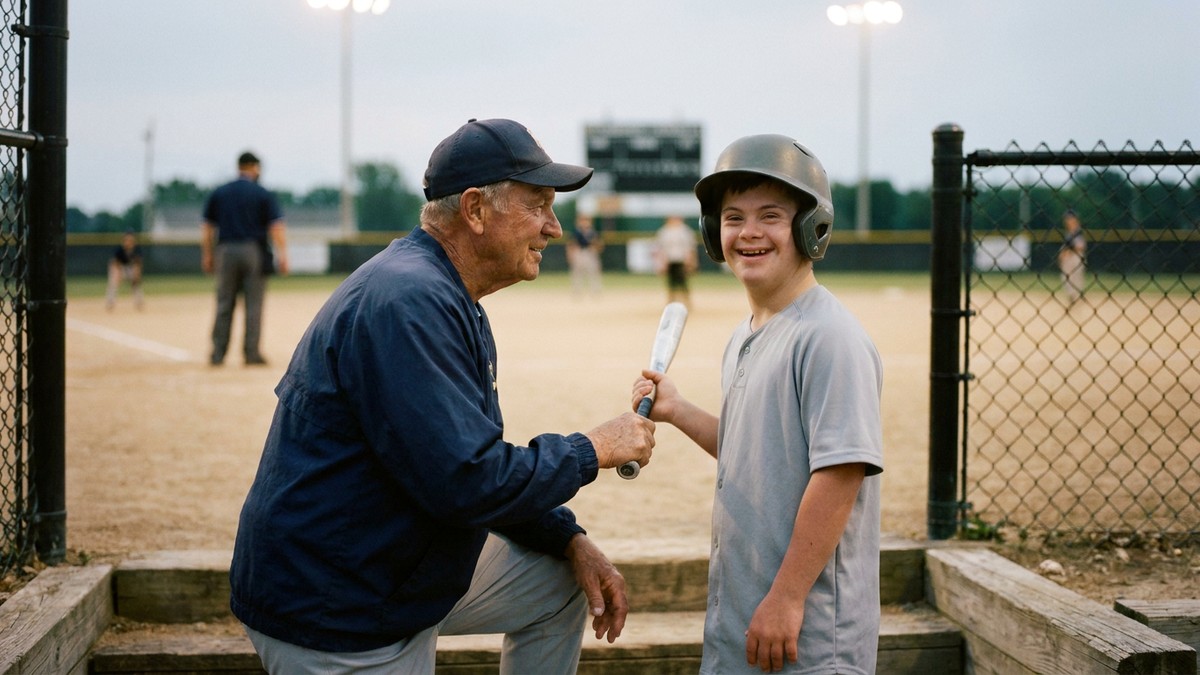
Benny Ruiz had carried the bats for four seasons, and he'd never once been allowed to swing one in a game.
He carried them anyway. Every game, home and away, he was the first one at the field and the last one to leave. He lugged the big canvas bat bag from the bus to the dugout.
He lined the bats up in the rack by length, shortest to longest, and he got very upset if anybody put one back in the wrong slot. He filled the water cooler. He kept the scorebook in pencil, in a hand so neat that the newspaper in Mason City called him for the box scores.
He knew every player's batting average to three decimal places, and he'd tell you yours whether you asked or not.
"Luke," he'd say, when Luke Schroeder struck out. "You're hitting .312. That's still good. Don't be sad."
Luke would laugh, every time. "Thanks, Benny."
"You're welcome. You swing too early on curveballs."
Gil Stroud had coached American Legion baseball in Linden Falls, Iowa, for thirty-eight summers. He was seventy-one. He'd played catcher for the same Legion post in 1972, and he'd come back to coach it in 1989, after his own knees gave out, and he'd never left.
He'd coached three state tournament teams and a boy who made it to the big leagues for a cup of coffee with the Royals. He'd coached farm kids and town kids and kids whose fathers he'd coached first. He wore the same navy windbreaker to every game, rain or shine, and he chewed sunflower seeds until his lips were raw.
He'd met Benny Ruiz in 2023, when Benny was thirteen and his mother brought him to a summer practice and asked if he could help out.
Maria Ruiz was a nurse at the hospital in Mason City. She'd moved to Linden Falls after her divorce, with a boy who had Down syndrome and a heart for baseball the size of Iowa.
Benny watched every Cubs game on TV with his hat on. He knew the rules better than half the umpires in the county.
"He just wants to be on a team," Maria had told Gil, standing behind the backstop. "He doesn't need to play. He just wants to belong somewhere."
Gil had looked out at the field, where Benny was already picking up stray baseballs in the outfield and putting them in a bucket, one by one, and talking to each one.
"He can be our manager," Gil said.
That was four seasons ago. Benny was seventeen now. He'd been the manager ever since.
What Maria didn't know, and what most of the town didn't know, was that every spring, when Gil turned in the official roster to the American Legion state office, he put Benny's name on it.
Not as manager. As a player.
Benny was eligible. He was seventeen, he lived in town, he went to the high school. Every year, Gil filled out the form with Benny's name and birth date, and every year, Benny Ruiz was officially an outfielder for Linden Falls Post 213, with a uniform number.
Number 1. Benny had picked it.
Benny took batting practice every day with the team. He was not a good hitter.
He swung hard and late and mostly missed. But about one time in ten, he got a piece of it, and when he did, the whole team cheered like it was the World Series.
Gil had never put him in a game. There had never been a right time.
The district final was on a Saturday night in late July, under the lights at Linden Falls Memorial Field. The winner went to the state tournament. The loser went home for the summer.
The other team was Mason Ridge Post 77, from forty miles east. They were good, and they had a tall right-hander named Nate Hollister who threw harder than any kid Gil had seen in five years.
It was a close game all night. Mason Ridge scored two in the first.
Linden Falls got one back in the third and two more in the fifth. Mason Ridge tied it in the sixth on a bloop single and went ahead in the top of the seventh on a long fly ball that just cleared the left field fence.
Four to three. Bottom of the seventh. Last inning.
The bottom of the Linden Falls order came up. The seventh batter struck out on three fastballs.
The eighth grounded out to short. Two outs, bases empty.
Benny sat at the end of the bench with the scorebook in his lap, writing everything down in pencil, very neatly. His lip was trembling. He'd marked the two outs.
He knew what came next. He knew the next batter, a sophomore named Caleb Voss, was hitting .208.
Gil stood at the top of the dugout steps with his hands in his windbreaker pockets.
He looked out at the field, at the tall pitcher on the mound and the bright lights and the full bleachers. Then he looked down the bench.
Luke Schroeder, his best player, was sitting closest to him. Luke had been watching him. Luke glanced down the bench at Benny, and then back at Gil, and he nodded once, very slightly.
Gil took a breath.
"Benny," he said.
Benny looked up from the scorebook.
"Grab a bat, son," Gil said. "You're hitting for Caleb."