Benny didn't move at first.
He sat there on the end of the bench with the scorebook open in his lap and the pencil in his hand, looking up at Gil, as if he hadn't understood the words. Then his face changed. It opened up, slowly, like a sunrise.
"Me?" he said.
"You," Gil said. "You're on the roster. You've been on it four years. Number one."
Benny closed the scorebook very carefully. He set it on the bench and put the pencil on top of it, lined up straight, the way he always did. Then he stood up.
The whole Linden Falls dugout stood up with him.
Luke Schroeder went to the bat rack. He knew exactly which one.
A thirty-inch aluminum bat, the shortest one, third slot from the left. He handed it to Benny handle first.
"You've got this, Benny," Luke said. "Wait for a good one."
"You swing too early on curveballs," Benny told him, very seriously.
"I know, buddy. Don't you do it."
Caleb Voss, the sophomore Benny was hitting for, took off his own batting helmet and put it on Benny's head and buckled it. It was a little big. Benny pushed it up off his eyes with one finger.
Gil walked out to the home plate umpire, a heavyset man from Clear Lake named Dutch, and told him about the substitution. Dutch looked at the lineup card. He looked over at the dugout, at the boy in the number one jersey standing on the top step with a bat in his hand and a helmet too big for him.
Dutch didn't say anything. He just wrote it down.
Then the public address announcer, who had been announcing Linden Falls games since 1985, looked at the card someone handed him, and leaned into his microphone, and his voice cracked right in the middle of the name.
"Now batting for Linden Falls. Number one. Benny Ruiz."
The bleachers went quiet for a second. Then they understood.
Maria Ruiz was sitting in the third row behind home plate, in her scrubs, straight off a twelve-hour shift. She stood up with both hands over her mouth.
The people around her stood up too. Then the whole Linden Falls side was on its feet, clapping and yelling and stomping on the aluminum bleachers until the whole place shook.
Benny walked to the plate. He did it exactly the way he'd seen Luke do it a thousand times. He knocked the bat against his cleats.
He tapped the plate twice. He dug in his back foot. He raised the bat up over his shoulder and looked out at the mound.
Nate Hollister stood on the mound with the ball in his glove, looking in.
Gil couldn't read his face from the dugout. The boy had been throwing ninety miles an hour all night. Gil held his breath.
The first pitch came in soft. Not a fastball.
A slow, easy pitch, belt high, right down the middle. Benny swung hard and late and missed it by a foot.
Strike one.
The second pitch was the same, slow and fat and right over the plate. Benny swung even harder. He missed it again and nearly spun himself around.
Strike two.
Benny stepped out of the box. He looked at the dugout. His lip was trembling again.
"Wait for it, Benny," Luke called. "You're swinging early. Just like me."
Benny nodded. He stepped back in. He held the bat up over his shoulder, and he waited.
Nate Hollister threw the third pitch, slow and easy, right down the middle.
Benny waited. Waited. And then he swung, and the bat met the ball with a small, perfect aluminum ping.
It wasn't hit hard. It was a slow roller, bouncing gently back toward the pitcher's mound.
Benny stood at home plate looking at it.
"Run, Benny," the whole dugout screamed. "Run."
Benny dropped the bat and ran.
He wasn't fast. He ran with his arms pumping and his helmet bouncing over his eyes and his mouth wide open. Nate Hollister came off the mound and picked up the ball cleanly with his bare hand.
He had all the time in the world. He could have thrown it to first base three times over.
He didn't.
He held the ball a second. Then another second.
He looked toward first base, where his own first baseman was standing with his glove up, not moving, waiting. Then he made a soft, high, looping throw that bounced once in the dirt in front of the bag.
Benny's foot hit first base about half a step before the ball hit the glove.
The umpire at first base, a skinny old man named Hap who'd been calling Legion games for thirty years, spread both arms wide.
"Safe."
The noise was something Gil Stroud would remember for the rest of his life.
Benny stood on first base with both arms over his head, screaming. The Linden Falls dugout was screaming.
Maria Ruiz was screaming. And across the field, the Mason Ridge dugout was on its feet too, clapping.
Gil found out later why. Nate Hollister had a little brother named Owen. Owen was nine years old, and he had Down syndrome, and he was sitting in the front row of the Mason Ridge bleachers in his big brother's old jersey, waving a foam finger.
Luke Schroeder came up next. He swung at the first pitch, a real curveball, and swung too early, and popped it up to the shortstop. Game over.
Mason Ridge 4, Linden Falls 3. Mason Ridge was going to state.
Neither dugout acted like it.
Both teams ran out onto the field at once. They met at first base, where Benny was still standing on the bag, because he hadn't been told he could leave it.
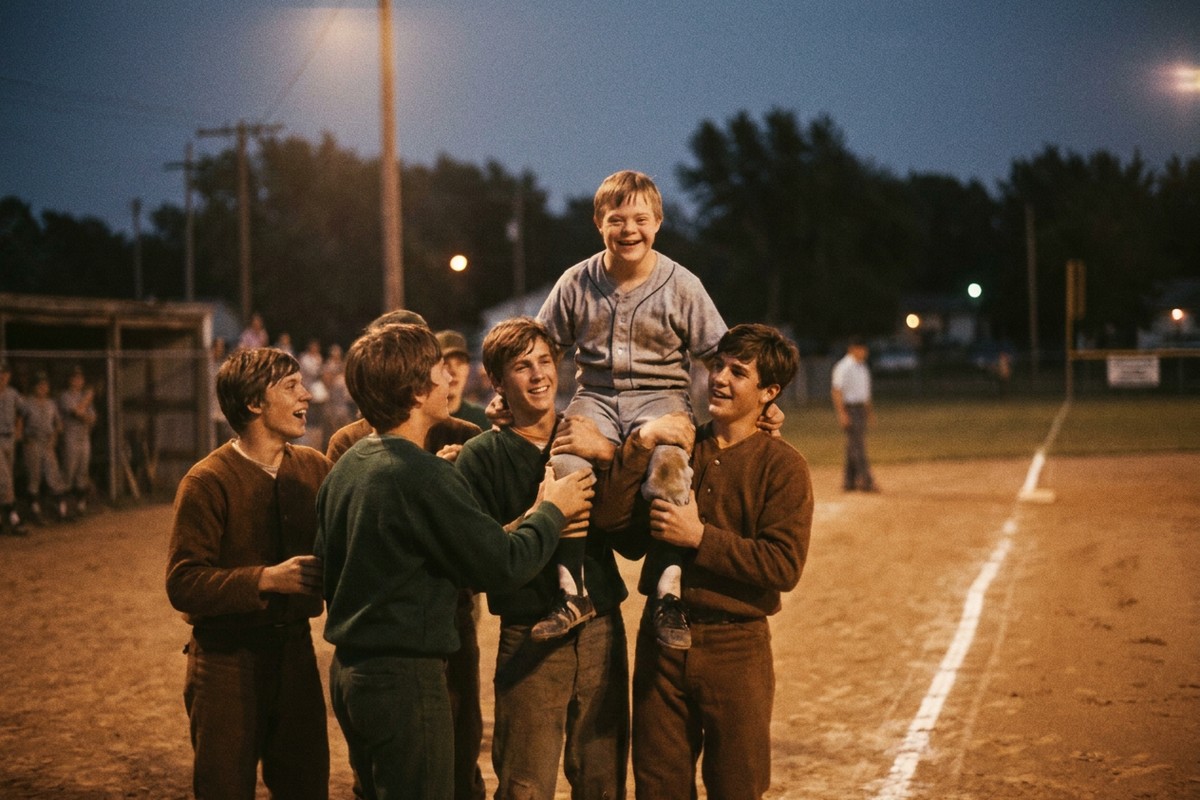
Luke got under one of his arms. Nate Hollister, the boy who'd thrown three soft pitches and one slow throw in a district final, got under the other. They lifted Benny Ruiz up on their shoulders, and two teams of sweaty teenage boys in two different uniforms carried him around the infield under the lights while the bleachers on both sides stood and cheered.
Benny pumped his fist at the sky.
"I'm hitting a thousand," he yelled. "I'm hitting a thousand."
He was. One for one.
Gil sat down on the dugout bench after the field had cleared a little. His knees hurt. He picked up Benny's scorebook from where Benny had left it, with the pencil lined up straight on top.
Maria found him there. She'd come down from the bleachers, and she was still crying, and she sat down next to him on the bench and didn't say anything for a while.
"You lost," she said finally. "You could have gone to state."
"I've been to state," Gil said. "Three times. I don't remember much about any of them."
He opened the scorebook. In the bottom of the seventh, on the line for the ninth batter, Caleb Voss had erased his own name in careful pencil while Benny was at the plate, and written in a new one.
Ruiz. Then a single line from home to first, and a 1B.
Gil handed the book to her.
"I'll remember this one," he said.
Out on the infield, Nate Hollister's little brother had climbed down from the bleachers and run out to first base in his big brother's jersey. Benny was showing him exactly where his foot had hit the bag, half a step before the ball.