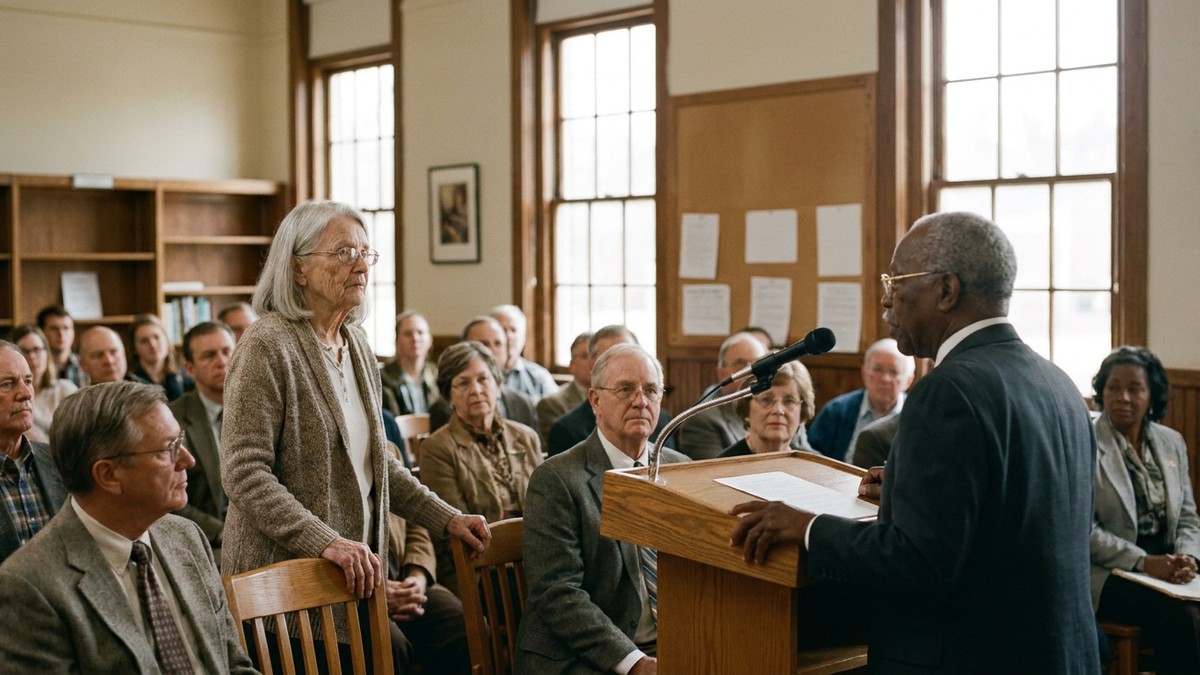
Peggy Sutton had poured coffee for fifty years, and the only cup she was ashamed of was the one she didn't pour.
She could still see it. A heavy white china mug, the kind with the green stripe around the rim, sitting upside down on the shelf behind the lunch counter at Hadley's Five and Ten on Main Street in Carverton, North Carolina.
It was February of 1960. She was seventeen years old.
Four young Black men in jackets and ties sat down on four red stools at the counter. The one closest to her looked up and smiled politely and said, "A cup of coffee, please, miss."
And Peggy Lyle, who would later be Peggy Sutton, said what Mr. Hadley had told her to say.
"We don't serve colored here."
She was eighty-five now. She'd waited tables in Carverton for fifty years. Hadley's, then the Carolina Grill, then the Waffle Shop out by the highway, then the Main Street Diner until it closed in 2010.
She'd raised three children on tips. She'd buried a husband, Gene Sutton, who drove a bread truck and told terrible jokes. She lived alone in a little yellow house on Pine Street with a cat named Biscuit and a bad hip.
She'd been a good waitress. She'd remembered orders.
She'd slipped free pie to children whose parents were having a hard month. She'd poured coffee for truck drivers and preachers, mill workers and mayors, Black and white, for half a century.
She'd never forgotten the one she didn't pour.
It had happened five days after Greensboro.
Peggy had heard about Greensboro on the radio. Four students from the A&T college up there had sat down at the Woolworth's lunch counter and asked to be served, and been refused, and stayed in their seats until the store closed.
They'd come back the next day with more students, and the next day with more. Within two weeks, it had spread to towns all over North Carolina.
In Carverton, it came on a Saturday.
Peggy remembered how quiet the store went. She remembered Mr. Hadley's face, red and stiff, coming out from behind the stockroom door. She remembered the four young men, students from Shiloh College across the river.
They didn't raise their voices. They didn't argue. They sat with their hands folded on the counter and their textbooks open in front of them.
Mr. Hadley had leaned over the counter and hissed in her ear. Don't you dare serve them, Peggy. You'll lose your job.
Her daddy had been laid off from the mill that winter. Her paycheck was paying the light bill.
So she said it. Then she turned her back on them and stood at the coffee urn with her hands shaking so hard she couldn't hold a cup.
They sat at that counter for four hours. White boys from the high school came in and stood behind them and called them names Peggy wouldn't repeat to her dying day. One of them poured a Coca-Cola down the back of the young man closest to her, the one who'd asked so politely.
He didn't move. He just kept reading his book.
Peggy went into the stockroom and cried behind a stack of boxes.
Mr. Hadley closed the counter at four o'clock. The young men stood up, put on their coats, and walked out the front door with their heads up.
They came back every Saturday for six months. In August, Hadley's quietly opened its counter to Black customers, like the Woolworth's in Greensboro had done in July. By then, Peggy had quit and gone to work at the Carolina Grill.
She'd never found out the names of the four young men. She'd never tried.
She'd thought about them every day of her life.
The notice was in the Carverton Courier on a Thursday in September. Peggy read it at her kitchen table with her coffee.
The Carverton Public Library will host Reverend Dr. Calvin Barnes for a talk titled "Four Stools on Main Street: Remembering the Carverton Sit-In." Reverend Barnes, 86, is a retired minister from Durham and one of the four Shiloh College students who began the Carverton sit-in on February 6, 1960.
There was a photograph. An old Black man with white hair and gold-rimmed glasses, in a dark suit, smiling.
Peggy looked at it for a long time.
She knew the smile. She'd seen it across a lunch counter when she was seventeen, right before she said the worst thing she ever said.
She almost didn't go.
She got dressed three times. She sat in the car in the library parking lot for twenty minutes. She thought about her children, and what they'd think, and her pastor, and the ladies in her Sunday school class.
Then she went inside and sat in the very back row.
The meeting room was full. Two hundred people, maybe.
Old people and young people, Black and white, schoolchildren with notebooks, a reporter from the Courier. Reverend Barnes stood at a podium in front, a little stooped, with a strong voice that carried to the back without a microphone.
He talked for an hour. About Shiloh College, and the four of them planning it in a dormitory room.
About how scared they'd been, walking across the river bridge that Saturday morning in their good clothes. About the Coca-Cola down his back, and how cold it was, and how he'd made himself keep reading the same paragraph in his biology book over and over so he wouldn't turn around.
"I didn't hate those boys," he said. "I was too scared to hate anybody. I just kept thinking, if I can sit here one more minute, maybe somebody's daughter won't have to."
Peggy sat in the back row with her hands knotted in her lap.
At the end, the librarian asked if there were any questions. A few people raised their hands.
A schoolgirl asked if he was ever afraid for his life. A man asked about Dr. King.
Then Peggy Sutton raised her hand.
The librarian pointed to her. Peggy stood up slowly, holding the chair in front of her for her bad hip.
Heads turned. She could feel her heart pounding all the way up in her throat.
"My name is Peggy Sutton," she said. Her voice shook. "In 1960, my name was Peggy Lyle. I worked the lunch counter at Hadley's."
The room went completely silent.
At the front of the room, Reverend Calvin Barnes took off his gold-rimmed glasses, very slowly, and looked straight down the long aisle at her.