Peggy had practiced what she would say. She'd written it on an index card at her kitchen table, and crossed it out, and written it again.
The card was in her purse. She didn't take it out.
"I'm the one who told you we didn't serve colored," she said. "I said it to your face. I was seventeen. Mr. Hadley told me to say it, and my daddy was out of work, and I was scared of losing my job." She stopped. She made herself go on. "But none of that is a reason. It's just what happened. I said it, and I turned my back on you, and I let those boys pour that Coca-Cola down your back while I stood at the coffee urn and didn't do one thing."
Her voice broke. She held on to the chair.
"I've been sorry every day for sixty-seven years," she said. "I don't have an excuse, Reverend. I didn't come here to make one. I came to tell you I was wrong, in front of people, because what I did, I did in front of people." She took a breath. "And to ask you to forgive me, if you can. You don't have to."
She sat down. Her legs wouldn't hold her any longer.
The room was so quiet that Peggy could hear the air conditioner running and a child shifting in a folding chair.
Reverend Barnes stood at the podium, holding his glasses in one hand. For a long time, he didn't say anything. He just looked at her.
Peggy looked down at her hands in her lap. She couldn't look at him.
Then he put his glasses back on, and stepped out from behind the podium, and started walking.
He came down the center aisle slowly, one step at a time, an old man in a dark suit with a cane he hadn't used during his talk. Two hundred heads turned to follow him. He walked all the way to the back row, and stopped in the aisle beside Peggy's chair, and looked down at her.
"You were the one who cried," he said.
Peggy looked up.
"I remember you," Reverend Barnes said. His voice was very gentle. "Skinny girl with a blond ponytail. You said what he told you to say, and then you turned around, and I watched your hands at that coffee urn. They were shaking so hard you spilled coffee all over the counter. And then you went in the back, and I heard you crying through the stockroom door. I heard you for an hour."
Peggy put her hand over her mouth.
"I told my friends that night, back at the dormitory," he said. "I said, that waitress didn't want to say it. I said, that girl is going to be all right someday." He smiled a little. "I've wondered about you for sixty-seven years, Mrs. Sutton. I'm glad to know I was right."
He held out his hand to her.
"I forgive you," he said, loud enough for the whole room to hear. "I forgave you a long time ago. I just never had anybody to say it to."
Peggy took his hand. She couldn't speak. She held on to it with both of hers, an old white woman's spotted hands around an old Black man's, and she cried the way she'd cried in that stockroom in 1960, except this time somebody was holding on.
Somebody in the front row began to clap. Then somebody else. Then the whole room.
When it was quiet again, Reverend Barnes leaned down to her.
"There's one more thing," he said. "And then we're square."
Peggy looked up at him, wiping her eyes.
"You still owe me a cup of coffee," he said.
She laughed. She couldn't help it. It came out of her like something that had been stuck for sixty-seven years.
The Main Street Diner had closed in 2010. But two years ago, a young couple from Raleigh had bought the old building and opened a little breakfast place called the Corner Counter. It had a long Formica counter and red stools, because the young couple liked old things.
It was two blocks from the library. Reverend Barnes and Peggy walked there together, slowly, his cane and her bad hip, with half the people from the library talk trailing behind them on the sidewalk and the reporter from the Courier taking pictures.
The young owner, a woman with a nose ring and flour on her apron, looked up in surprise as a crowd of forty people came through her door at four in the afternoon.
"Ma'am," Peggy said to her, "I'm going to need to borrow your coffeepot."
The young woman looked at her. Then she looked at the old minister, and at the crowd, and at the reporter, and something in her face understood. She handed Peggy the pot.
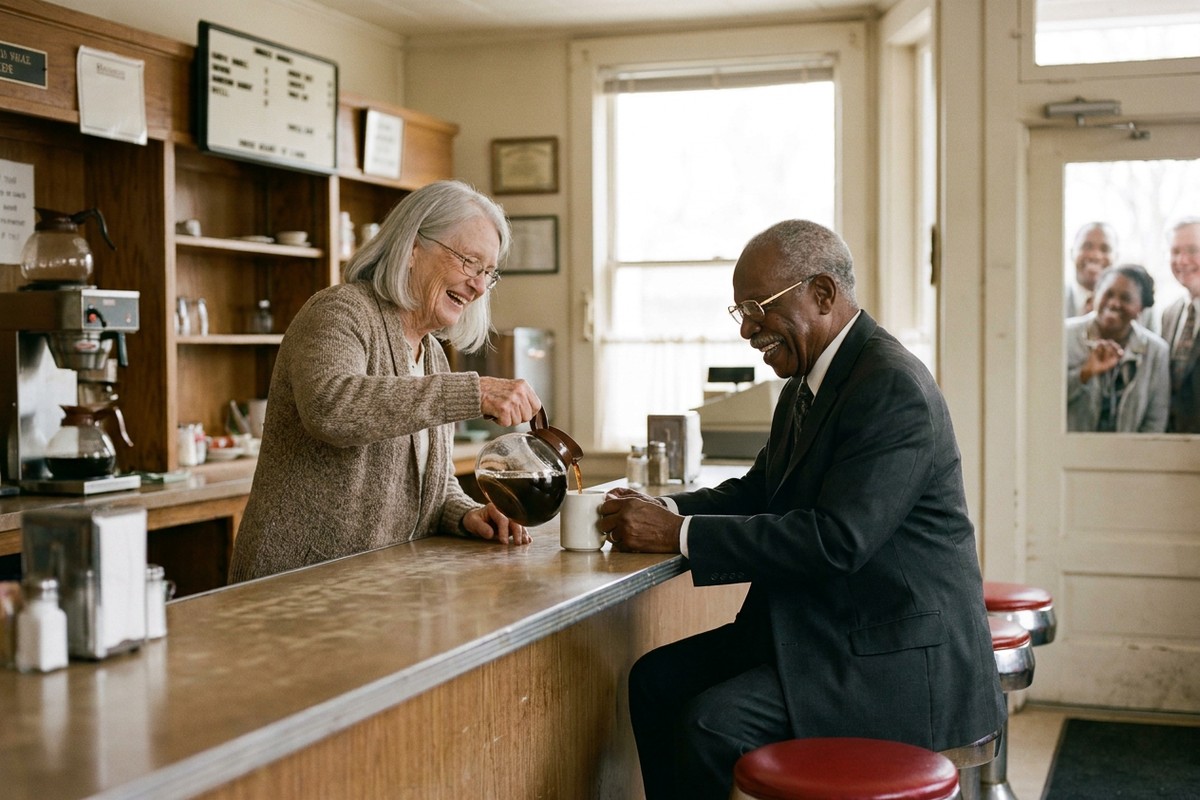
Reverend Calvin Barnes sat down on a red stool at the counter. He hung his cane on the edge of it. He folded his hands on the Formica, the same way he'd folded them in 1960.
Peggy walked around behind the counter. She found a heavy white mug on the shelf, turned it right side up, and set it in front of him.
Her hands were shaking. His were too.
"Coffee, sir?" she asked.
"Yes, please, miss," he said. "Thank you."
She poured it. She didn't spill a drop.
He picked up the mug and took a long sip, and closed his eyes, and set it down again.
"That's good coffee," he said.
"It's terrible," Peggy said. "I've been pouring it for fifty years. I know terrible coffee."
He laughed, a big, warm laugh that filled the little diner. The crowd at the door laughed with him. The reporter from the Courier took one more picture, the one that ran on the front page that Sunday.
It showed an old white woman behind a lunch counter, holding a coffeepot, and an old Black minister on a red stool with a white mug in his hands. Both of them were laughing.
Both of them had tears on their faces. And neither of them was looking at the camera.
They were looking at each other.