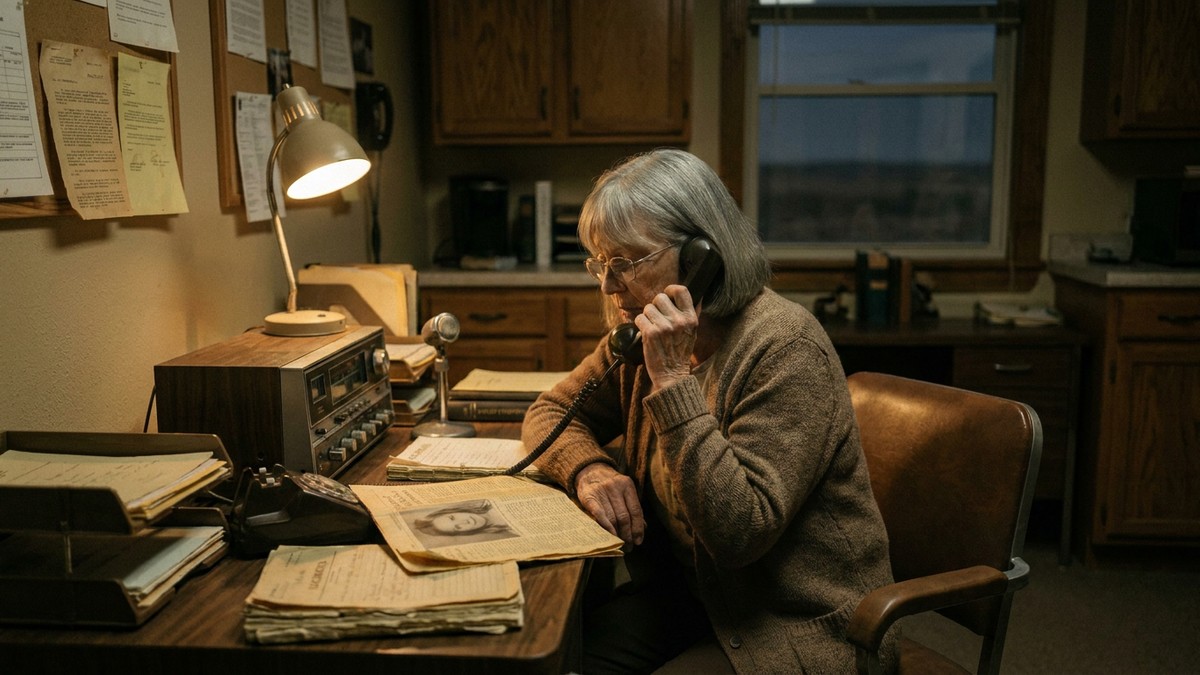
Glenda Pratt had taken eleven thousand emergency calls, and she could still recite the one from June 9, 1979, word for word.
It came in at 1:14 in the morning on the sheriff's emergency line in Sandy Bluff, Oklahoma. Glenda was twenty-eight, three years on the job, working the overnight shift alone in the little dispatch room at the back of the county jail. She had a radio console, two telephones, and a typewriter for the log.
The phone rang. She picked it up the way she always did.
"Sheriff's office, what's your emergency?"
There was nothing for a second. Then a girl's voice, very young, very quiet, the kind of quiet that comes from trying not to wake anybody up.
"Please don't send anybody," the girl said. "Please. I just need somebody to tell me what to do."
Glenda was seventy-six now. She'd been a dispatcher for thirty-eight years, and retired in 2014. She lived alone in a brick house on Elm Street with two cats and a garden full of tomatoes, and she volunteered at the public library on Tuesdays.
That was where the young man found her.
His name was Evan Albers, about thirty, in a ball cap and glasses. He'd grown up in Sandy Bluff and now made a podcast about unsolved cases.
"I'm doing a season on Darla Kaye Simmons," he said. "I think you might have been the last person who talked to her."
Glenda set down the stack of books she was holding.
Every grown-up in Sandy Bluff over the age of fifty knew the name.
Darla Kaye Simmons, fifteen, red hair and freckles, clarinet in the high school band. She'd lived with her mother and stepfather in a white frame house out past the grain elevator.
On the morning of June 9, 1979, her mother went to wake her for church, and her bed was empty. Her window was open. A small suitcase was gone, and forty dollars from her mother's purse.
The sheriff searched for weeks. They dragged the stock pond and walked the wheat fields in long lines, a hundred men across.
For years after, there were sightings. None of them were Darla.
Plenty of people in town had looked hard at the stepfather, Wayne Simmons, a big man with a temper. There'd never been any proof. Wayne had lived in that white frame house until he died in 2011, and the case had stayed open for forty-eight years.
The sheriff's office had kept a log of every call. Evan Albers had found it in a box in the county archive, with a single line on June 9, 1979.
1:14 a.m. Call received. Female juvenile. Hang-up.
No further action. G. Pratt.
"You logged it as a hang-up," Evan said. "Six hours before she was reported missing. I talked to the sheriff from back then. He's ninety-one. He said they never connected that call to Darla." He leaned forward. "But I think it was her. Do you remember it?"
Glenda looked at him for a long time across the library table.
"Yes," she said. "I remember it."
She didn't tell him the rest. Not that day.
She went home and sat in her kitchen with the lights off and thought about a promise she'd made forty-eight years ago to a voice on a telephone.
The girl had whispered for eleven minutes. Glenda had never told a living soul what she said.
She'd said her stepfather came into her room at night. She'd said her mother didn't believe her, or couldn't.
"If you send a deputy," the girl had whispered, "he'll talk to them on the porch. They know him. They go hunting with him. And then they'll leave, and I'll still be here."
Glenda had sat in that little room with her hand pressed over her mouth. She'd known the girl was right.
She'd seen it happen before. She'd seen deputies stand on porches.
"Do you have somewhere you can go?" she'd asked finally. "Anybody?"
"I have an aunt. In Oregon. My real dad's sister. She sends me birthday cards. She said if I ever needed anything." The girl's voice had cracked. "I don't know how to get there."
Glenda had looked at the clock on the wall. 1:21 a.m. She'd known the Greyhound schedule by heart, the way dispatchers know things.
The westbound bus to Albuquerque stopped at the Phillips 66 truck stop out on the interstate at 4:10 every morning. From Albuquerque, you could get anywhere.
Her cousin Wanda worked the counter at that truck stop overnight.
"Listen to me," Glenda had said. "Can you walk two miles in the dark?"
"Yes, ma'am."
"There's a truck stop out on the interstate. The Phillips 66. You go inside and ask for Wanda. You tell her Glenda sent you. She'll sell you a ticket, and if you don't have enough money, she'll put the rest on my name. The bus leaves at 4:10. Don't miss it." Glenda's hand had been shaking on the phone. "And when you get to your aunt's, you don't call home. You hear me? Not for a long time."
There'd been a long silence on the line.
"Why are you helping me?" the girl had whispered.
Glenda hadn't had a good answer. She'd only had the true one.
"Because somebody should have helped me," she'd said.
"Will you tell anybody where I went?"
"No, honey," Glenda had said. "I promise you. I will never tell."
Then the line had clicked. Glenda had typed one line in the log. Hang-up.
No further action. Then she'd picked up the other phone and called Wanda.
The next afternoon, she'd driven out to the truck stop and paid Wanda fifty-two dollars, the rest of a ticket to Portland, Oregon. Wanda never asked a single question, and took it to her grave in 1996.
For forty-eight years, Glenda kept that promise.
She'd kept it while Darla's mother went on the Oklahoma City news and cried.
She'd told one person. Only one. In the fall of 1980, she'd found Darla's mother alone in the ladies' room at the Methodist church, and she'd taken the woman's hands and said, "She's alive. She's safe. That's all I can say. Please don't ask me." And Darla's mother had looked at her for a long time, and then nodded, and never asked. She'd died in 1998.
Glenda had never known for certain if the girl made it to Oregon.
She'd never known if she'd done the right thing.
Evan Albers came back to the library three weeks later. He had his laptop open before he even sat down, and his face was pale.
"Mrs. Pratt," he said. "I found her."
Glenda held very still.
"I think. A woman on the Oregon coast, sixty-three, with Darla's birthday and a different name. I sent her a letter. I didn't expect an answer."
"Did she answer?"
"She called me last night." Evan turned the laptop so Glenda could see. He'd typed out what the woman said, word for word.
I won't talk to you. I won't talk to the sheriff, or the newspaper, or anybody from that town.
I'll only talk to one person. The lady on the phone.