Glenda hadn't been on an airplane since 1994. She flew out of Oklahoma City on a Thursday in June, with a window seat and a paperback she didn't read, and changed planes in Denver, and landed in Portland in the rain.
Evan Albers had offered to come. She'd told him no.
He could have his story later, if the woman wanted to give it to him. This part wasn't his.
She rented a car and drove three hours west, over the Coast Range, through dark wet forests of fir trees taller than any grain elevator in Oklahoma. At four in the afternoon, she came down out of the mountains into a little town on the ocean called Florence, and found the address, and parked in front of a gray-shingled house with a red door and a yard full of blue hydrangeas.
She sat in the car for ten minutes. She was seventy-six years old, and her hands were shaking on the wheel the way they'd shaken on that telephone in 1979.
Then she got out and walked up the path.
The red door opened before she reached it.
The woman standing there was sixty-three, slim, in a denim shirt and reading glasses on a chain. Her hair was gray now, cut short, with just a little red still in it at the temples.
She had freckles. A lot of them.
They looked at each other for a long moment across the porch.
"Sheriff's office," the woman said finally. Her voice was low and shaking. "What's your emergency?"
Glenda put her hand over her mouth.
"I remembered your voice," the woman said. "All these years. I'd hear somebody on the radio, or in a store, with that Oklahoma sound, and I'd think, is that her?" She was crying now. "I never even knew your name. Only Glenda. Only what you told me to tell Wanda."
"Glenda Pratt," Glenda said. It came out as a whisper.
"Ruth Ellen Marsh," the woman said. "That's who I've been since 1979. My aunt helped me pick it." She stepped back from the door. "Please come in. I've been waiting forty-eight years to make you a cup of coffee."
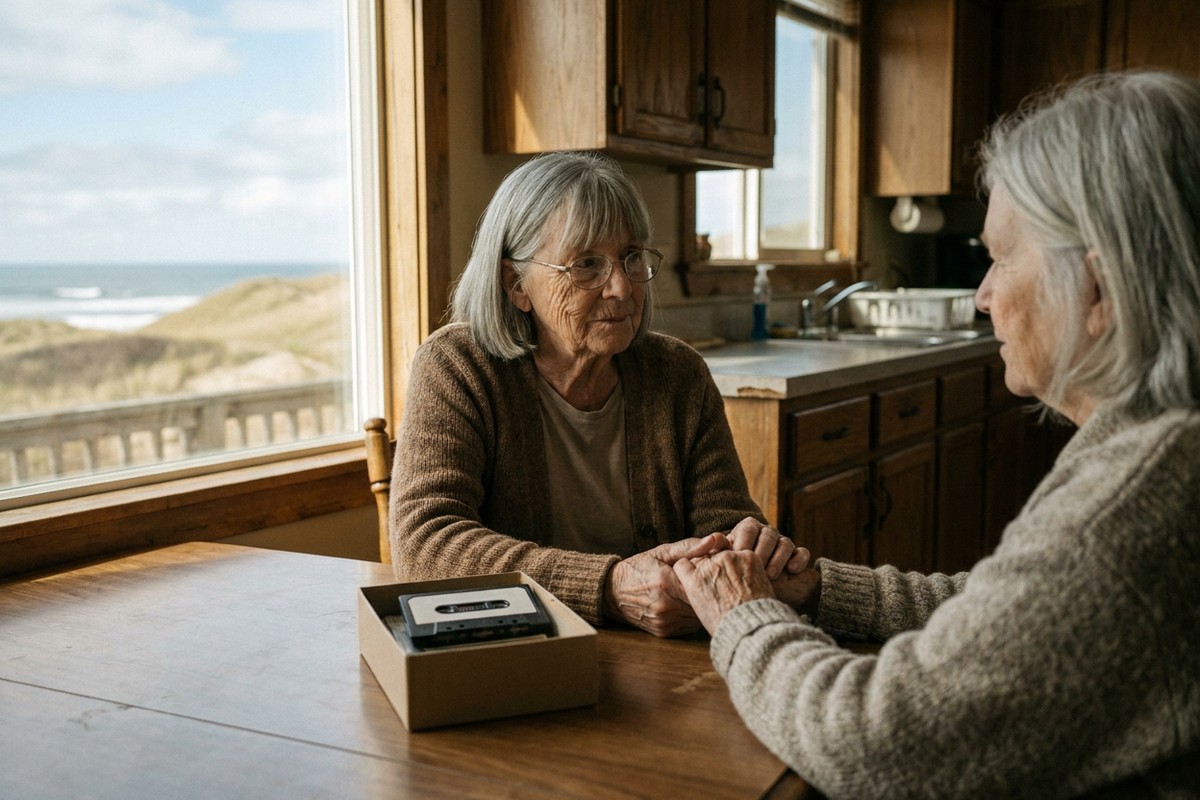
They sat at her kitchen table, by a big window that looked out over the dunes toward the gray Pacific.
Ruth told her all of it. How she'd walked two miles in the dark along the highway with her little suitcase, ducking into the bar ditch every time headlights came.
How Wanda had looked at her, a fifteen-year-old girl at four in the morning, and hadn't asked a single question. How Wanda had given her a sack of sandwiches and a pair of sunglasses and said, Don't talk to anybody, honey, just look out the window.
It had taken three days on three buses. Her Aunt Marjorie had met her at the station in Portland and held her for a long time without saying anything.
"She went to a lawyer that same week," Ruth said. "She knew how to do things the right way. I never had to go back. Not once."
She'd finished high school in Oregon, under her new name. She'd gone to college in Eugene.
She'd taught third grade in Florence for thirty-four years. She'd married a fisherman named Dave Marsh, and they had two daughters and four grandchildren.
"I wanted to call my mother so many times," Ruth said quietly. "I never did. I was afraid he'd find me."
Glenda reached across the table.
"Your mother knew," she said. "I told her. In 1980, at the Methodist church. I told her you were alive and safe, and that's all. She never asked me another thing." Glenda's voice cracked. "She knew, honey. She wasn't living with not knowing."
Ruth bent her head over the table and cried for a long time. Glenda held on to her hand and let her.
Later, when the light was going orange over the ocean, Ruth got up and went into the other room. She came back with a small cardboard box, soft with age, and set it on the table between them.
Inside was a cassette tape. On the label, in round teenage handwriting, faded to brown, it said: For the lady on the phone. 1980.
"I made it the first Christmas," Ruth said. "I played my clarinet on it. Silent Night. And I said thank you. Over and over, like a little kid." She smiled through her tears. "I was going to mail it to the sheriff's office. Then I thought, what if he finds the envelope? What if somebody traces it? So I never sent it."
She turned the box around and pushed it across the table.
"It's yours. It always was."
Glenda picked up the cassette. She held it in both hands. For forty-eight years, she'd never known.
Whether the girl made it to the bus. Whether she'd done right, or done something terrible. Whether she'd helped a child or sent one off alone into the dark.
"I didn't know if I'd done right," she said. "All these years. I didn't know."
"You saved my life," Ruth said simply.
They had an old boom box in the garage. Dave brought it in and plugged it in on the counter, and Ruth put the tape in, and pushed play.
There was hiss, and a click. Then a clarinet, a little squeaky, playing Silent Night all the way through, slow and careful. Then a fifteen-year-old girl's voice, very close to the microphone.
Hi. It's me. I made it.
I'm okay. Thank you.
Thank you. Thank you.
The two women sat at the kitchen table by the window, gray-haired and holding hands across the little cardboard box, and listened to it twice.
Ruth called Evan Albers herself, the next week.
She told him he could tell the story. All of it. The call, the bus, the truck stop, the lady on the phone.
She told him why she'd run, and that her stepfather had been a bad man, but not a killer, and that the town could stop looking in the stock pond now. She let him use the name she'd chosen. Ruth Ellen Marsh, retired schoolteacher, of Florence, Oregon.
"Tell them I lived," she said. "Tell them somebody helped me. Maybe a girl out there right now will hear it and call somebody."
The last episode aired in September. It ended with forty seconds of a clarinet playing Silent Night, a little squeaky, and a young girl saying thank you.
Glenda listened to it at her kitchen table in Sandy Bluff, with the cassette in her hand.