The lawyer read the will twice, because Henry Lindholm's daughter asked him to, and it said the same thing both times.
"I give my farm, all of my land, buildings, cattle, and equipment," the lawyer read again, slower, "to Arvid Nygaard, who has worked beside me for forty-one years."
Then he set the paper down on the conference table and folded his hands on top of it.
Karen Lindholm Ames didn't say anything. Her two brothers didn't say anything. They all turned, at the same moment, and looked at the man sitting by himself at the far end of the table in a clean flannel shirt and a seed cap he'd forgotten to take off.
Arvid Nygaard took it off. He held it in both hands. He looked as surprised as they did.
The Lindholm place was eleven hundred acres of wheat, corn, and pasture outside Vestby, South Dakota, a town of six hundred people and two churches, both Lutheran. Henry's grandfather had homesteaded it in 1883. Henry had farmed it for sixty-five years.
He'd died in March at ninety-one, in his own bed, the way he'd wanted to.
Arvid had found him. He'd come in at six for coffee, the way he'd done every morning since 1986, and the kitchen was cold and the coffee wasn't made.
He'd gone upstairs and stood in the bedroom doorway for a long time. Then he'd called the doctor, and then the funeral home, and then, last, Henry's children.
Karen lived in Minneapolis. Dale lived in Denver.
Paul lived in Omaha. They'd all grown up on the farm, and they'd all left it as soon as they could, and they came home for Christmas most years and sometimes for Easter.
Arvid had been there every day.
He was sixty-eight now, a tall, quiet man with big hands and a face weathered the color of a saddle. He lived in the little white house by the machine shed, the one the hired man had always lived in. He'd never married.
He went to the early service at Our Savior's on Sundays and sat in the back pew. He'd known Henry Lindholm longer than he'd known his own father.
"This isn't right," Karen said.
She said it quietly, which was worse than if she'd shouted. She was sixty-one, a hospital administrator, sharp and organized, and she'd spent the drive from Minneapolis making a list of what had to be done with the farm. Selling it had been at the top of the list.
"Mrs. Ames," the lawyer said carefully, "your father signed this will in my office two years ago. He was very clear."
"My father was eighty-nine years old." Karen turned and looked straight down the table at Arvid. "He was alone out there. He had one person he talked to every day. One person who made his coffee and drove him to the doctor and handled his checkbook when his eyes went." Her voice shook just slightly. "I'm not accusing anyone of anything. I'm just saying I can see how this happened."
Arvid didn't answer. He turned his cap slowly in his hands.
Dale, the middle one, cleared his throat. "Karen."
"Don't Karen me. That land's been Lindholm land since 1883." She stood up and put on her coat. "Dad wouldn't do this. Not in his right mind."
Arvid drove home in the farm pickup with the radio off.
He fed the cattle. He checked the heifer in the north pen that was close to calving. He went into the little white house and sat at his kitchen table with a cup of coffee he didn't drink, and he looked out the window at the big farmhouse across the yard, dark now, with Henry's reading lamp still on a timer in the front room.
He'd come to this farm in October of 1986 with everything he owned in the back of a Chevy pickup.
That was the year the bank took his father's farm, forty miles west, in the worst of the farm crisis. Three generations of Nygaards, gone at a courthouse auction in nineteen minutes.
His father never really recovered. Arvid was twenty-seven, with no land and no plan, and Henry Lindholm had needed a hired man.
"You know cattle?" Henry had asked him, standing in the yard.
"Yes, sir."
"You drink?"
"No, sir."
"Then you can start tomorrow. Coffee's at six."
That was the whole interview. Arvid had been at that kitchen table at six the next morning, and every morning for forty-one years after.
He'd never asked Henry for the farm. He'd never once thought of it. He'd have been happy to work it for whoever owned it, until his knees gave out, and then live in the little white house until they carried him out of it.
But he knew what Karen thought. He could see how it looked.
The papers came on a Tuesday in April.
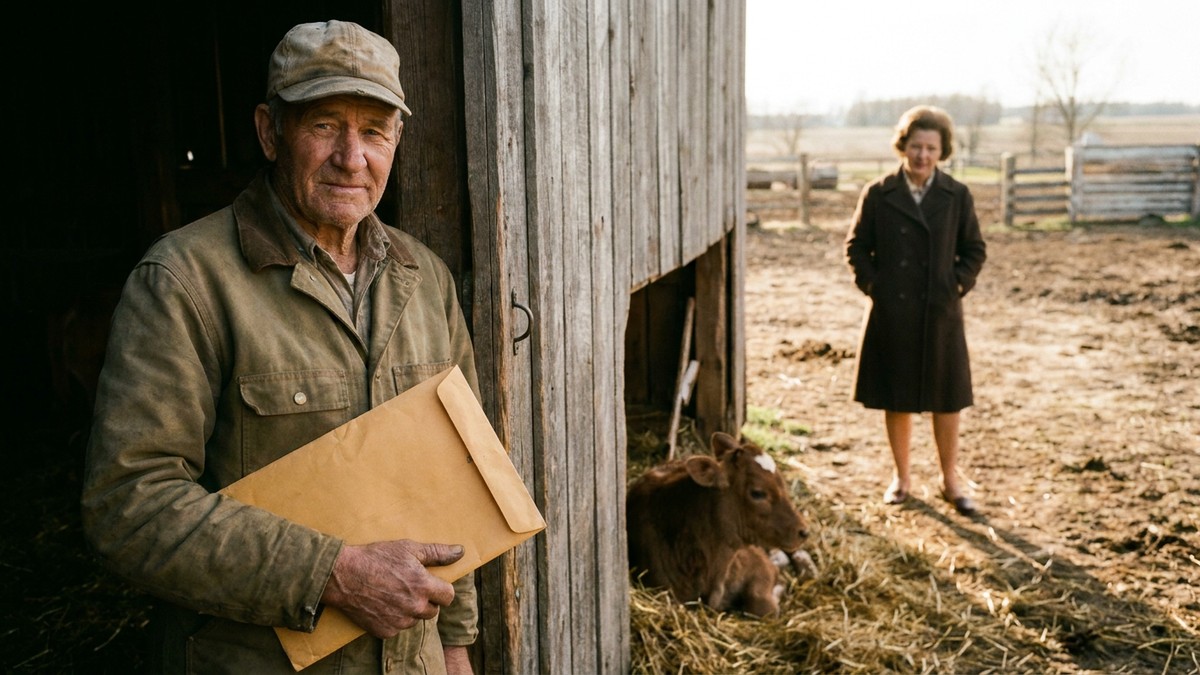
Arvid was in the barn, pulling a calf. The heifer had been in trouble since four in the morning, and he'd gotten the chains on the calf's front legs and was working with her, slow and steady, pulling only when she pushed. He was on his knees in the straw with his sleeves rolled up past the elbow when he heard a car door slam in the yard.
He didn't look up. You don't look up from a calving.
The calf came at 9:15, a big wet bull calf, alive, shaking his head. Arvid cleared his nose and rubbed him with a handful of straw until he snorted. Then he sat back on his heels, breathing hard, and saw the deputy standing in the barn door.
It was Mike Haugen. Arvid had known him since he was in 4-H.
"Morning, Arvid," Mike said. He looked like he wished he were somewhere else. "Sorry to bother you. I've got to give you something."
He held out a thick envelope. Arvid wiped his hands on his jeans before he took it, but they were still dirty, and he left two brown fingerprints on the white paper.
He opened it standing in the straw, with the new calf trying to get up on its legs beside him.
Karen Lindholm Ames was contesting her father's will. The petition said Henry Lindholm had not been of sound mind when he signed it. It said he'd been subject to undue influence by a person in a position of trust.
That person was named on the second page.
Arvid read his own name three times. Then he folded the papers back into the envelope, very carefully, and stood in the barn where he'd worked since 1986 and watched Henry Lindholm's last calf take its first wobbly steps.