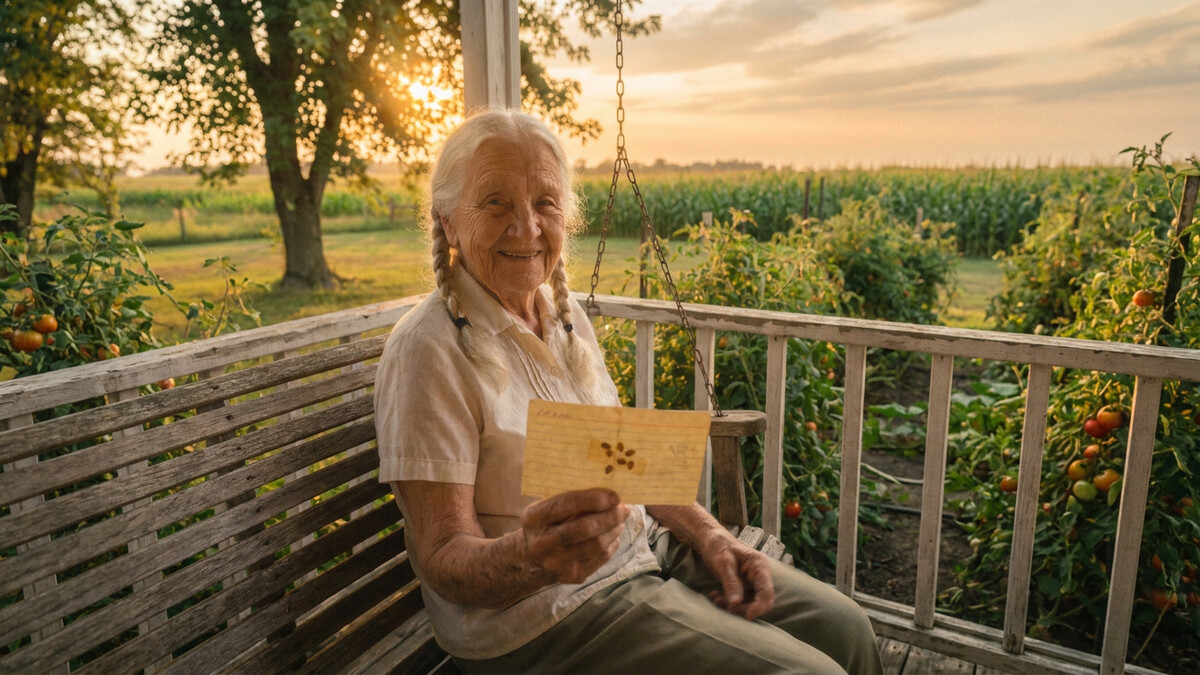
In the spring of 1943, when Bernadine Kucera was nine years old and her father was away at an Army camp, a farm magazine printed her name on its Victory Garden pen pal page, and a girl in Tennessee named Sallie Brewer wrote to her about tomatoes.
Eighty-three years later, in August, a small padded envelope came to Bernadine's house in Nebraska with a Tennessee postmark, and inside it were six ripe red tomato seeds taped to an index card, and a label in a stranger's handwriting.
Frank's Tomato. From Nebraska, 1944. Grown every summer since.
Bernadine sat down hard on the porch swing.
Frank was her father's name.
She was ninety-two. She had lived on the same farm outside Prague Hill, Nebraska, her whole life, in the white house her grandfather built when he came from Bohemia in 1889. She had buried her husband, Joe, in 2011, and her younger brother in 2020. Her son ran the farm now. She lived in the house and kept a garden.
She had kept a garden every summer for eighty-three years.
And every summer, in the sunniest corner, she grew one kind of tomato. A big, lumpy, deep red Czech tomato her grandmother had brought from the old country in a twist of paper in her coat pocket. They called it Babička's Red. Grandma's Red. It was the best tomato in Saline County. Bernadine had saved the seeds every fall of her life.
She had never once in all those years thought of it as anybody's but her grandmother's.
The pen pal page had been her mother's idea.
It was 1943. The war was everywhere. Her father, Sergeant Frank Kucera, had gone into the Army with the Nebraska National Guard, the 134th Infantry, in 1940. In 1943, he was in a training camp far from home. He wrote home every week, but he could not say where he was or what he was doing, and his letters had holes cut out of them by the censors.
Her mother planted a Victory Garden behind the house, like every farm wife in Nebraska. She put Bernadine in charge of the tomatoes. And she sent Bernadine's name to the pen pal page of the farm magazine, for children who were growing Victory Gardens.
Sallie Brewer was the first one who wrote.
Bernadine still had the letters. She went inside and got them out of the cedar chest at the foot of her bed. Forty-one letters, in a bundle tied with string, in a little girl's round, careful handwriting, on lined paper.
Dear Bernadine, I am 9 too. I live on a farm in Tennessee near a town called Dayton Springs. I am growing tomatoes and beans and okra in my Victory Garden. Do you have okra in Nebraska? My daddy is in the Army. He is at a camp somewhere. Is yours?
They wrote every two weeks for three years.
About tomatoes, mostly. And beans, and the weather, and school. About whose garden was doing better. Sallie's tomatoes came in a month earlier than Bernadine's every year, which Bernadine thought was unfair. Bernadine's tomatoes were bigger, which Sallie thought was unfair.
And about their fathers.
In one letter, in the spring of 1944, Sallie wrote something that made Bernadine's mother stop reading out loud at the supper table.
My daddy wrote that he is with a Nebraska outfit now. They put some Tennessee boys in with them. He says the Nebraska boys are good soldiers but they talk funny. He says his sergeant is named Kucera, and isn't that a funny coincidence, because that's your name.
Bernadine's mother read it twice. Then she got up from the table and went to write a letter to her husband.
It was not a coincidence. It was the war. The Army had put Private Clyde Brewer of Tennessee in Sergeant Frank Kucera's squad.
That summer, the summer of 1944, Bernadine did something she had never done before.
She saved the seeds from her best Babička's Red tomato, the biggest one in the garden. She dried them on a paper towel on the kitchen windowsill. She folded six of them into a square of wax paper.
And she mailed them to Tennessee.
These are my grandmother's tomatoes from Czechoslovakia, she wrote. They are the best ones. Plant them next spring and see if they come in before yours. Your friend, Bernadine.
Sallie wrote back that she would plant them in the very best spot.
The letters stopped in 1946.
Not for any sad reason. The war was over. Both their fathers had come home. The girls were twelve, and busy, and the letters got further apart, and then one day there wasn't one. That was all.
Frank Kucera came home in the fall of 1945. He never talked about the war. Not once, in the thirty-eight years he lived after it. He farmed. He went to church. He grew corn. If anybody asked him about France, he changed the subject. He died in 1983.
Bernadine had not thought about Sallie Brewer in seventy years.
Now she sat on her porch swing with the index card in her lap and the six red tomato seeds taped to it.
Frank's Tomato. From Nebraska, 1944.
There was a letter in the envelope too. Two pages, typed, signed in blue ink.
Dear Mrs. Kucera,
My name is Amanda Brewer Lacey. I am sixty years old. I live in Dayton Springs, Tennessee, on the farm where my grandmother, Sallie Brewer Lacey, grew up. Grandma Sallie passed away in May at the age of ninety-two. I am sorry to tell you that.
While I was going through her things, I found a bundle of letters from a girl in Nebraska named Bernadine Kucera. I hope you are her.
I want you to know something. Every summer for eighty-one years, my family has grown a tomato we call Frank's Tomato. Grandma Sallie planted the first ones in the spring of 1945, from six seeds that came in a letter from Nebraska. We have saved the seeds every year since. My grandmother grew them. My mother grew them. I grow them. My son grows them in Knoxville. We give the seeds to every new bride at our church.
We always called it Frank's Tomato. I grew up thinking it was named after some old farmer in Nebraska.
It wasn't. I didn't know that until I read the letter Grandma left with the bundle, addressed to me.
Bernadine turned the page. Her hands were shaking.
Grandma Sallie wrote that her father, my great-grandfather, Clyde Brewer, came home from the war in 1945. He never talked about it. But one night, when she was grown, he told her one thing. On July 15, 1944, near a town called St. Lô in France, he was shot through both legs in a hedgerow and could not walk. And his sergeant, a big quiet Nebraska farmer named Frank Kucera, picked him up and carried him on his back for almost a mile, under fire, to the aid station.
My great-grandfather said Sergeant Kucera never once put him down.