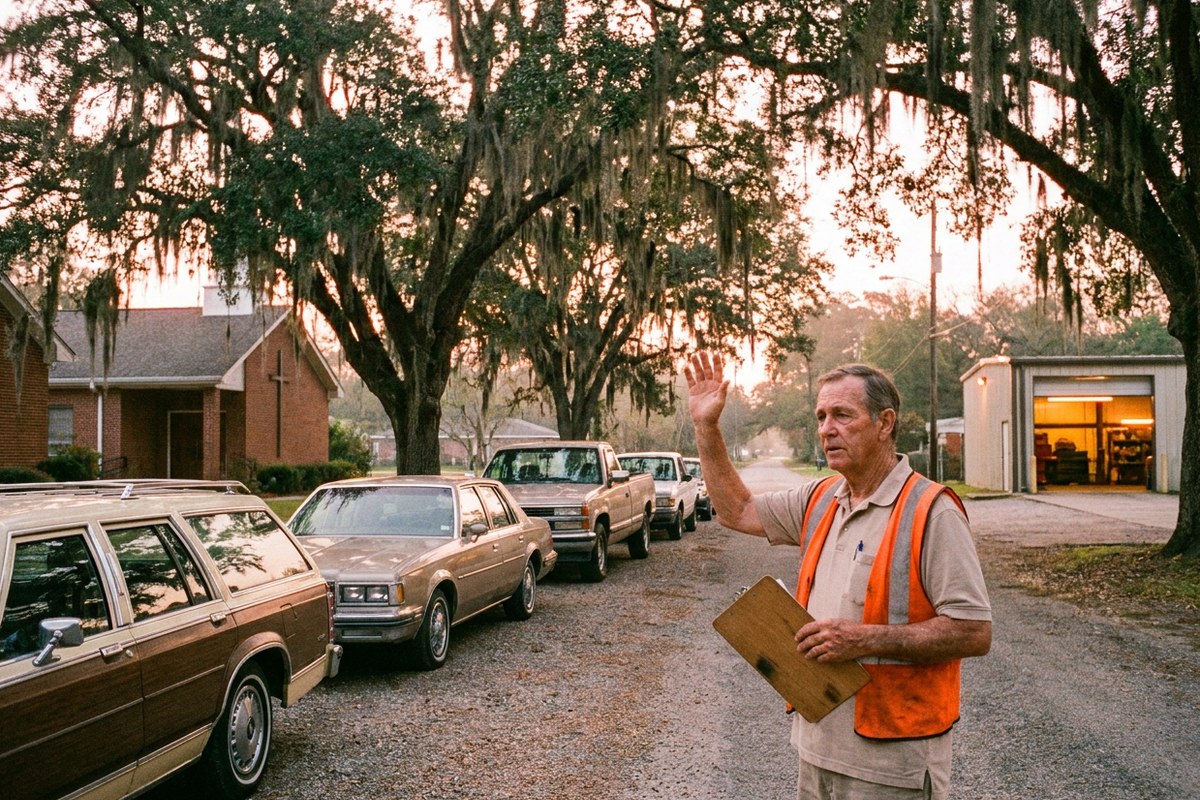
"I'm so sorry," Marian said, waving at the steam. "I'm so sorry. Gerald's at his brother's in Baton Rouge till tomorrow, and I was coming back from the pharmacy, and the light came on, and I didn't know where else to go. Yours was the only garage with a light on."
Lucien looked at the steam. He listened to it.
"Upper radiator hose," he said. "Split at the clamp. I can hear it."
"Can you fix it tonight? I'm sorry. I know it's late. I'll pay whatever it costs."
Lucien looked at her standing in his driveway in her bathrobe. Then he looked at the cardboard sign by the mailbox post, which she hadn't seen yet, and then back at her.
"Go sit down in the kitchen, Mrs. Voight," he said. "There's coffee. It's free."
It was the upper radiator hose. He'd known it would be.
He let the engine cool while Marian drank coffee at Odile's kitchen table and looked at the pictures on the wall. Then he drained the radiator into a pan, cut off the split hose, and fitted a new one from the shelf.
Two clamps. He refilled it with coolant, started the engine, let it run till the thermostat opened, and checked for leaks with a flashlight.
The whole thing took forty minutes.
Marian came out to the garage while he was wiping down his tools. She'd been looking at the photographs on the kitchen wall. Most of them were of cars, and the people standing next to them, smiling.
"Who are all those people?" she asked.
"Tuesdays," Lucien said.
She didn't understand, so he told her. About Odile, and 2005, and the woman with the salt water in her car. About Miss Delphine's starter, and the Thibodeaux girl's wheel bearing, and the preacher's van.
He didn't make a speech of it. He just answered the question.
Marian was quiet when he finished.
"What do I owe you?" she said.
"Hose was twelve dollars."
"And the labor?"
Lucien shrugged. "It's Tuesday somewhere," he said.
On her way out of the driveway, Marian's headlights swept across the cardboard sign propped against his mailbox post.
She stopped the car. She sat there with the engine running for a long moment. Then she drove across the street to her own house and went inside.
The zoning board met on Thursday night in the parish council chambers, a low brick building by the courthouse with fluorescent lights and folding chairs.
Lucien came in his good shirt with Remy beside him. He expected the room to be empty.
There were sixty-three people in it.
They'd come straight from work in scrubs and coveralls and church clothes. Miss Delphine Guidry was in the front row with her cane across her knees.
The Thibodeaux girl had brought her baby. The preacher from the highway had brought half his congregation, and they'd filled the back two rows and were standing along the wall.
Lucien stopped in the doorway and couldn't go any farther. Remy had to take his elbow.
"How," Lucien said.
"Somebody's been calling people," Remy said. "Since yesterday morning. Every name she could find."
"She?"
Remy nodded toward the second row.
Marian Voight sat there with a manila folder on her lap. Beside her, in his pressed polo shirt, with his arms folded, sat Gerald.
The chairman read the complaint into the record. Then he asked if the complainant wished to speak.
Gerald Voight stood up. The room went quiet in a way Lucien didn't like.
"I filed this complaint in October," Gerald said. He had an engineer's voice, flat and clear. "I stand by every fact in it. There are too many cars on a narrow street on Tuesday mornings, and the parking does block my driveway, and somebody parked on my lawn."
Somebody in the back row muttered. Gerald ignored it.
"What I didn't know," he said, "was why the cars were there." He looked down at his wife, and then across the room at Lucien. "On Monday night, my wife's car broke down, and Mr. Breaux fixed it. He charged her twelve dollars for the part. She tells me he was standing next to a sign saying he was closing his Tuesdays because of my complaint when he did it."
He opened the manila folder.
"So I'd like to withdraw the complaint," Gerald said. "And I'd like to propose a solution to the actual problem, which is parking. Bayou Clair Methodist is two blocks away. Their lot sits empty every Tuesday morning. I spoke with the pastor today. They'd be happy to let the line wait there, and I've drawn up a traffic plan." He held up a sheet of paper covered in neat drafting lines. "One car at a time walks over when it's their turn. I've timed it. It works."
The room was silent. Then Miss Delphine Guidry, eighty-eight, started clapping with her cane on the floor, and the whole room joined in.
The chairman banged his gavel twice, gave up, and waited.
The next Tuesday morning, at five minutes to seven, there were fourteen cars in the parking lot of Bayou Clair Methodist.
They waited in a neat row, nose to tail, exactly where the traffic plan said. At the entrance to the lot, in a bright orange safety vest and his pressed polo shirt, stood Gerald Voight with a clipboard, sending them across the street one at a time.
At seven o'clock sharp, Lucien rolled up the garage door. The cardboard sign was gone from the mailbox post.
The coffee was on, and the first car in line was Marian's, with a box of pralines on the dashboard.