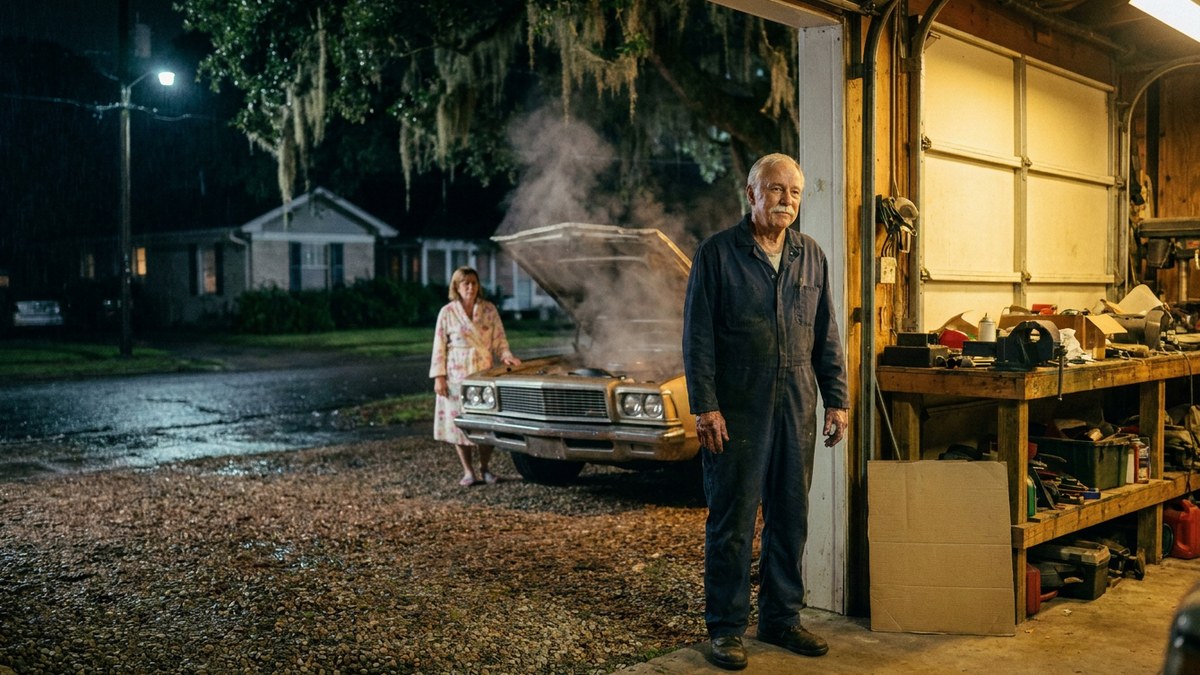
Every Tuesday for twenty-one years, Lucien Breaux's garage door rolled up at seven in the morning and the coffee was free.
So was the work.
Widows came on Tuesdays. Single mothers working two jobs.
Old men on fixed incomes, and young couples with a baby in the back seat and a check engine light they couldn't afford to look at. They lined their cars up along Cypress Street in Bayou Clair, Louisiana, and waited their turn, and Lucien fixed what he could and charged them for the parts if they could pay and nothing if they couldn't.
The rest of the week, he charged like any other mechanic. Tuesdays were for the Lord, he said, and his late wife Odile, who'd started it.
Odile had started it in October of 2005.
That was the fall after the hurricanes, when half of southwest Louisiana was flooded and the other half was sleeping in church gyms. A woman had come to their door in tears with a car full of salt water and three kids, and Lucien had told her he didn't have time. Odile had looked at him across the kitchen and said, Lucien Breaux, you have time.
He fixed the car. The next week, the woman's sister came. The week after that, four more.
"Make it Tuesdays," Odile had said. "One day. The Lord gets one day of your hands a week."
Odile passed in 2019. Lucien was seventy now. He kept doing Tuesdays.
He could tell you every regular by the sound of their car turning onto Cypress Street. Miss Delphine Guidry, eighty-eight, in a 1997 Buick with a starter that groaned like an old dog.
The Thibodeaux girl, who worked nights at the hospital, in a little Honda with a bad wheel bearing that he'd told her about twice. A preacher from out on the highway whose van was held together with prayer and hose clamps.
He could hear what was wrong with most of them before they'd put it in park. Odile used to say he listened to engines better than he listened to her. She was right about that, and he'd told her so.
The letter from the parish came in a white envelope with a gold seal.
It was a notice of a code violation hearing before the parish zoning board, the following Thursday at six. The complaint said Lucien was operating a commercial business beyond the terms of his home occupation permit. Specifically, a recurring weekly volume of customer vehicles creating a traffic and parking obstruction on a residential street.
Lucien read it at his kitchen table three times. Then he called his nephew Remy, who was a paralegal in Lafayette.
"Somebody complained," Remy said. "Has to be. The parish doesn't go out looking."
Lucien knew who. He'd known since September.
The house across Cypress Street had sold in the summer to a retired couple from Houston. Gerald and Marian Voight.
Gerald had been an engineer at a refinery for thirty-five years. He wore a pressed polo shirt to get the mail, and he'd planted a perfect square of St. Augustine grass in the front yard, and he'd put up a little sign at the edge of it that said PLEASE KEEP OFF.
On the first Tuesday after the Voights moved in, a lady in an old Buick had parked with one wheel on Gerald's new grass.
On the second Tuesday, the line of cars had blocked his driveway for twenty minutes.
On the third Tuesday, Gerald walked across the street, stood at the open garage door with his arms folded, and asked Lucien how long this was going to go on.
"Since 2005," Lucien had said, wiping his hands on a rag. "I expect a while yet."
Gerald hadn't laughed. He'd gone home, and he hadn't come back across the street since.
"They can fine you," Remy said on the phone. "Two hundred dollars a violation, maybe more. Every Tuesday. Or they can pull your permit, and then you can't work out of the garage at all. Not on Tuesdays and not on Mondays either."
"Can they do that?"
"They can do that, Uncle Lucien."
Lucien sat in the garage that night with the lights off and the door shut.
He thought about the woman with the salt water in her car in 2005. He thought about Odile across the kitchen table. He thought about the eleven cars that would be lined up on Cypress Street at seven o'clock next Tuesday morning, and the two hundred dollars, and the permit, and the Mondays.
He was seventy years old. The garage was the only living he had.
At nine o'clock, he got up and found a piece of cardboard and a black marker. He wrote on the cardboard in big square letters.
CLOSED TUESDAYS. SORRY.
He carried it out to the end of the driveway and propped it against the mailbox post, where the first car in line would see it.
He was standing there looking at it when headlights turned onto Cypress Street.
The car was coming slow and crooked, the way a car drives when it's in trouble. White steam was pouring out from under the hood. It hissed into his driveway and stopped six feet from his garage door, and the engine died with a clank.
The driver's door opened. A woman got out in a bathrobe, coughing in the steam, with a phone in one hand.
It was Marian Voight. Gerald was nowhere in sight.