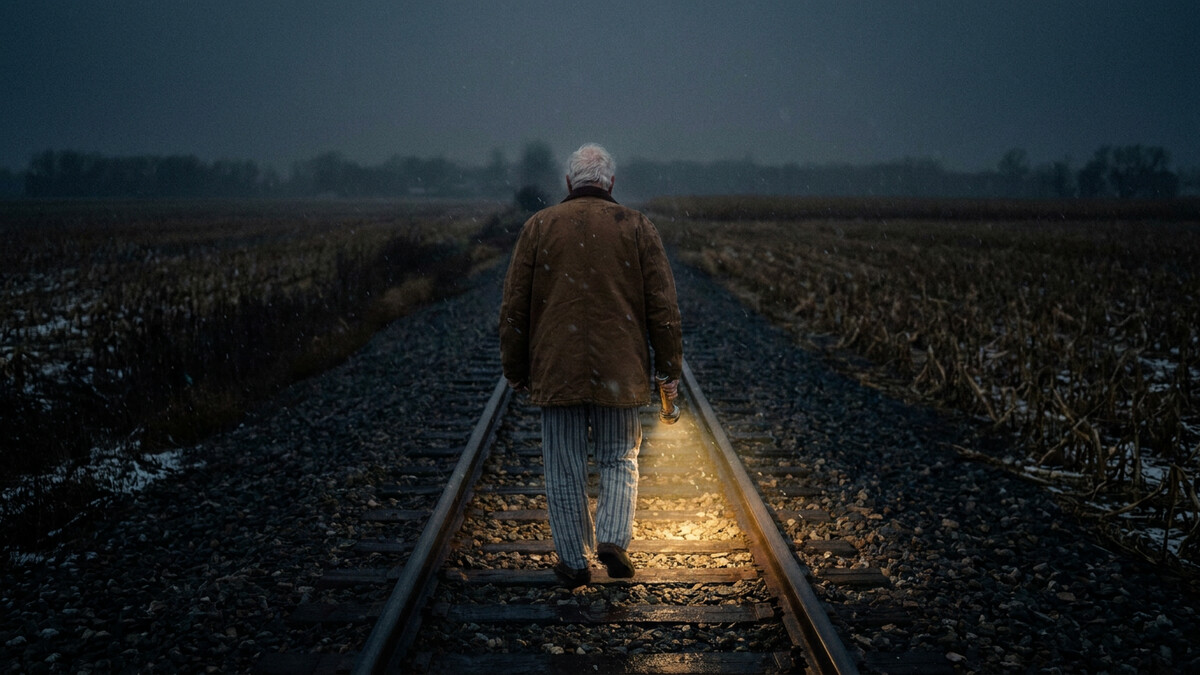
Marvin Dekker stood perfectly still on the trestle in the dark.
He did not move his feet. He did not reach for anything. He stood with the snow falling on his bare head and his heart going like a hammer in his chest, and he made himself breathe.
He had been a farmer for sixty years. He had been in a lot of places where one wrong move meant the end of you. On a tractor on a side hill. In a grain bin. Under a bull. The first thing you learned, if you lived long enough to learn anything, was that panic killed more men than the danger did.
So he did not panic.
He thought.
He knew where he was. Halfway across. He knew there was a gap in front of him, two feet wide. He knew the ties behind him were solid, because he had just walked on them.
And he knew that in about two hours, the sun would come up.
Marvin lowered himself, very carefully, onto the tie he was standing on. He sat down on it, with his legs hanging over the side, the way the boys did in summer. He put his good hand on the rail beam beside him. He pulled his barn coat tight around his pajamas.
Then he waited.
It was the hardest thing he had done all night. His hip burned. The cold came up through the wet wood. The snow covered his shoulders and his knees. He thought about Ruth, and about the garlic in his coat pocket, a dozen fat heads in a plastic sandwich bag. He said the Lord's Prayer twice and the twenty-third Psalm once.
He did not move.
At six-twenty, the sky in the east began to go gray.
At six-forty, there was enough light to see the gap. It was a missing tie, rotted out and fallen into the creek. The ties on either side of it were sound. It was a long step, but not a jump.
At six-fifty, Marvin Dekker stood up, very slowly, took the long step across the gap with his bad hip, and walked the rest of the way across the Mud Creek trestle in the snowy dawn.
At a quarter past eight, he walked up his own lane.
The snow had stopped. The garden behind the house was a white square, with Ruth's old tomato cages leaning in the corner.
He got the spade from the garage. He brushed the snow off the bed where the garlic always went, along the south fence. The ground underneath was cold but not frozen. He had been right about that.
He knelt down. His hip screamed. He let it.
He broke the first head of garlic into cloves, the way Ruth had shown him in 1962, and began to plant them. Root-end down. Two inches deep. Six inches apart.
He was on the fourth row when he heard the cars.
There were three of them. The county sheriff's SUV. A white car from the care center. And Denise's silver car from Des Moines, which she must have driven since four in the morning, after the care center called her.
Denise got out first. She ran across the yard in her good coat and stopped at the edge of the garden.
Her father was kneeling in the snow in his pajamas and barn coat, with a spade in one hand and a clove of garlic in the other, his face gray with cold and his hip twisted at a bad angle.
"Dad," she said. Her voice broke. "Dad, you could have died."
"I know it," Marvin said. "I almost did. The trestle's missing a tie."
"You walked across the trestle? In the dark?"
"I sat on it for two hours," Marvin said. "Waiting for the light. Then I walked across it."
He set the clove in the ground and patted the dirt over it.
"Denise," he said. "Your mother's garlic has gone in the ground every November since 1962. Hard freeze Thursday. If it didn't go in this week, it never would. And I wasn't going to let it die in a cupboard."
Denise knelt down beside him in the snow.
She did not say anything for a long time. Then she held out her hand.
Marvin put a clove in it.
"Root-end down," he said. "Two inches deep."
The care center filed a report. Steve flew in from Denver again. There was a hearing at the county courthouse two weeks later, in front of a district judge, about whether Marvin Dekker was able to make his own decisions.
The children's lawyer told the judge that Mr. Dekker had walked out of a care facility at two in the morning, in pajamas, in a snowstorm, and nearly fallen through a railroad bridge.
Then the judge asked Marvin to explain himself.
He did. Slowly. Clearly. He explained the hard freeze forecast. The planting window. The railroad grade, the shortest route, which he had walked since 1951. The granola bar and the two pairs of socks. The flashlight. The missing tie. The decision to sit down and wait for light instead of going on or going back.
"I'd have liked to tell somebody," he said. "But not one person in that building would have let me go. So I made my own plan. It wasn't a good plan. But it was a plan. And I followed it."
The judge looked at him over her glasses for a long time.
"Mr. Dekker," she said finally, "I've heard a lot of testimony this week. That's the most sensible explanation of a foolish thing I believe I've ever heard."
She denied the petition.
Marvin went home. Not alone.
His grandson Ethan, Denise's oldest, twenty-two, had just finished an ag degree at Iowa State. He moved into the upstairs bedroom in December. He took over the rental from the Vander Wals the next spring. He carried the hay bales now, and he put a button on a cord around his grandfather's neck that would call him from anywhere on the farm.
The man from Ames stopped calling.
In July, the garlic came up.
Marvin and Denise pulled it together on a Saturday morning, kneeling side by side along the south fence, the big white heads coming out of the black dirt with a soft tearing sound.
Denise held one up and brushed the soil off it.
"How many do we save for planting?" she asked.
Marvin looked at her. He thought about Ruth, and her mother, and her mother's mother, and a coffee can carried across an ocean.
"The biggest ones," he said. "Always the biggest ones. You'll be doing this when I'm gone."