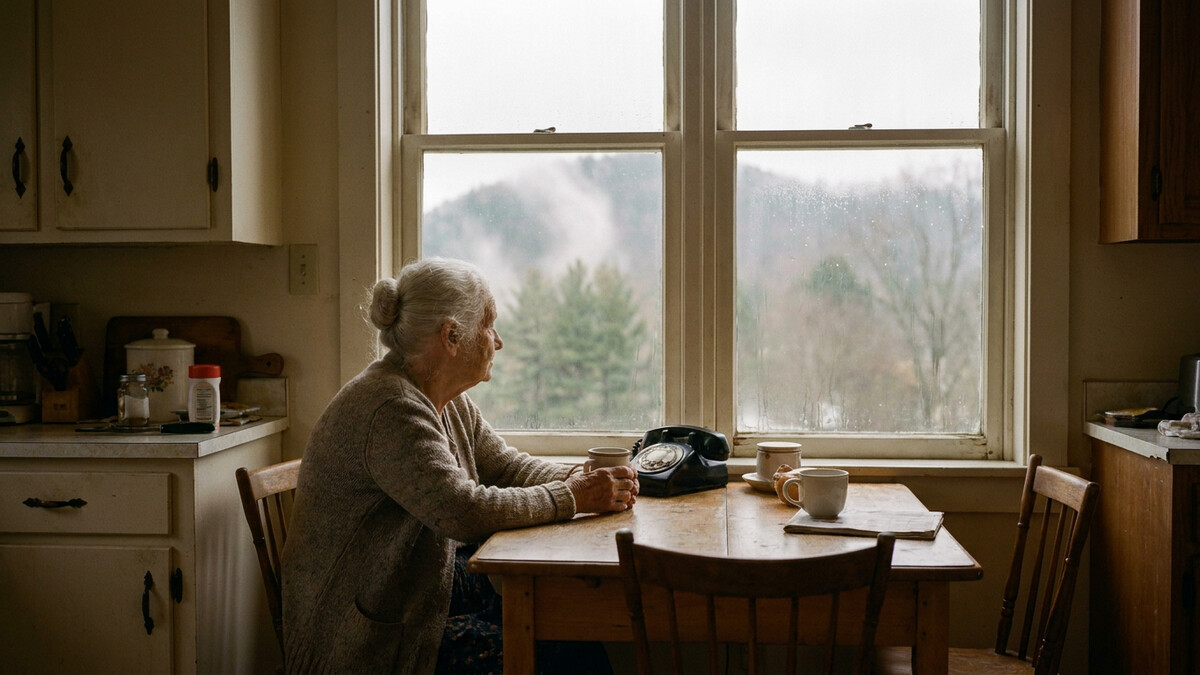
"I pulled it," Ludie said.
She said it simply, at the breakfast table, seventy-one years later, the way she might have said she had pulled a weed.
"And I held it down. And every telephone in Cane Fork started ringing. All ninety of them. All at once. One long ring that didn't stop."
She had held it for forty minutes.
When people picked up, angry or frightened, asking what on earth was going on, she did not explain. There was not time. She said the same twelve words into every line, over and over, until her voice went hoarse.
"The dam's weeping. Get up the ridge. Get up the ridge now."
Some people did not believe her. Some did. The ones who did went next door and pounded on their neighbors' doors. Men ran down the row of company houses in the rain, shouting. Somebody started ringing the church bell.
By two-thirty, there were lanterns and flashlights moving up the side of the ridge above the creek, a long line of them in the dark and the rain. Women carrying babies. Men carrying old people. Children in their nightclothes. Dogs.
Ludie stayed at the switchboard until Aunt Dovie came downstairs in her nightgown and pulled her away from it by the arm.
They climbed the ridge together, the last ones out.
At ten minutes after three in the morning, the Cane Fork dam gave way.
Ludie heard it from the top of the ridge. A sound like a freight train coming down the mountain, getting louder and louder, until it filled the whole world.
In the gray light at dawn, the town stood on the ridge in the rain and looked down at what was left.
Thirty-one houses were gone. The company store was gone. The school was gone. The creek had become a river of mud and broken lumber and uprooted trees, a quarter mile wide.
Aunt Dovie's house was gone, and the switchboard with it.
Every person in Cane Fork was standing on that ridge.
"Not one soul died," she said. "Not one. Four hundred people. In the middle of the night."
Brooke had tears running down her face.
"Granny," she said. "Why didn't anybody ever know it was you?"
Ludie looked out the window.
"Because Mr. Boggs went down to Hazard that afternoon," she said, "and talked to the newspaper. And he told them he'd gotten a report from the dam watchman in the night, and he'd ordered the general alarm rung. And the newspaper believed him. Why wouldn't they? He was the superintendent."
"And Elvin Pratt? He knew."
"Elvin knew," Ludie said. "And Ora. And Aunt Dovie. And Mr. Boggs. But Elvin worked for the company. And Aunt Dovie needed a new house from the company. And I'd broken the rules." She turned her coffee cup around on the table. "Mr. Boggs came to see me a week later. He said, Young lady, I'm grateful. I'll never forget it. But you understand what you did was against company rules, and if you tell people, I'll have to let your aunt go. So I didn't tell."
She shrugged, a small, old shrug.
"Then I grew up. And I married your granddaddy. And it was a long time ago."
The plaque dedication was set for the third Saturday in March, on the seventy-first anniversary, at the little memorial park where the school used to be.
Brooke made phone calls for a week.
Elvin and Ora Pratt were long dead. Aunt Dovie had died in 1979. Mr. Boggs had died in 1988, in Florida.
But Elvin and Ora Pratt had a daughter. Her name was Betty Pratt Hall, and in March of 1955, she had been eight years old, asleep in the little shack on top of the dam.
She was seventy-nine now. She lived in Hazard.
Brooke drove there and sat in her living room.
"I remember the phone," Betty Hall said, before Brooke had even finished explaining. "I remember Daddy hanging up after he talked to Mr. Boggs. He was sitting at the kitchen table with his head in his hands. Mama was crying. And then the phone started ringing. And it didn't stop. It just rang and rang and rang."
She looked at Brooke.
"Daddy picked it up," she said. "And I heard a girl's voice. A young girl. She said, Mr. Pratt, I heard. I'm ringing the whole hollow. Get Betty and get off that dam." Betty Hall's voice shook. "Daddy put the phone down and looked at Mama and said, That's the Sizemore girl at the switchboard. God bless her. And he picked me up out of bed and carried me down off that dam in the rain."
Brooke called the county judge-executive the next morning.
His name was Thomas Boggs. He was fifty-two years old. He was the superintendent's great-grandson, and he had been the one who proposed the plaque.
He listened to the whole story on the phone. He did not interrupt. When Brooke finished, he was quiet for a long time.
"Ms. Sizemore," he said finally. "Is your grandmother well enough to come to the dedication?"
"She's eighty-eight," Brooke said. "But she's sharp."
"Would you ask her," Thomas Boggs said, "if she would let me take her to lunch first? I'd like to hear it from her."
On the third Saturday in March, there were two hundred people at the little memorial park in Cane Fork.
Old people who had been carried up the ridge as babies. Their children and grandchildren. Betty Pratt Hall, in a wheelchair, with her grandsons. A high school band.
The plaque was covered with a blue cloth on a stone pedestal.
Thomas Boggs stood up at the microphone.
"Seventy-one years ago," he said, "my great-grandfather told the newspaper that he saved this town. He didn't. He told the dam watchman to go back to bed." He paused. "The woman who saved this town is sitting in the front row. She was seventeen. She broke the rules. And she has kept quiet about it for seventy-one years, because she was told to."
He looked down at the front row.
"Mrs. Sizemore," he said. "On behalf of my family, I'm sorry. And on behalf of this county, thank you."
Then he pulled the blue cloth off the plaque.
It was bronze, with raised letters.
On March 18, 1955, at 1:52 a.m., Ludie Mae Sizemore, age 17, night operator at the Cane Fork telephone exchange, rang the general alarm on every line in the hollow and held it for forty minutes. At 3:10 a.m., the Cane Fork dam failed. Every resident of the town was safe on the ridge.
She wasn't supposed to listen. Thank God she did.
Ludie Mae Sizemore did not make a speech.
She stood up slowly, with her cane, and Brooke on one side and Betty Pratt Hall's grandson on the other, and she walked to the plaque and read it.
Then she reached out her old hand and put it flat on the bronze, the way she had once put it on a switchboard key.
Somewhere behind her, in the crowd, a telephone began to ring. Somebody's cell phone, in a pocket.
Then another. Then a dozen.
It took Ludie a moment to understand. Brooke had called the families that morning. Every one she could find.
They had all set their phones to ring at the same time.