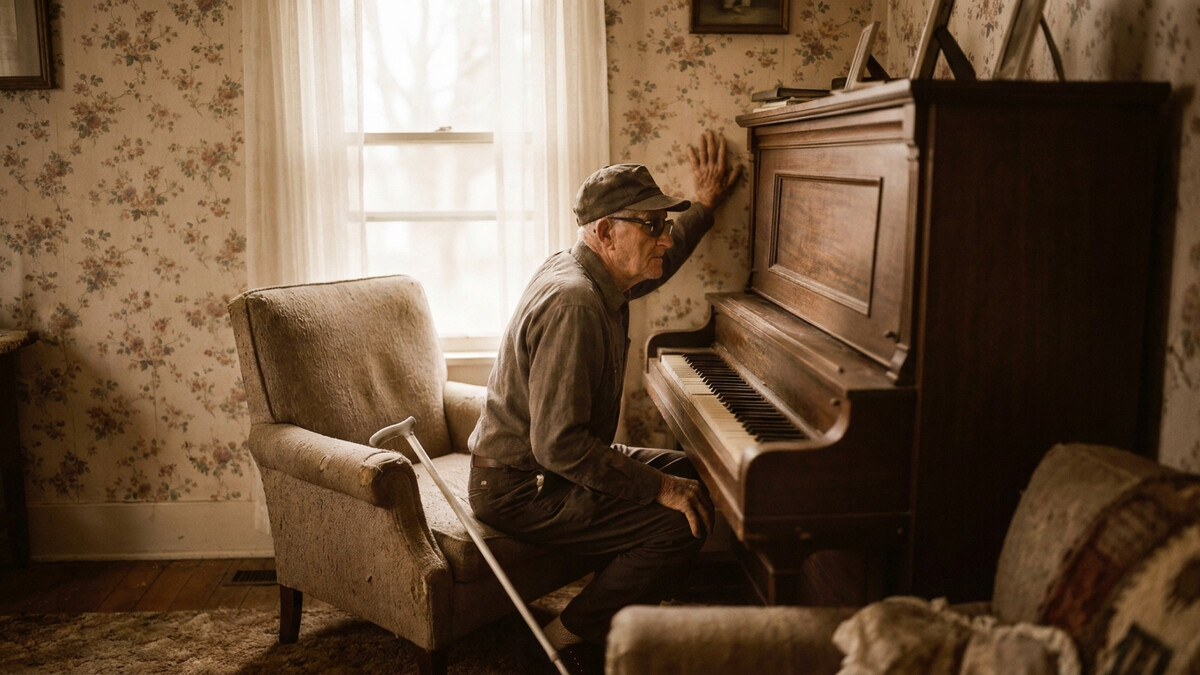
Lowell Pettibone had been blind since the day he was born, and he had tuned pianos in the farmhouses and churches of southern Missouri for fifty-one years, and in all that time he had never heard a wall sound the way the wall behind the old upright in the Carr farmhouse sounded on the first Thursday in November.
He was kneeling on the parlor floor with his tuning hammer in one hand and the other flat against the plaster, the way he always checked a wall before he started, to hear how the room would carry the sound.
He rapped it once with his knuckle.
Then again, a foot to the left.
Then he sat back on his heels and was very quiet for a long time.
"Mrs. Mercer," he said. "Would you mind coming here a minute?"
Lowell was seventy-four. He had learned to tune pianos at the Missouri School for the Blind in St. Louis in the 1960s, from an old German who could hear a string a hair out of true from across a room. He had been doing it ever since. Churches. Schools. Farmhouses. A hundred and twenty miles of Ozark back roads, driven by his wife until she died, and by his nephew since.
He could not see the pianos. He did not need to. He could hear everything about them. Their age. Their wood. Whether the soundboard was cracked. Whether the room was too damp. Whether a mouse had nested in the bass strings.
And he could hear walls.
Most people did not know that walls had voices. They did. Plaster on lath sounded one way. Plaster on brick another. A wall with a stud behind it sounded solid and short. A wall with nothing behind it sounded like a drum.
This wall, behind this piano, sounded like a drum.
The farmhouse belonged to a young couple, Jason and Amy Mercer, who had bought it in September from the estate of Ida Carr Willis's cousin. It sat at the end of a gravel road outside Bethel Springs, Missouri, a white two-story house built in 1908, with a front parlor and a wraparound porch.
The old upright piano had come with the house. It was too heavy to move, the realtor said, and too old to sell. It had been against the same parlor wall for at least sixty years. The Mercers had two little girls who wanted to take lessons, so they had called the only piano tuner left in the county.
The girls were sitting on the parlor stairs now, watching the blind man with the tuning hammer the way children watch a magician. Lowell could hear them whispering. He liked that. Children always listened better than grown-ups.
Amy Mercer came in from the kitchen, wiping her hands.
"Is something wrong with the piano, Mr. Pettibone?"
"The piano's fine," Lowell said. "It's a 1912 Kimball. Good bones. It needs a lot of work, but it's fine." He rapped the wall again. "It's this wall. There's something behind it."
"Behind it?"
"It's hollow," Lowell said. "Right here. A space about so big." He held his hands apart, two feet wide. "But everywhere else on this wall is solid. Plaster on lath on studs. I can hear the studs every sixteen inches. And then right here, behind where the piano sits, there's an empty space between two of them. And somebody's put a board over it."
He rapped it once more, gently.
"And there's something in it," he said. "When I knock, something shifts. Something soft. Like cloth."
Jason Mercer came in from the barn. He and Amy pulled the old upright away from the wall. It took both of them and a long time. It had not been moved in decades, and its casters had sunk into the floorboards.
Behind it, the wallpaper was a different color. A faded green with roses, from some long-ago decade, protected from the light.
And in the middle of the patch, low to the floor, there was a square seam in the plaster. Neat. Almost invisible. A panel, about two feet square, painted and papered over to match.
Lowell could not see it. But he heard Amy catch her breath.
"There's a little door," she said.
Jason got a putty knife and worked it around the seam. The old paint cracked. The wallpaper tore. The panel came loose all at once, and he pulled it away.
Behind it was a small, dark space between two studs, about a foot deep.
Amy shone her phone flashlight into it.
"There's a bag," she said. "A canvas bag. Like a bank bag."
"Don't pull it out yet," Lowell said quietly. "Tell me what it says."
Amy bent closer.
"It's stamped," she said slowly. "On the front. In black ink. It's faded. Bethel Springs Methodist Church. Building Fund." She paused. "And there's a tag tied to the drawstring. With a date."
"What date?"
"December 23, 1962."
Lowell Pettibone sat back on his heels on the parlor floor.
He knew that date. Every Methodist in that end of the county over the age of seventy knew that date. He had been ten years old, sitting in a pew at Bethel Springs Methodist Church, the Sunday the preacher stood up and told the congregation that the organ fund was gone.
Eighteen hundred and forty dollars. Six years of bake sales and pie suppers and pennies from the Sunday school.
And the woman they had blamed for it had lived in this house.