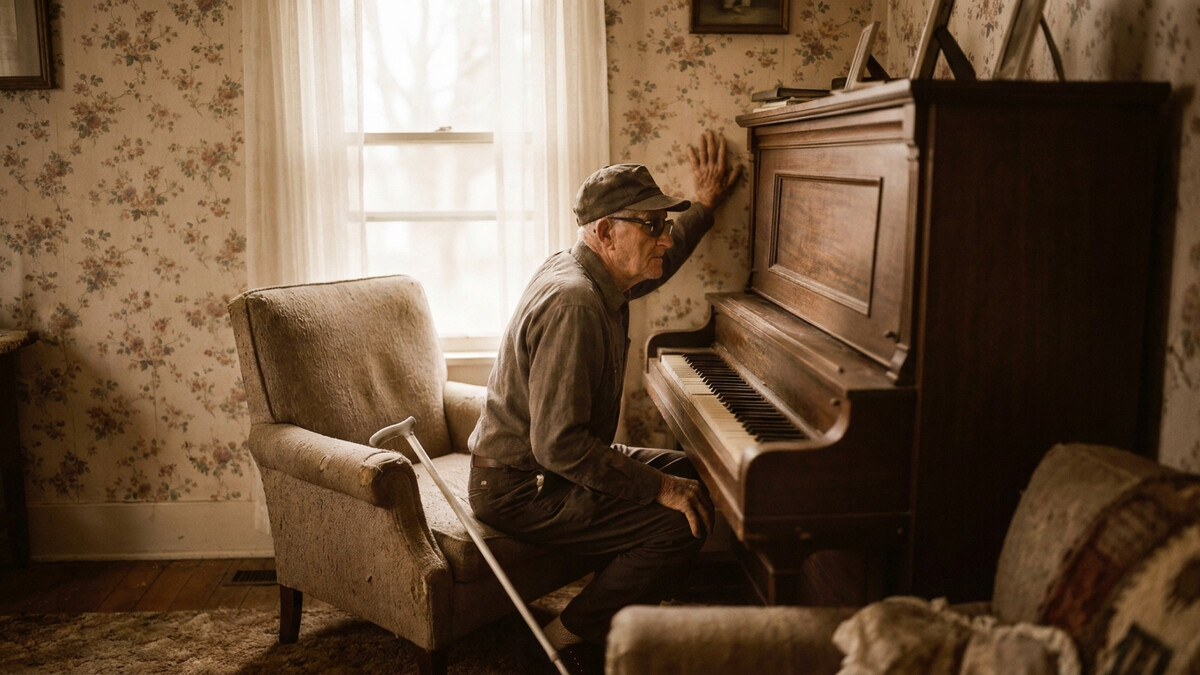
Her name was Lavina Carr.
Lowell remembered her the way blind people remember: by her voice, and her footsteps, and her hands. She had been the church treasurer for twenty years. She had a soft, low voice and a quick, firm step. She played the old pump organ at Bethel Springs Methodist every Sunday, and she played it beautifully, though it wheezed. When he was a little boy, she used to let him sit beside her on the organ bench and feel the keys move under his fingers.
She was the one who had started the fund for a new organ. In 1956.
By December of 1962, it had eighteen hundred and forty dollars in it. The plan was to order the new organ from Kansas City after Christmas.
Lavina kept the fund money at home. She was supposed to take it to the bank in West Plains on the Monday after Christmas.
On the night of December 23, 1962, she had a stroke.
"I remember," said Ida Carr Willis.
She was ninety. Lavina's only daughter. She lived in a small house in Bethel Springs behind the post office, and she had come out to the farmhouse that afternoon with her grandson as soon as Amy Mercer called.
She sat in a kitchen chair in the parlor, with her cane across her knees, and looked at the canvas bag on the floor in front of her. She had not touched it. She was not sure she could.
"I was twenty-six," she said. "Married and living in town. Daddy called me at five in the morning on Christmas Eve. He said, Mama's had a spell. Come quick." Her voice was shaking. "She was in bed. Her right side wouldn't move. She couldn't talk. She could only make sounds."
Lavina Carr had lived for eleven more years after the stroke. She never spoke a clear word again.
And on the Sunday after Christmas, when the preacher came to the house to pick up the organ fund to take to the bank, it was not there. Not in the strongbox in the bedroom closet where she always kept it. Not in the desk. Not anywhere.
"Daddy tore the house apart," Ida said. "For a week. Every drawer. Every closet. The attic. The barn. He never found it."
"And the church?" Amy asked gently.
Ida looked down at her hands.
"There were some who said she'd spent it," she said. "Or given it away. Or that Daddy had taken it. There were some who said worse." Her mouth tightened. "Not one of them said it to her face. They didn't have to. She couldn't answer anyway."
Lowell Pettibone had been listening, sitting on the piano bench with his hands in his lap.
"Mrs. Willis," he said. "After the stroke. Could your mother move at all?"
"Her left hand," Ida said. "A little. Not much."
"Did she ever try to tell you anything? With that hand?"
Ida Carr Willis was quiet for a long time.
Then she began to cry. Quietly, the way very old people cry, without making much sound.
"She pointed," she said. "At the piano. Every day. For eleven years. Whenever anybody came in the parlor, she'd make that sound, and she'd point her left hand at the piano. Over and over. We thought..." She stopped. She pressed her hand against her mouth. "We thought she wanted music. We thought she missed playing. So we'd play for her. Hymns. Every Sunday afternoon. My boys took lessons on that piano so they could play for their grandmother. We thought it made her happy."
She looked at the little dark space in the wall.
"She was trying to tell us," she said. "For eleven years. She was pointing at the wall behind it."
The parlor was very quiet.
"Why would she hide it there?" Jason Mercer asked finally. "If she was going to the bank on Monday?"
Ida wiped her eyes.
"Because of my brother," she said. "Ronnie. He was nineteen that winter. He'd gotten in with a bad crowd in West Plains. He'd been taking money out of Daddy's wallet. Mama knew. She never told Daddy. She just started hiding things." She looked at the canvas bag. "Daddy must have built that little cupboard when he built the parlor. Years before. For valuables. Mama would have known about it. She'd have put the church money there, behind the piano, where Ronnie would never think to look. Just for the weekend."
"And then she had the stroke," Lowell said quietly.
"And then she had the stroke," Ida said. "And Daddy pushed the piano back against the wall after he searched the parlor. And it never moved again."
They opened the bag at the kitchen table, Ida's grandson and Jason Mercer together, while Ida watched.
Inside were rubber-banded stacks of old bills. Tens and fives and ones, faded and soft. A roll of quarters in brown paper. A small spiral notebook in Lavina Carr's neat, careful handwriting, with every bake sale and pie supper since 1956, and every donation, down to the penny.
The last line said: Dec. 22, 1962. Total. $1,840.00.
Jason counted the money twice.
It was all there.
The preacher at Bethel Springs Methodist Church was a young woman named Rachel Dunlap, who had been there three years. On the second Sunday in November, she asked Ida Carr Willis to come forward during the service.
The church was full. Word had gotten around.
Rachel told the story from the pulpit. All of it. The organ fund. The stroke. The eleven years of pointing. The blind piano tuner who heard a hollow wall.
Then she held up the old canvas bag.
"For sixty-four years," she said, "some people in this congregation believed that Lavina Carr took what belonged to this church." She paused. "She never took a penny. She kept every one. She just couldn't tell us where."
Then an old man in the third pew, ninety-one years old, stood up slowly with his cane. His name was Howard Bass. He had been on the church board in 1962.
"I was one of them," he said, in a shaking voice. "I said things about Lavina I've been ashamed of my whole life." He turned toward the front pew, where Ida was sitting. "Ida, I'm sorry. I'm sorry to you and to your mother."
Ida Carr Willis nodded. She could not speak.
The eighteen hundred and forty dollars in 1962 bills were worth a good deal more than eighteen hundred and forty dollars to a coin and currency dealer in Springfield. Enough, it turned out, along with a second collection taken that Sunday, to have the old upright piano from the Carr farmhouse fully restored.
The Mercers donated it to the church.
Lowell Pettibone did the work himself, over the winter, in the church fellowship hall, with his nephew's help. New hammers. New strings. A cracked soundboard repaired by feel. When he was done, it sounded the way it must have sounded in 1912.
It sits now in the front of the sanctuary at Bethel Springs Methodist, beside the old pump organ. There is a small brass plate on the lid.
The Lavina Carr Piano. She kept it all.
On the first Sunday in March, Ida Carr Willis, ninety years old, sat down on the bench of her mother's piano for the first time in sixty years.
Her fingers were stiff. Her eyes were not good anymore.
But she played the first hymn of the service. The one her mother had played on the pump organ every Easter of Ida's childhood.
Lowell Pettibone sat in the front pew with his white cane across his knees and listened.
Every note was true.