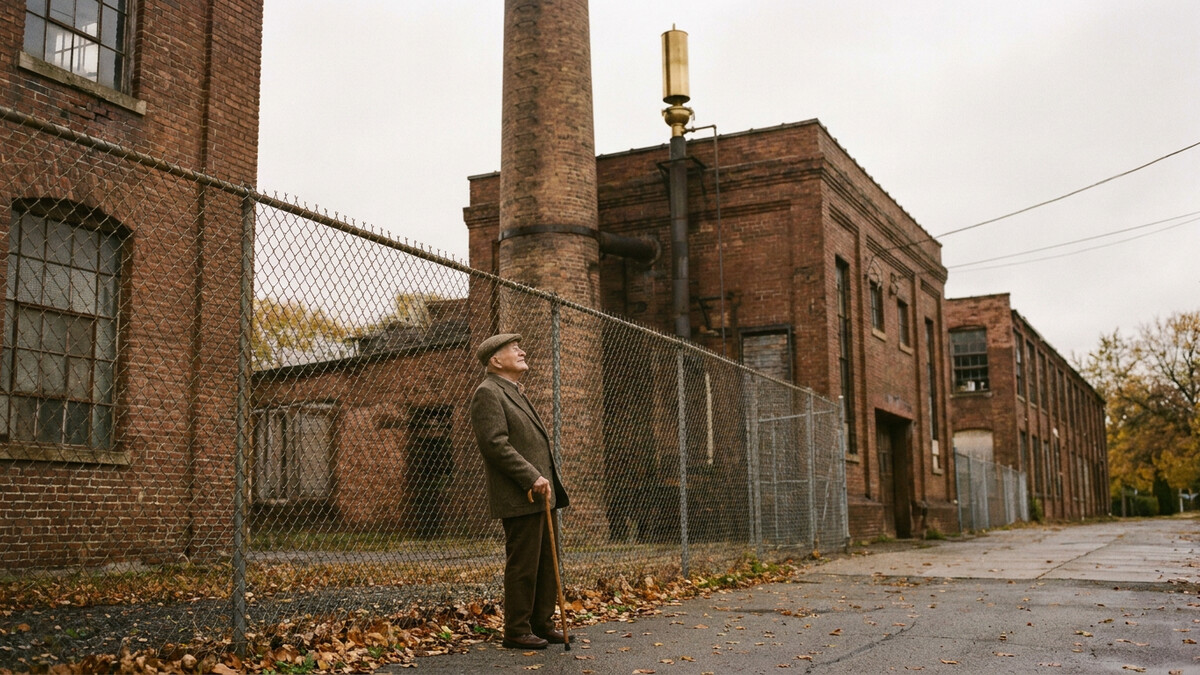
On October 18, 1985, the last day the Dumont Shoe Company ever ran in Riverbend Falls, Maine, eight workers from the stitching room sat in a booth at Gagnon's Diner after the final shift and made a pact, and forty-one years later, Armand Pelletier was the only one of them left to keep it.
He read about the demolition in the newspaper on a Tuesday morning in October, at his kitchen table, with his coffee.
DUMONT MILL TO COME DOWN FRIDAY. RIVERFRONT APARTMENTS PLANNED.
Armand put down his cup.
He was eighty-eight years old. He had promised seven people a long time ago. And he had three days.
For ninety years, the Dumont Shoe Company had been Riverbend Falls.
It was a long brick mill on the river, five stories high, with a tall brick boiler house at one end and a smokestack that you could see from every street in town. At its peak, in the 1950s, it employed eleven hundred people.
Most of the workers were French Canadian, like Armand's family. They had come down from Quebec in the 1890s to work in the mills. They lived in the triple-decker houses on the hill above the river and went to Mass at St. Anne's and spoke French at home.
And every day at seven in the morning, at noon, and at three-thirty in the afternoon, the steam whistle on the roof of the Dumont boiler house blew.
You could hear it all over town. Two long notes and a short one. Children set their watches by it. Women started supper by it. When Armand was a boy, his mother used to say, Armand, when the Dumont whistle blows at three-thirty, your father is coming home.
Armand had gone to work in the stitching room in 1955, at seventeen. He sewed uppers on a big black Singer machine for thirty years. So had his father. So had his wife, Thérèse, until her eyes went bad.
He had been forty-seven when the mill closed.
It closed the way so many mills in New England closed in those years. Shoes could be made cheaper overseas. The orders dried up. The shifts got shorter. And on a Friday in October of 1985, the foreman called the whole mill to the shipping floor and read a letter from the owners in Boston.
At three-thirty that afternoon, the whistle blew for the last time.
There were eight of them in the stitching room who had worked side by side for the longest. Twenty, twenty-five, thirty years.
Armand Pelletier. Lucien Gagnon, whose brother owned the diner. Roger Thibodeau. Yvette Ouellette. Norm Levesque. Marie-Claire Dubé. Bert Cyr. And Jeannine Roy, who was the youngest, only thirty-one, with three little boys at home.
After the last whistle, they had walked out of the mill together and down Front Street to Gagnon's Diner and squeezed into the big corner booth. Lucien's brother brought them coffee and pie.
Then Roger Thibodeau, who was the oldest, said something they never forgot.
"They're going to tear it down someday," he said. "Maybe not this year. Maybe not for a long time. But someday. And when they do, somebody ought to blow that whistle one more time. For the shift that never came back."
They looked at each other across the booth.
"Whoever's last," Roger said. "Whoever's still around when they tear it down. That one blows the whistle. At three-thirty. And says our names."
They put their hands in the middle of the table, all eight of them, the way children do.
"Promise," Jeannine Roy said.
"Promise," the others said.
For forty-one years, they met at Gagnon's Diner every October 18.
At first, all eight of them. Then seven, when Roger died in 1994. Then six. Then five. Every few years, one fewer. They sat in the same corner booth. They ate pie. They told the same old stories.
And at the end, every year, one of them would say: "Still standing?"
And somebody would look out the diner window at the old brick mill on the river, empty now, with its windows broken and pigeons in the boiler house.
"Still standing," they'd say.
In April of this year, Jeannine Roy died. She was seventy-two.
Armand went to the funeral at St. Anne's. He sat in the back. He was eighty-eight, and he was the last.
On October 18, he went to Gagnon's Diner alone. It was owned by Lucien's grandniece now. She knew him. She brought him coffee and a slice of blueberry pie and sat with him in the corner booth for a while, because she did not want him to sit there by himself.
"Still standing?" she said gently, at the end, because she had heard them say it every year since she was a little girl.
Armand looked out the window.
"Still standing," he said.
Four days later, he read the newspaper.
The Dumont boiler house was the first building scheduled to come down. Friday morning. The whistle was still on its roof. Armand could see it from Front Street. A tall brass steam whistle, green with age, on a pipe sticking up from the roof beside the smokestack, seventy feet in the air.
He went down to the mill on Wednesday.
There was a chain-link fence around the whole property now, with signs. DEMOLITION ZONE. KEEP OUT. There were trailers and bulldozers and a big yellow excavator with a claw.
Armand stood at the fence with his cane for a long time.
Then he walked to the gate and asked for whoever was in charge.
The site manager was a polite young man from Portland in a white hard hat. He listened to Armand's whole story. The stitching room. The eight of them. The booth at Gagnon's. The promise.
When Armand finished, the young man was quiet for a moment.
"Mr. Pelletier," he said. "I'm sorry. I really am. But the whistle's seventy feet up on a roof that isn't safe to stand on. Half the boiler house floor is rotted through. Our insurance won't let anybody up there. Not even my own crew." He shook his head. "And there's no steam. There hasn't been steam in that building for forty-one years. Even if we got the whistle down, it wouldn't blow."
"I understand," Armand said.
"The building comes down Friday at nine a.m.," the young man said. "I'm sorry."
Armand nodded. He walked back out through the gate.
He stood on the sidewalk outside the chain-link fence, eighty-eight years old, with his cane, and looked up at the old brass whistle on the roof of the boiler house, green and silent against the gray October sky.
Then a voice behind him said, "Mr. Pelletier?"
He turned around.
A big young man in a dusty orange safety vest was standing on the other side of the fence. He had just come off the excavator. He was in his thirties, with a beard and a hard hat pushed back on his head.
He had the same wide gray eyes as Jeannine Roy.
"Mr. Pelletier," he said. "I'm Nick Roy. Jeannine was my grandmother." He swallowed. "She told me about the whistle."