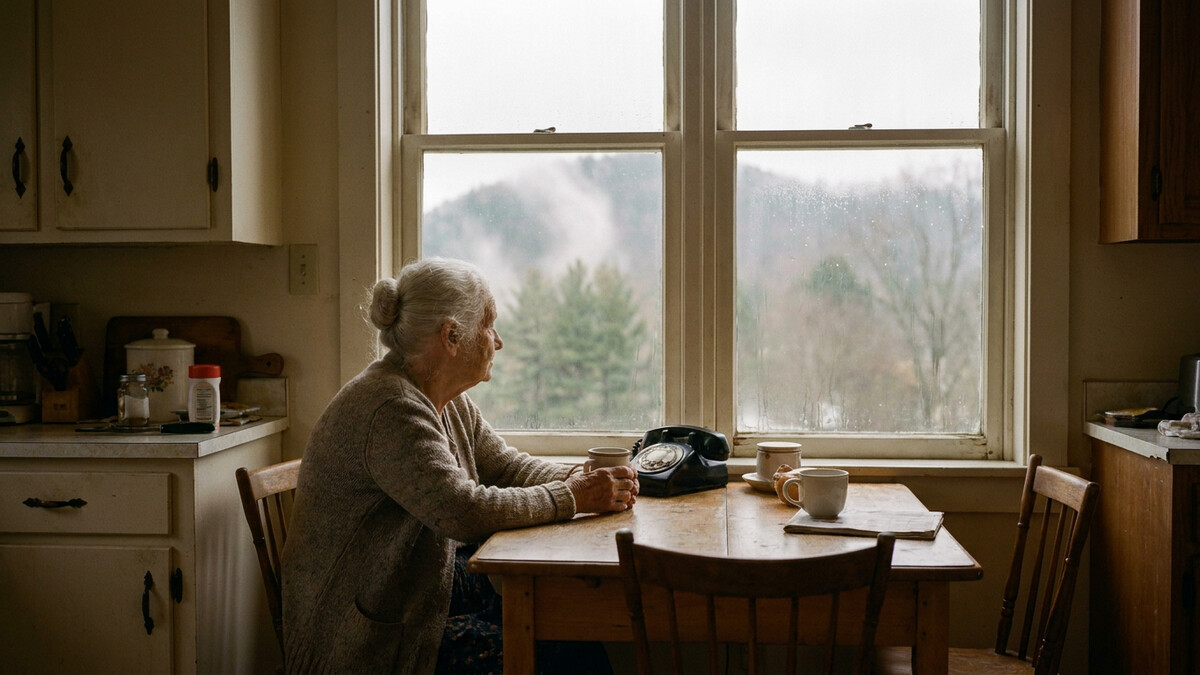
When the Cane Fork Courier announced that the county would put up a bronze plaque honoring the mine superintendent who had "saved the town of Cane Fork, Kentucky, from the dam break of 1955," Ludie Mae Sizemore's granddaughter read it to her out loud at the breakfast table, and Ludie set down her coffee cup and said, very quietly, "That's not how it was."
She was eighty-eight. She had never said a word about the dam in seventy-one years.
Her granddaughter, Brooke, looked up from the newspaper.
"Granny," she said. "What do you mean?"
Ludie looked out the kitchen window at the ridge across the hollow, where the morning fog was lifting off the trees.
"I mean I wasn't supposed to be listening," she said.
In 1955, Cane Fork was a coal camp of about four hundred people, strung along a narrow hollow in the mountains of eastern Kentucky. Two rows of company houses along the creek. A company store. A church. A school.
And above all of it, at the head of the hollow, an old earthen dam.
The railroad had built it in 1923, to hold water for the steam engines. When the railroad switched to diesel, the coal company took it over. It was eighty feet high and made of packed dirt and rock, and it held back a lake half a mile long. The whole town lived in its shadow and did not think about it, the way people do not think about a mountain.
Ludie was seventeen that year. She was the night operator at the Cane Fork telephone exchange.
The exchange was a switchboard in the front room of her Aunt Dovie's house, at the bottom of the hollow, by the post office. It served about ninety telephones. Most of them were on party lines, eight or ten houses sharing one wire, each house with its own ring. Two shorts and a long. One long and three shorts.
Ludie worked from ten at night until six in the morning. Most nights, nothing happened. She did her homework. She read movie magazines. She answered the occasional call from the doctor or the mine.
And she was not, under any circumstances, ever, supposed to listen in.
"Aunt Dovie told me the first night," Ludie said at the breakfast table. "A good operator never listens. She connects the call and takes her key out and minds her own business. If the company ever found out you listened, you were done."
"Did you listen?" Brooke asked.
Ludie almost smiled.
"I was seventeen," she said. "In a coal camp. At two in the morning. Of course I listened."
On the night of March 18, 1955, it had rained for four days.
Ludie could hear it on the tin roof of Aunt Dovie's front porch. Hard, steady, cold spring rain. The creek outside was running high and brown. There had been talk at the company store all week about the dam.
At one-forty in the morning, a light came on at the switchboard.
It was the dam watchman's house. Elvin Pratt and his wife, Ora, lived in a little shack on top of the dam, and Elvin walked it every two hours, all night, with a lantern.
Ludie plugged in.
"Number please."
It was Ora Pratt. Her voice was tight and shaking. "Get me the superintendent's house. Mr. Boggs. Quick, honey."
Ludie rang the superintendent's house. Three longs. She heard him pick up, sleepy and gruff. She heard Ora say, Elvin needs to talk to you, Mr. Boggs.
Then Ludie should have taken out her key.
She did not.
"I'll never forget it," Ludie said. Her old hands were flat on the kitchen table. "I can hear it right now. Elvin Pratt's voice. He'd been out on the dam with his lantern. He said, Mr. Boggs, she's weeping. On the downstream face. About two-thirds of the way down. Muddy water coming out of the dirt. And it's getting bigger. I can hear it running."
Brooke did not say anything.
"I didn't know what that meant," Ludie said. "Weeping. But I could hear in his voice that it was bad."
"What did the superintendent say?"
Ludie was quiet for a moment.
"He said, Elvin, that dam's held thirty years. It's a little seepage. Go back to bed. I'll send a crew up at daylight." She shook her head. "And Elvin said, Mr. Boggs, I don't think we've got till daylight. And Mr. Boggs said, I'm not going to wake up four hundred people in the middle of the night and have them standing in the rain on the ridge over some mud. You'll start a panic. Daylight, Elvin. That's final."
"Then he hung up," Ludie said.
"And Elvin?"
"Elvin stayed on the line. I could hear him breathing. And then I heard Ora in the background say, Elvin, what are we going to do. And he said, I don't know. I don't know. He's the boss."
Ludie looked down at her hands.
"And then he hung up too," she said. "And I was sitting there at that switchboard with my headset on, seventeen years old, in my aunt's front room, at a quarter to two in the morning. With the rain on the roof. And I knew what I'd heard."
She had sat there for five minutes. Maybe ten.
She knew what would happen if she did anything. She would be fired. Aunt Dovie would be fired. The company owned the telephone lines. The company owned the houses. The company owned Aunt Dovie's house. A seventeen-year-old girl who listened in on the mine superintendent and then went against him would be lucky if her family was not put out of the hollow by the end of the week.
And she might be wrong. Mr. Boggs might be right. It might just be a little mud.
She looked at the switchboard.
On the far right side, separate from all the others, was one key that Aunt Dovie had told her about on the very first night, and told her she would never, ever use.
The general ring.
It rang every telephone on every party line in Cane Fork, all at once. One long ring that did not stop. It was only for one thing. On party lines all over the mountains, folks knew what it meant. A long ring that would not stop meant fire, or flood, or death.
It meant get up. Get out. Now.
At one fifty-two in the morning, Ludie Mae Sizemore put her hand on that key.