Nadine carried the trunk down from the attic herself. Her brother helped with the last flight of stairs, grumbling about his back.
That night, she laid the three things out on her kitchen table. The empty bank bag. The clipping.
The ledger. She sat looking at them under the lamp until after midnight.
Then she called her brother.
"Dwight," she said. "Grandpa really did it."
There was a long silence on the line.
"Nadine," Dwight said finally, "it's a family story. It's a joke. Grandpa was a saint, and he's been dead almost fifty years. Leave it alone."
"He wrote I never paid it back," Nadine said. "In March of 1978. Two months before he died. That's not a joke, Dwight. That's a man who was sorry."
"So what do you want to do? Put it in the paper? Tell the whole county our grandfather was a thief?"
Nadine looked at the ledger on the table. At the careful, square, eighth-grade handwriting. At forty-one families.
"I want to balance the book," she said.
She'd been a bookkeeper for thirty-eight years. She knew what to do with an account that didn't close.
The first thing she did was find out who the money belonged to. That took most of September.
The Cedar Fork Bank & Trust had survived the Depression, barely. It had been bought in 1951 by a larger bank in Charleston, which had been bought by a larger bank in Pittsburgh, which had been bought by a bank so large that when Nadine called its customer service line, the young man on the phone had never heard of West Virginia.
So she went to the old bank building instead.
It still stood on Main Street in Cedar Fork, red brick with a stone arch over the door and CEDAR FORK BANK & TRUST 1902 carved over the arch. Since 1988, it had been the home of the Cedar Fork Community Credit Union.
The old vault was still in the back. They kept the coin machine in it.
The manager listened to Nadine politely for about two minutes. Then she put down her pen and went and got the chairman of the board.
The chairman of the board was a woman named Lynette Doss Miller. She was sixty-nine, small and sharp, with white hair and pearls.
She read the clipping. She read the ledger, every page, without saying a word.
When she was finished, she took off her reading glasses and set them on the table.
"Harlan Doss was my great-grandfather," she said. "The bank president."
Nadine's stomach dropped. "I'm so sorry. I didn't know."
"Don't be sorry." Lynette tapped the clipping, where Harlan Doss had called the robbery a cowardly act against the honest people of the county. "My grandmother used to say her grandfather foreclosed on half this county and never lost a night's sleep over it. He bought two of those farms himself at the auction in 1934. For eighty dollars apiece." She was quiet for a moment. "Your grandfather saved four of them."
She looked at the ledger again.
"Mrs. Hively," she said, "what is it you want to do?"
"Pay it back," Nadine said. "With interest. To somebody. It's the only way to close the account."
It wasn't simple. The credit union wasn't the bank.
It couldn't legally accept repayment for a 1933 robbery of a bank that had been gone for seventy-five years. Its lawyer said so in a two-page letter.
But Lynette Doss Miller came back to Nadine with an idea.
"Pay it," she said, "and we'll give it away. Every cent. To the county food pantry, in your grandfather's name. And the credit union will match it." She smiled a little. "My great-grandfather took food off those tables. It's about time this building put some back."
Nadine did the math that night at her kitchen table, in pencil, the way she did everything. In today's dollars, $1,840 from 1933 came to a little over forty-five thousand dollars.
She didn't have forty-five thousand dollars.
So she wrote a letter. One page, typed, with a photocopy of the ledger's first and last pages.
She mailed it to every living grandchild and great-grandchild of Walter James Starcher. There were twenty-six of them, in nine states.
She told them the truth. All of it.
Dwight sent the first check. It was for five thousand dollars.
Under the amount, in the memo line, he'd written: For Grandpa. You were right, Sis.
In seven weeks, they'd raised forty-five thousand, three hundred and twelve dollars.
The ceremony was held in the old bank lobby on the Saturday before Christmas, ninety-four years to the week after Walter Starcher let himself in with his janitor's key.
Nadine had expected maybe thirty people. More than two hundred came.
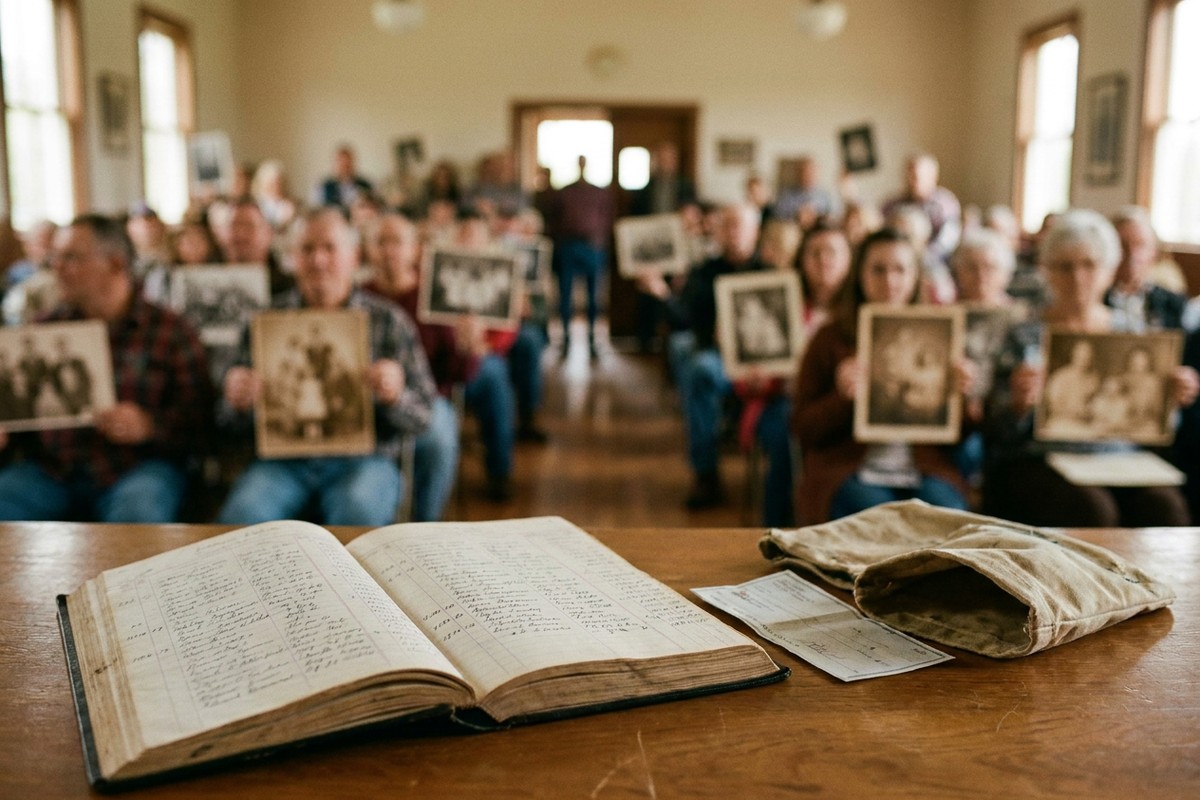
The Sentinel had run the story in November. It had run the list of names, too, with Nadine's permission. And from all over the county and three states beyond, the grandchildren and great-grandchildren of those forty-one families had come, carrying old photographs in frames and in shoeboxes and on their phones.
A man in his eighties, a Hollins, held up a picture of seven children on a porch in 1934, all of them wearing new shoes. A woman from Ohio brought her great-grandmother's Bible, with a note tucked inside it: Walter brought the milk cow. A family named Bragg came from the farm on Painter Creek that had been on the 1933 auction list and was still theirs, four generations later.
Nadine stood at a table in the middle of the lobby. On it, she'd laid her grandfather's ledger, open to the first page. Beside it was the empty canvas bank bag.
And beside that, a check for forty-five thousand, three hundred and twelve dollars, made out to the Cedar Fork County Food Pantry, signed by Nadine Starcher Hively and twenty-six of Walter's descendants. Lynette Doss Miller laid the credit union's matching check on top of it.
Then Nadine took a pen out of her purse. She turned the ledger to the last page, to the shaky line in ballpoint from March of 1978.
I never paid it back.
Underneath it, in her own careful bookkeeper's hand, she wrote: Paid in full. December 1933 to December 2027. Your family.
She closed the book. The room was very quiet.
Then the old Hollins man in the front row started to clap, holding his photograph against his chest with one hand. And the whole lobby of the Cedar Fork Bank & Trust clapped with him.