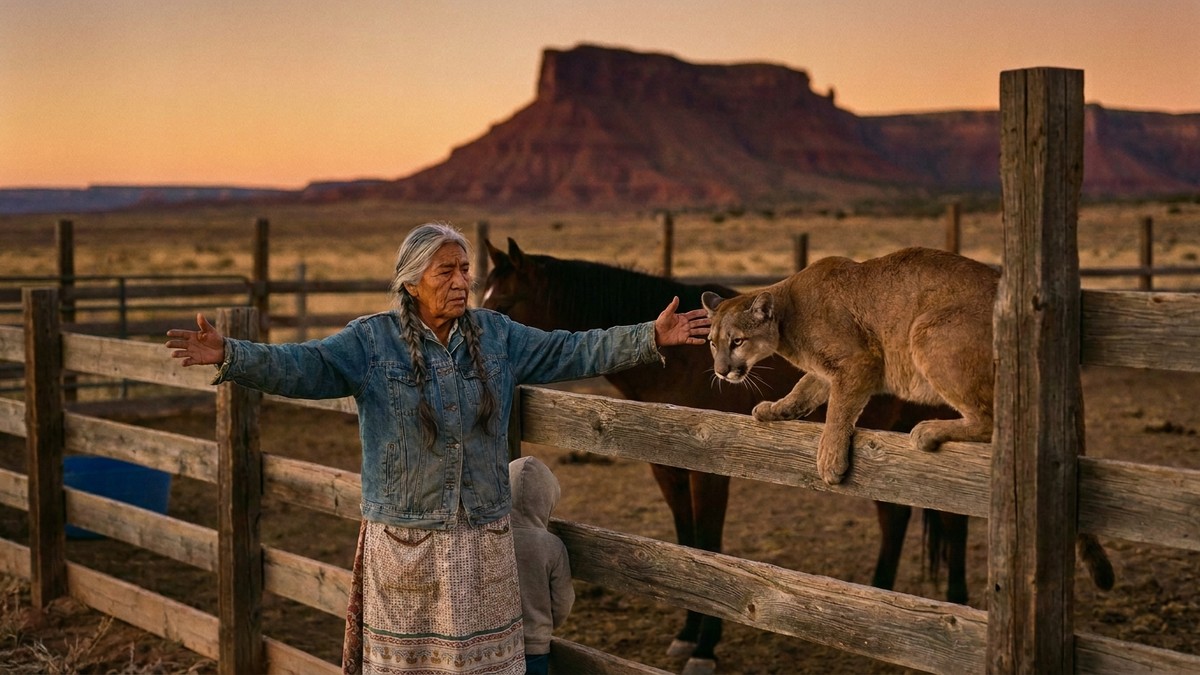
Josie Quintana had seen a lion on the ranch three times in fifty years, and the fourth time, it was watching her grandson.
The first time was 1979, the summer after she married Ramón. A tawny shape crossing the arroyo at dusk, long tail low, there and gone.
The second time was 1994, on the ridge above the stock tank, in the snow. The third time was 2011, a pair of green eyes in the headlights on the ranch road at midnight.
Each time, Ramón had said the same thing. They don't want us, Josefina.
They want deer. Leave them alone and they'll leave us alone.
For fifty years, that had been true.
Josie was seventy-eight. She'd lived on the ranch above the Rio Chama in northern New Mexico since she was thirty, two hundred acres of piñon and juniper and red rock, with a small adobe house, a barn, a corral, and a few dozen goats. Ramón's family had run sheep on that land since before New Mexico was a state.
Ramón had died in 2016. Her son lived in Albuquerque now, with his wife and two children, and worked for the state.
Every August, the grandchildren came to stay for a week. Sofia was eleven, and serious, and read books on the porch. Mateo was six, and fearless, and could not sit still for one minute of his life.
This year, the week they came, something had been killing the goats.
It had started in July. A young doe goat gone from the far pen one morning, the fence untouched.
Then two kids from the pasture along the arroyo. Then, on the Monday the grandchildren arrived, Josie had walked down to the arroyo at sunrise and found what was left of her best milk goat, Canela, under a juniper, half covered with dirt and pine needles.
Josie knew what did that. Only one animal buried its kill to come back for it later.
She called the state Game and Fish office in Chama that morning. A young officer named Lucero drove out in a green truck and walked the arroyo with her. He found tracks in the sand, four toes, no claws, as big as Josie's palm.
"It's a lion, Mrs. Quintana," he said. "A young male, probably. The drought's pushed the deer down out of the high country, and he followed them." He looked up at the ridge. "We'll set a trap. It might take a few days. In the meantime, keep the goats in the barn at night, keep the kids close to the house, and don't let anybody walk the arroyo alone at dusk."
Josie thanked him. She brought the goats in.
She told Sofia and Mateo the rules. Stay where Grandma can see you.
Never go past the corral. Never, ever go out at dusk by yourself.
Sofia nodded seriously. Mateo nodded too, the way six-year-olds nod at everything.
On Thursday evening, Josie was making tortillas.
It was hot in the little adobe kitchen, and the windows were open, and she was rolling the dough out on the old board Ramón's mother had used, the way she'd done every evening for fifty years. Sofia was reading on the porch. Mateo had been in the front room with a box of plastic dinosaurs.
The sun was going down behind the red mesa. The light outside had gone gold, then orange, then the soft dark blue of dusk.
Josie put the last tortilla on the comal and called over her shoulder, "Mateo, wash your hands for supper."
There was no answer.
She called again. Then she wiped her hands on her apron and went into the front room.
The plastic dinosaurs were on the floor in a line. The screen door to the side yard was standing open.
Josie's heart turned over.
"Sofia," she said, in a voice she didn't recognize. "Where's your brother?"
Sofia looked up from her book. Her face went white.
"He said he wanted to show the dinosaurs to the horse," she said.
Josie went out the screen door and around the corner of the house, fast, faster than she'd moved in years.
The corral was forty yards from the house, past the woodpile, a big circle of old cedar posts and rails Ramón had built in 1980. Their one old horse, a bay mare named Paloma, was standing at the far side of it with her head high and her ears pinned flat, blowing hard through her nose.
Mateo was standing at the gate. He had a plastic stegosaurus in one hand, and he was holding it up to show the horse.
He was looking at the horse. He wasn't looking at the fence.
Josie was.
On the top rail of the corral fence, twelve feet from the boy, something was crouched. Long and low and tawny, the color of the dry grass, with its belly flat against the wood and its long tail twitching slowly at the tip.
It was watching Mateo. It was watching him the way a cat watches a bird.
Josie stopped walking.
She thought, very clearly, of Ramón's rifle. It was in the closet in the bedroom, behind the winter coats, unloaded, with the shells on the top shelf. Forty yards behind her and two doors away.
There wasn't time. There wasn't anything in her hands but flour.
The lion's head turned. It looked at her. Then it looked back at the boy.
And its back legs shifted under it, slowly, the way a cat gathers itself to jump.