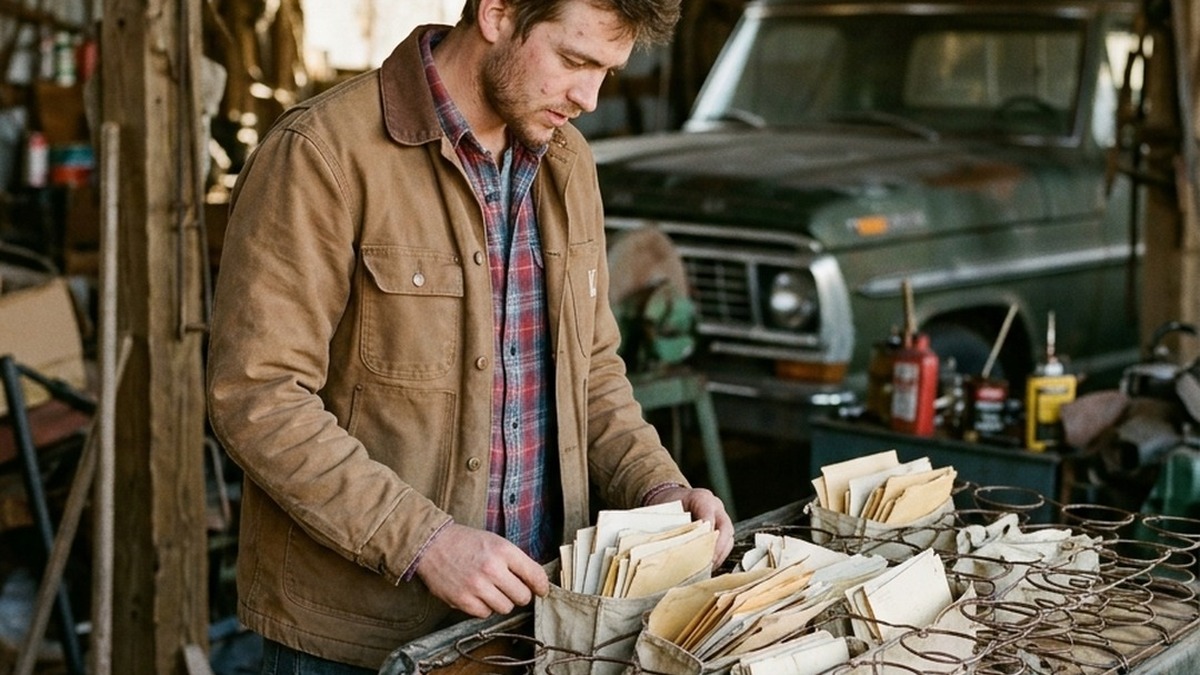
When Leland Pike slid the keys to the rusted 1972 Ford across the table, Wyatt's Uncle Brad laughed loud enough to rattle the window blinds.
"Come on, Leland," Brad said, leaning back in his chair. "Dad drove a county road grader for thirty-four years and farmed a quarter section of wheat, and Wyatt gets a pickup with primer spots and a split bench seat?"
Beside Brad, Aunt Trudy Mercer-Sloan snapped her purse shut. She had driven out from Overland Park that morning and checked her watch three times in twenty minutes.
"At least Wyatt gets a souvenir he can haul to the scrap scale," Trudy said with a thin smile. "Though I doubt the radiator holds enough antifreeze to reach the highway."
Wyatt Mercer sat at the end of the oak table with his hands folded. At twenty-three, his knuckles were stained from rebuilding gearboxes at the Colby co-op grain elevator, and his canvas jacket pocket sagged under a pair of steel hog-ring pliers.
Two weeks before Vernon died, eighty-one-year-old Vernon had called the elevator to ask if Wyatt was coming out Saturday morning to help re-cover the sagging bench seat of his green 1972 Ford F-100. Wyatt had worked a double shift repairing an auger at the co-op elevator and missed their Saturday job, telling his grandfather they would finish it next weekend.
On Tuesday morning, the rural mail carrier had found Vernon peaceful in his porch rocker with his boots laced.
Leland Pike, seventy-four, adjusted his bifocals and looked at Brad and Trudy.
"Under Article Four," Leland read at the Friday ten o'clock reading, "the Citizens State Bank checking account, totaling thirty-six thousand dollars, is divided equally between my son, Brad Mercer of Wichita, and my daughter, Trudy Mercer-Sloan of Overland Park."
Brad frowned at the bank statement. "Thirty-six grand total? Eighteen thousand apiece? Dad lived on oatmeal and garden tomatoes, Leland, so where did forty years of road-department pension and wheat checks go?"
"Your father kept no debt and managed his own affairs at Citizens State Bank," Leland replied evenly. "Under Article Five, to my grandson, Wyatt Mercer, I leave my 1972 Ford F-100, together with all tools, springs, and contents attached to or contained within its cab."
Brad snorted and nudged Trudy. "Don't spend all nine hundred dollars in one place, kid."
Leland slid the brass keys and the pink vehicle title Vernon had signed over across the blotter to Wyatt.
When Wyatt turned the pink title over, he saw a note written in Vernon's carpenter's pencil: *Finish the springs before you let anybody sit on your work. 9/16 socket.*
"Listen up, Wyatt," Brad said, standing and buttoning his coat. "I hired scrap dealer Clyde Harker to clear the machine shed and yard tomorrow morning, and the farm auction crew locks the gate at twelve noon sharp this Saturday."
"Grandpa's pickup is in the machine shed," Wyatt said quietly.
"Not past noon tomorrow," Brad said. "Every piece of iron still on the property at twelve noon Saturday goes onto Clyde's trailer, so if that junk heap won't crank, bring a tow rope."
Friday evening after his shift, Wyatt sat in his small garage with the hog-ring pliers in his hand.
Beside his toolbox lay the roll of forest-green marine vinyl and the burlap webbing Vernon had bought three weeks ago. Every time Wyatt touched the pliers in his pocket, he regretted the Saturday morning he hadn't shown up.
He had ridden on that bench seat beside his grandfather since he was six years old while the inline-six hummed down the section roads.
Every July after wheat harvest since 1972, Vernon had driven into the Citizens State Bank in his dusty boots and come out whistling, slapping the vinyl bench seat of the green 1972 F-100 and telling Wyatt the same words.
"A good bench seat holds a man up better than any bank vault in Topeka, son, so long as you grease the hog rings."
Wyatt had always smiled and figured the old grader operator was just proud of the pickup he had bought brand-new the summer Brad was born.
Over the last six winters, while Brad and Trudy never visited from Wichita and Overland Park, Wyatt had spent every weekend splitting Vernon's stove wood and keeping the Ford running.
Wyatt looked again at the pencil note on the back of the pink title.
*Finish the springs before you let anybody sit on your work. 9/16 socket.*
He packed his ratchet, a nine-sixteenths socket, a jumper box, and the roll of green vinyl into his canvas tool bag.
Saturday morning at nine-thirty, Wyatt turned into his grandfather's lane under a cold November wind.
Clyde Harker, sixty, had already backed his scrap trailer up to the machine shed and was pulling a steel winch cable toward the open bay while Brad stood by the fence and Trudy watched from her SUV.
Inside the shed sat the green 1972 F-100, its hood spotted with gray primer and its battery dead from the cold.
"Hold up, Clyde," Wyatt called, stepping out with his tool bag.
Brad walked over. "Save your breath, Wyatt. The battery is stone dead and it's sitting on estate ground, so Clyde is giving me six hundred dollars cash to winch it onto the scrap trailer right now before the noon gate lock."
Clyde held the steel winch hook by the front bumper. "Brad said it was abandoned estate iron, Wyatt."
"It's not estate iron," Wyatt said, stepping between the winch hook and the bumper and holding up the signed pink title. "My name is on the title, Clyde, and I have until twelve noon to move it."
Clyde checked the notarized title and dropped the hook onto the gravel. "He's right, Brad. I don't winch a titled truck with the owner standing in front of it. I'll load the harrow disks by the granary first."
Brad glared at his watch. "You have until twelve noon when the auction crew locks the gate, Wyatt."
While Clyde moved his trailer, Wyatt lifted the Ford's hood and clamped his jumper box to the battery terminals. He pulled the choke halfway out and turned the key.
The inline-six fired up on the second crank and settled into a steady rumble.
Wyatt aired up the low rear tire, backed the pickup into the machine shed out of the wind, and shut the engine off.
A broken spring wire poked through the torn vinyl of the bench seat. Remembering Vernon's pencil note, Wyatt pulled his ratchet and the nine-sixteenths socket from his bag and unbolted the four floor bolts holding the bench seat.
At eleven-twenty, he wrestled the heavy seat frame out the passenger door, flipped it upside down on two sawhorses, and froze: wired neatly between the zig-zag coil springs in heavy oiled canvas mail pouches were forty-two thick Treasury envelopes, just as Brad's shadow fell across the shed doorway.