Part 2
The captain hesitated. Then he nodded once.
Elias knelt in the mud in his irons. He did not touch the print. He bent over it with his face a foot from the ground, the way he bent over a horse's foot in the shoeing shed, and studied it.
"Well?" said Sutton. "What's he doing?"
"Reading," said First Sergeant Carter.
Elias raised his head.
"This is a near forefoot, sir," he said to the captain. "Shod. And the shoe is closed across the heel. That's a bar shoe. You see the line, here, straight across the back, where an open shoe would leave a gap." He pointed with both hands, because of the chain. "A bar shoe is for a horse with a cracked hoof. There are four hundred horses on this post, sir, and I shod every one of them. I have put exactly one bar shoe on a near fore since Christmas."
"Whose?" said the captain.
Elias looked at the lieutenant. He did not look away.
"Lieutenant Whitlow's gray gelding, sir. Thursday afternoon. For a quarter crack. The lieutenant was there."
Sutton's mouth fell open.
Then Lieutenant Whitlow laughed. It came out a little high.
"Captain, this is absurd. Any horse in Texas might wear a bar shoe."
"Then we'll follow it," the captain said slowly. "Corporal?"
Elias got up out of the mud. The guards walked with him, and the captain and Carter, and Sutton and the saloon men, and Lavinia last of all with the shirt over her arm. The prints went down the alley and out behind the courthouse and down the bank to Limpia Creek. Every few yards, in soft ground, the barred heel showed plain. Twice Elias stopped and pointed where the horse had stood a moment, its hind feet shifting.
At the creek the prints went into a stand of cottonwoods and stopped at a heap of driftwood under the cutbank.
"There, sir," Elias said. "He stood here long enough to make a hole in the ground with his feet."
Carter and one of the guards pulled away the driftwood.
Under it, wrapped in a canvas feed sack, was a black japanned cash box with its hasp broken.
Sutton made a sound like a man who has been kicked.
The captain opened the box on the cutbank. It was all there. Three hundred and forty dollars in paper and silver, and Sutton's daybook on top.
He stood up and looked at Lieutenant Whitlow.
Whitlow's face had gone the color of the paper. He did not try the fence again.
"I owe four hundred dollars to men in San Antonio who don't write letters, sir," he said, very low. "My father put me through West Point and told me never to come home owing a dime. I thought..." He stopped. "I thought no one would look past the corporal."
Lavinia saw Elias's jaw tighten. That was all. He said nothing.
"Mr. Carter," the captain said. "Take those irons off the corporal and put the lieutenant under arrest in quarters."
The irons came off with a small clink. Elias rubbed one wrist with the other hand and stood at attention in the mud, very straight, with the cottonwoods moving over him. Carter handed him back his forage cap. Elias put it on and squared it, carefully, as if he were standing inspection on the parade ground and not in a creek bottom with mud to his knees.
Orville Sutton came up the bank to him with his cash box under his arm.
His face worked. Then he put the box down on a rock, took off his hat, and held out his hand.
"Corporal Freeman," he said. "I said things about you in my store. I said them to the whole town. I'll unsay them the same way, in the same place, Saturday when the post is paid." He swallowed. "And your account at my store is good for whatever you like, as long as I'm in business."
Elias looked at the hand. Then he shook it, once, firmly, as he would have shaken any man's.
"I'd be obliged for the nails, Mr. Sutton," he said. "I never did get to use them."
Some of the soldiers who had drifted down to the creek laughed at that. Even Sutton did.
The captain came to Lavinia's house that afternoon himself, with his hat in his hand, which no captain had ever done.
He thanked her. He said the post would remember. He asked whether she would go on taking officers' laundry, after all this, and she said that shirts did not get dirty by themselves.
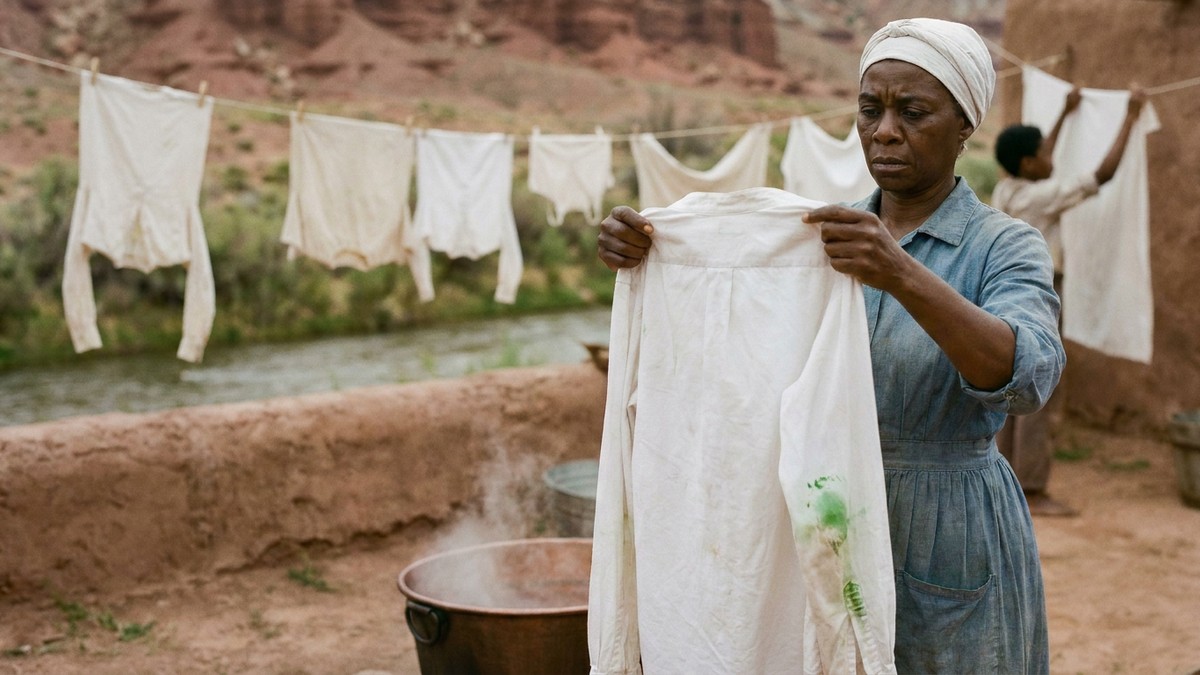
That evening, Lavinia boiled Lieutenant Whitlow's last four shirts in the copper tub. She took the green paint off the elbow with turpentine and soap, a little at a time, until it was gone. She starched the collar and pressed it.
On Wednesday morning she carried the bag up to the post herself and set it down on the step outside the room where the lieutenant was held.
"His shirts are clean," she told the sentry. "A man ought to have a clean shirt, whatever he's done."
Walking home, she passed the shoeing shed. Elias was there with the forge glowing, a horse's foot between his knees and a new paper of nails open on the bench. He looked up as she went by, and lifted his hammer to her, and went back to work.