Part 1
There were no pine trees anywhere near Hana Novák's sod house, so on December 20, 1886, she went out and caught a tumbleweed.
She lived in Bon Homme County, Dakota Territory, on the flat white prairie north of the Missouri River. The Nováks had come from Bohemia four years before. They had a soddy with one window, a team, a cow, three children, and a quarter section of land that the wind had been trying to carry off ever since.
The wind had brought the tumbleweeds too.
Nobody had seen them before the flax seed came from Russia. Now every autumn they broke loose and rolled across the country in their thousands, and piled up against every fence and wall, gray and prickly and hated. The Germans called it the Russian thistle. The Americans called it worse.
Hana walked the fence line between their claim and the Langes' and picked the roundest one she could find. It was taller than her youngest. It was nearly perfect. She carried it home by the stem at arm's length, while it scratched her wrists through her mittens.
"Mamo," said Anička, who was seven. "What is it for?"
"It is for Christmas."
Vašek, who was ten and very serious, looked at the tumbleweed on the floor of the soddy, and then at his mother.
"It is a weed," he said.
"Tonight it is a weed," Hana said. "Tomorrow, we will see."
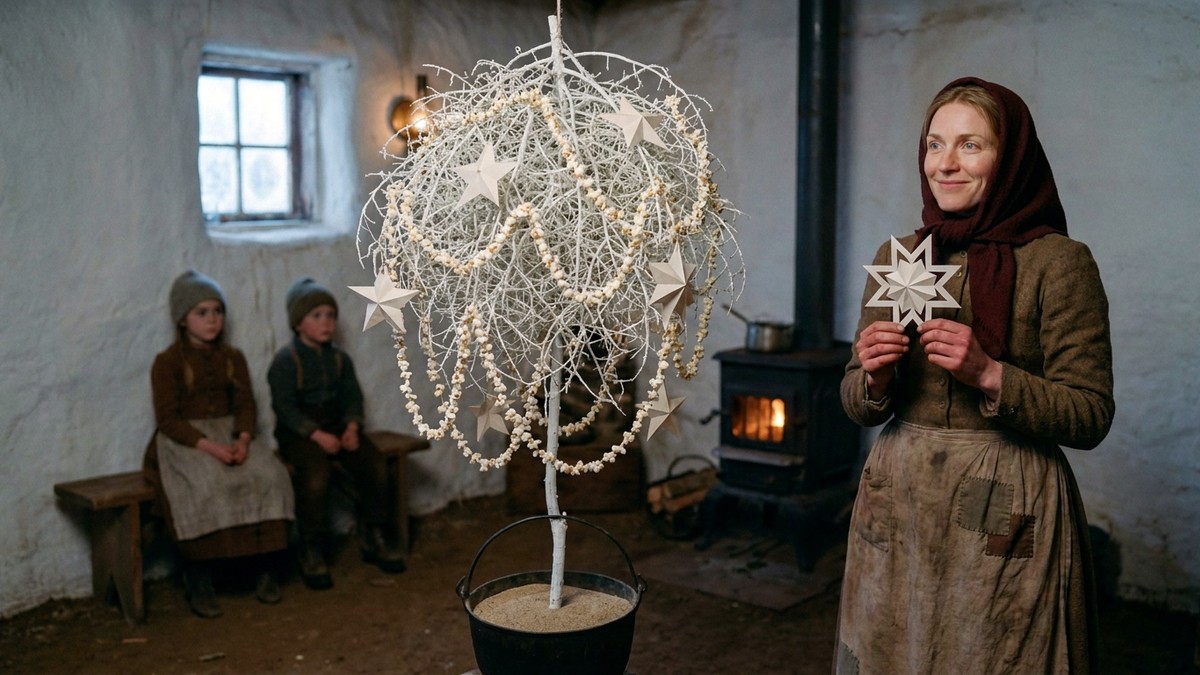
She set it in an iron kettle full of sand. She mixed lime and water in the washtub, the same whitewash they used every spring on the soddy walls, and she painted the tumbleweed white with a rag tied to a stick. Every branch. Every thorn. It took her all afternoon.
When it dried, it stood in the corner of the soddy like a little tree made of frost.
Every evening that week, after supper, they worked on it.
Hana popped corn in the iron skillet and the children strung it on thread with a darning needle. She cut stars from a sheet of brown paper and from the white paper the sugar had come in, folding and snipping as her mother had done in Bohemia, until each one opened into lace. Josef carved three tiny wooden birds and Hana dipped their tails in blueing.
There were no candles on it. Hana was firm about that. A dry thistle would go up like gunpowder.
"Candles go on the table," she said. "Where I can watch them."
On Thursday, Bertha Lange came over for the loan of a cup of salt.
Bertha was the nearest neighbor, a mile east, a big red-handed German woman with four children. She had laughed easily once. In November her baby had died of croup in a single night. Since then Hana had seen her twice, and she had not laughed at all.
She stopped in the doorway and stared at the white tumbleweed with its popcorn and its paper stars.
"Gott im Himmel," she said. "You have put the devil's weed in your house."
"It is a Christmas tree," said Hana.
"It is a weed." Bertha's mouth went tight. "My Heinrich spends all autumn burning those. They choke his fences. They took half his flax." She took the salt and turned to go. "In my house," she said over her shoulder, "there is no Christmas this year. I do not want it."
The door banged behind her and let in a gust of snow.
Hana stood very still by the stove. She had wanted to say something kind. What she said instead, to the closed door, in Czech, was not kind at all.
Vašek looked up from the popcorn. He had heard her.
The Lange children came over on Saturday. All four of them, walking the mile across the snow without their mother's leave. They stood in the doorway of the soddy with their noses running and their eyes huge.
Little Lotte Lange, who was six, walked straight to the white tree and stood in front of it with her mittens clasped.
"Is it real?" she whispered in German.
"Real enough," said Hana.
The Lange children stayed until dark. They came back on Sunday. On Monday Fritz, the oldest, brought a bit of red yarn and asked if he might hang it on a branch, and Hana said yes.
Josef shook his head at her over supper.
"Bertha will not like it," he said. "Her children here every day, with our weed."
"Her children need to be somewhere," Hana said, "where someone is not crying."
Christmas Eve came cold and clear.
In Bohemia nobody ate until the first star appeared in the sky. So all day Hana cooked and nobody ate. There was mushroom soup from dried mushrooms she had carried from home in a flour sack. There were dumplings. There was a fat catfish Josef had pulled through the ice of the Missouri. And on the table, as her mother had always done, Hana set one more plate than there were people in the house.
"For whoever comes in from the cold," she told Anička. "There is always one more place."
At four o'clock, with the sky going green in the west, the four Lange children were back in the soddy, sitting in a row on the bench under the white tree.
At half past four the door banged open without a knock.
Bertha Lange stood in the doorway with snow on her shawl and her face white and terrible. She did not look at Hana. She looked at her children, and then at the tumbleweed above them with Fritz's red yarn on it.
"Home," she said. "All of you. Now."
Lotte began to cry.
Bertha crossed the soddy in three strides, past the children, and seized the white tumbleweed by its trunk with her bare hand, thorns and all, to throw it out into the snow.