Part 2
"Bertha," Hana said. "Wait."
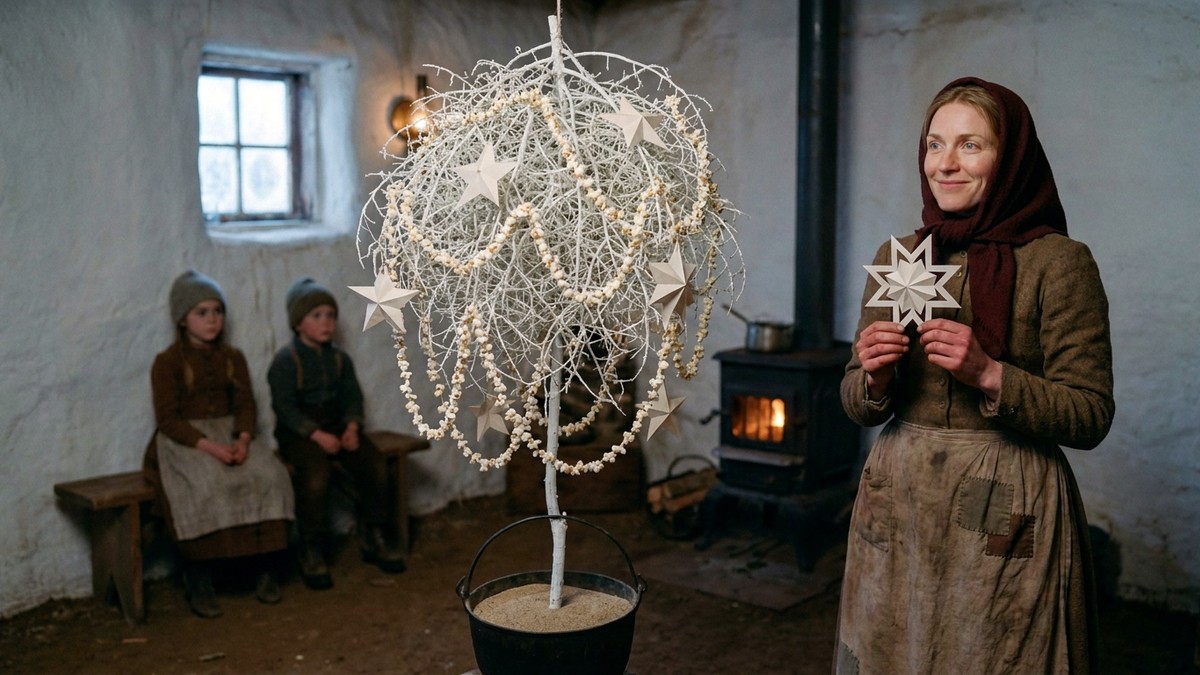
Bertha did not wait. She had the tumbleweed half out of its kettle. Sand spilled across the dirt floor. A paper star tore loose and drifted down.
Then she stopped, because her hand was bleeding.
The thorns had gone into her palm through the whitewash. She stood holding the tree in the air, with blood running between her fingers onto the white branches, and she looked at it as if she had never seen her own hand before.
"Mama," Lotte sobbed. "Mama, don't. Please don't."
Bertha let go.
The tumbleweed dropped back into its kettle and leaned there, crooked, with Fritz's red yarn swinging. Bertha sat down very suddenly on the end of the bench and put her bleeding hand in her lap, and she began to cry. She cried the way Hana had not heard a grown woman cry since the ship.
Nobody in the soddy moved. The children were frozen on the bench. Josef stood by the stove with the coffee pot in his hand. Even the baby in the cradle was quiet.
Hana went to the water bucket. She wet a clean cloth and knelt in front of Bertha on the dirt floor, and took the bleeding hand in both of hers, and began to pick out the thorns one at a time.
"I know," she said in German, very softly. "I know."
"You don't," Bertha said. "You don't know."
"No." Hana picked out another thorn. "Not that. But I know this house is warm, and your children are here, and there is soup."
Bertha's shoulders shook. When she could speak, she spoke to the floor.
"He would have been four months old today," she said. "Four months. And Heinrich says we must keep Christmas for the others, and I cannot. I cannot. I cannot look at a tree." She lifted her face. "And then you put up the weed. The weed that took our flax. And my children love it. They would rather sit under your weed than in my house."
Hana wrapped the cloth around her hand and tied it.
"Bertha," she said. "Do you know where I found it?"
Bertha shook her head.
"On the fence line between your place and ours. On your side." Hana almost smiled. "So it is your weed. It grew on your land. I only painted it."
Bertha stared at her. Then she looked up at the crooked white tumbleweed, with its popcorn and its paper stars and its three blue-tailed birds, and something in her face gave way.
It was not quite a laugh. But it was close.
"Mamo," said Anička from the window. "The star."
Everyone turned.
In the green-black sky over the snow, low in the west, one star had come out. Then, as they watched, another.
In Bohemia, that was when supper began.
Hana stood up. She brushed off her knees. She looked at the table, at the plates set out on the oilcloth, and at the one plate more than there were people in her house.
Then she looked at Bertha Lange.
"There is always one more place," Hana said. "My mother said it is for whoever comes in from the cold. Will you sit, Bertha? With the children?"
Bertha's eyes went to the extra plate.
"Heinrich," she said. "He is alone at the house."
"Vašek," said Josef. He was already reaching for his coat. "Come with me. We will fetch Mr. Lange in the wagon."
At the door Vašek stopped and looked back at his mother.
"Mamo," he said in Czech, low. "What you said on Thursday. To the door."
"I was wrong to say it," Hana said. "Go and help your father."
They ate supper at nine o'clock that Christmas Eve, eleven of them around a table built for five, sitting on the bench and the trunk and the woodbox and two upturned buckets.
There was mushroom soup and dumplings and catfish. When Heinrich Lange came in and saw the white tumbleweed in the corner, he took off his cap and stood turning it in his hands.
"Ach," he said at last. "So that is where they go when I am not burning them."
And for the first time since November, Hana heard Bertha laugh.
Heinrich had brought a jug of cider and a bag of German nut cookies Bertha had baked in November and had not been able to look at since. The children ate until they fell asleep where they sat. Lotte Lange slept with her head on the table and a paper star clutched in her fist.
Late in the night, when the candles on the table had burned down to stubs, Bertha stood in front of the white tumbleweed with her bandaged hand.
She straightened it in its kettle. She brushed the spilled sand back in around the trunk. Then she picked the torn paper star up off the floor, smoothed it flat against her knee, and hung it back on the highest branch.
"Next year," she said to Hana, not looking at her, "I will paint one too."
In the morning, when the Langes drove home across the snow, Hana stood in the doorway of the soddy and watched the wagon go.
Lotte was sitting up in the back with her arms around something. It was another tumbleweed, a small one, from the fence line. It was gray and prickly and not painted yet.
Bertha was holding the reins with her good hand. When they reached the fence line, she turned and lifted her bandaged one, and waved.