Part 1
The missionary barrel from Massachusetts came at noon on Christmas Eve, and Ellen Whitcomb pried the lid off before her husband could stop her.
It was 1874, in central Kansas, the year of the grasshoppers. In July they had come out of the northwest in a cloud so thick it hid the sun. They had eaten the corn to the ground and the wheat to the roots. They had eaten the onions out of the ground and, people swore, the handles off the hoes. Then, after a week, they had risen and gone on the wind, and left the county with nothing.
Ellen was sixty-one. Her husband, the Reverend Asa Whitcomb, rode a Methodist circuit of five schoolhouses and three sod churches across two counties. All autumn, relief had come west on the railroad, free of freight. Beans, salt pork, flour, seed corn, cast-off coats. It kept people alive. It did not keep Christmas.
Ellen kept a list in the back of her hymnbook.
It had the names of every child on the circuit, and their ages, and what size boots they wore. She had made it in October, when she and Asa had written to the Woman's Missionary Society of the First Church in Northampton, asking, very humbly, if anything at all might be spared for Christmas.
There were twenty-three names on the list.
Hans Bauer, 9. Lottie Pryor, 5. The three Tolliver girls, 4, 6, and 8. Down to the very bottom, where she had added a line in November that had no name yet.
Penner, expected.
The Penners were Mennonites, just come from Russia that autumn with a trunk full of hard red wheat seed and almost nothing else. Ellen had met Katharina Penner at the relief wagon in Newton in November, very young and very far along, standing in the wind in a black shawl with her hands folded over her belly. They had no language in common. Katharina had smiled at her anyway.
The Christmas program was to be at seven that evening, at the Elm Creek schoolhouse, the biggest on the circuit. Asa would preach. The children would recite. And then, as at every Christmas program Ellen had ever known, there was supposed to be a tree, and a gift for every child.
There was a tree. Asa had cut a little cedar off the creek bluffs.
There were no gifts.
Ellen had promised every mother on the circuit that there would be something for each child. She had not known, when she promised, how she would keep it.
Their own barrel had been promised for the first of December. It had not come. Every day for three weeks Asa had driven the twelve miles to the depot and come home with nothing. This morning he had not even gone. He had sat at the table with his Bible open and not read it.
Then at noon, with snow beginning, the freighter's wagon had creaked into the yard with one barrel in the back, stenciled in black: REV. A. WHITCOMB, KANSAS.
The lid came off with a shriek of nails.
The barrel smelled of cedar shavings and camphor and somebody's attic. Ellen reached in with both arms.
What came out first was lavender.
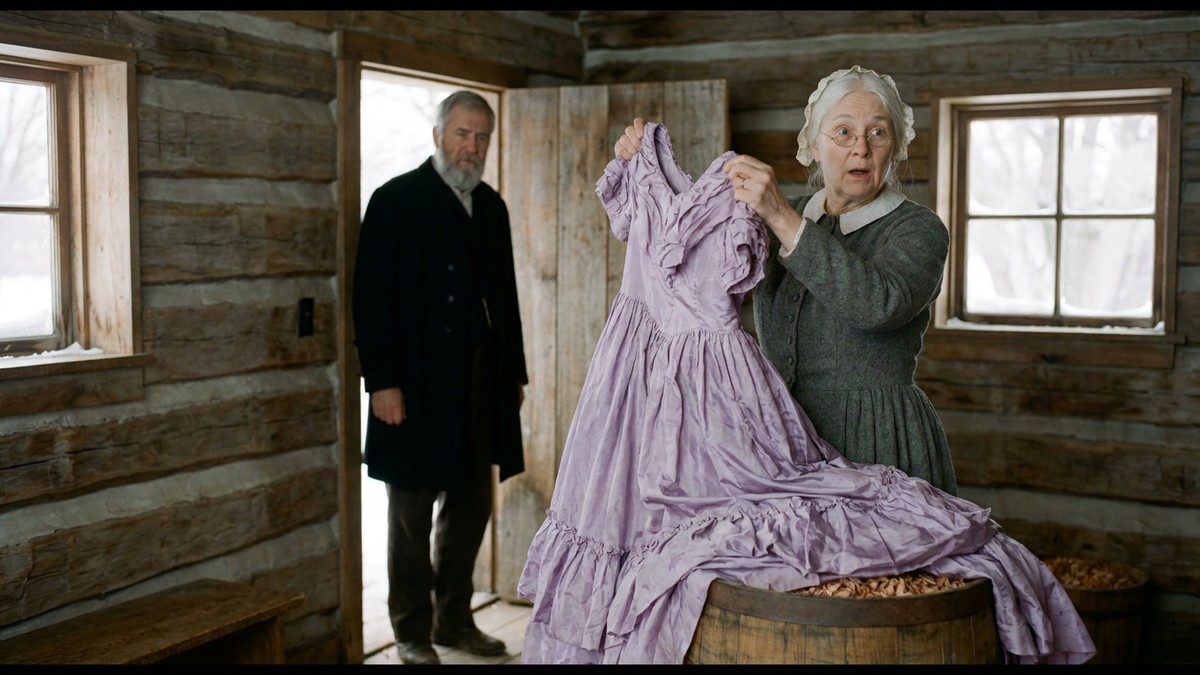
Silk. Yards and yards of it. A ball gown, with a skirt that billowed out of the barrel like a cloud and kept on coming, with tiers of ruffles and a bodice sewn with tiny seed pearls. It was the most beautiful dress Ellen had seen in thirty years. It was utterly useless.
She laid it over the bed. She reached in again.
A gentleman's silk top hat, tall and black and gleaming, in a round leather box.
She reached in again. Shavings. Shavings. At the very bottom, wrapped in tissue paper, one tiny pair of white kid shoes, for a baby. Hardly bigger than her thumb.
That was all.
Asa stood in the doorway and looked at the ball gown on the bed, and the top hat on the table, and the baby shoes in his wife's hand.
Then he laughed. It was not a good laugh.
"Twenty-three children," he said. "And the First Church of Northampton sends a ball gown." He took off his spectacles and pressed his eyes. "Well. I suppose I can preach on the lilies of the field. They toil not. Neither do they spin."
He went out to the barn. Ellen heard the door bang.
She stood alone in the little cabin with the snow coming down outside.
She touched the lavender silk. She had worn one very like it, once, in Ohio, the year she married. Asa had been a young preacher with one good coat, and she had been a judge's daughter, and her mother had wept at the wedding for all the dresses Ellen would never wear again.
Ellen had not minded. She did not mind now.
But it was very beautiful. She let herself hold it against her for one moment, there by the window, where no one could see.
Then she looked at the clock. It was ten minutes past one.
She went to the table and opened her hymnbook to the list at the back. Twenty-three names. Twenty-two and one line.
Twice she read them over. Then she set the hymnbook down open, took her sewing shears from the basket, and spread the lavender skirt out flat across the table, all its tiers and ruffles, from one edge to the other.
She held the shears over the silk.
Six hours.