Part 2
The first cut was the hardest. After that, it was only sewing.
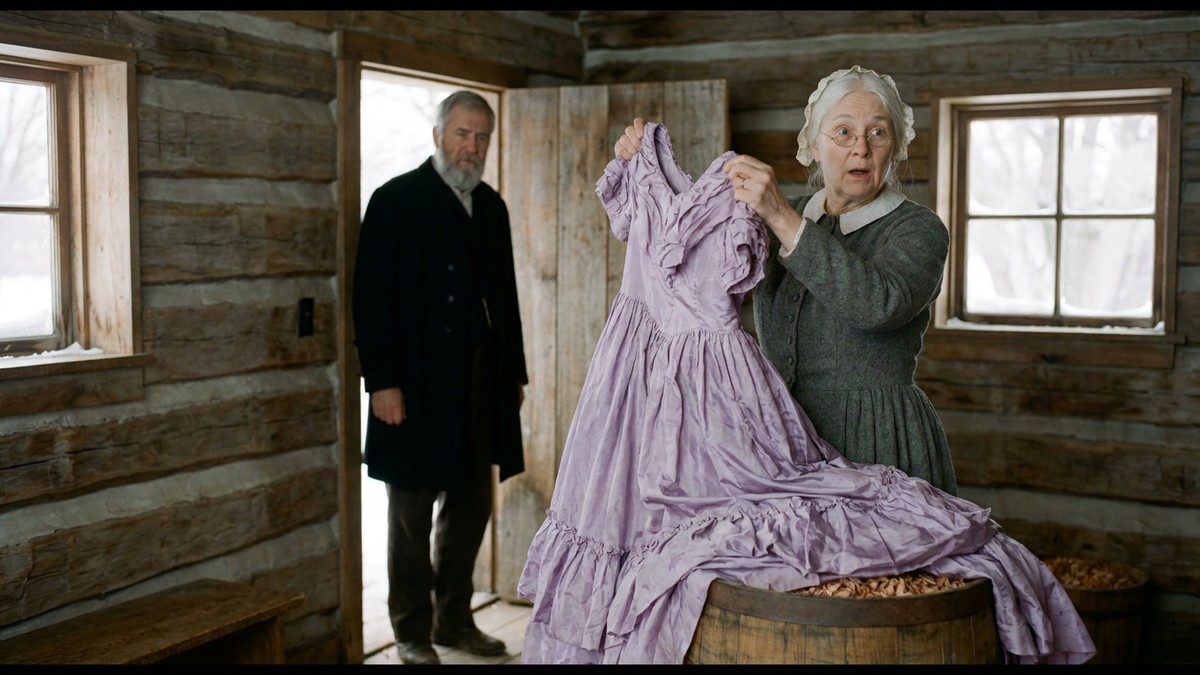
Ellen cut the ruffles off the skirt in long strips, each one a hand wide, and cut the strips into lengths. Hair ribbons. Lavender silk hair ribbons, two to a girl, for every girl on the list. She hemmed the ends with tiny stitches so they would not fray. There were eleven girls. There was silk left over.
She cut the bodice free of the skirt and picked the seed pearls off it one by one into a saucer. Then she cut the skirt itself into small squares, and folded each square over a pinch of dried lavender from the jar on her shelf, and stitched it shut with three stitches. Sachets, sweet-smelling, small enough to hold in a fist. One for every mother on the circuit. Nineteen mothers.
The muslin petticoat under the skirt became handkerchiefs. The lace at the hem became collars for the three Tolliver girls.
It was four o'clock, and snowing hard, when Asa came in from the barn.
He stopped in the doorway. The cabin was full of lavender. It was on the bed and the chairs and the floor and the table, in ribbons and squares and scraps, and his wife was sitting in the middle of it with her spectacles on the end of her nose and a needle in her mouth.
"Ellen," he said. "That was a ball gown."
"It still is," Ellen said, around the needle. "Only now it's a ball gown for twenty-three."
He looked at the saucer of seed pearls. He looked at the stack of little sachets.
"And the boys?" he said finally. "What do you mean to do for the boys, with a ball gown?"
Ellen took the needle out of her mouth and pointed it at the top hat on the shelf.
"That," she said, "is your department, Reverend."
He understood her slowly. Then, slowly, he began to smile.
There were twelve boys on the list. Asa sat down at the end of the table with his pocketknife and a pile of kindling, and he whittled until the light went. Twelve tops. Twelve little whistles out of elder wood. He was no carver, and some of them were lopsided, but every one of them spun and every one of them blew.
And at six o'clock, when they drove to the Elm Creek schoolhouse through the snow with the barrel in the back of the wagon, the Reverend Asa Whitcomb wore the silk top hat.
The schoolhouse was full. People had come from twenty miles, in wagons and on foot, because there was nothing else to do and nowhere else to go on Christmas Eve, in the year of the grasshoppers. The little cedar stood in the corner with tallow candles on it and a bucket of water beside it. The stove glowed red.
The children recited. Asa preached, shorter than usual. And then he took off the top hat and held it up.
Inside it were twenty-three slips of paper. Ellen had written every name on the list.
"In this hat," Asa said, in his preaching voice, "is everyone in this county who has been good this year. I am told that is all of them."
He drew the names one by one and read them out. Every child came up to the front of the room, and every child went back to its seat with something. Lavender hair ribbons. A spinning top. A whistle. A lace collar. When the mothers came up, Ellen pressed a sachet into each hand, and the schoolhouse began to smell, very faintly, of summer.
The last slip in the hat had no name on it. Only one word.
Penner.
The Penners were not there.
Ellen had known they might not be. She went out to the wagon anyway, with the tiny white shoes in her coat pocket, and Asa drove her the four miles to their dugout on the creek in the dark, with the lantern swinging and the snow coming at them sideways.
There was a light in the dugout. Ellen knocked.
Peter Penner opened the door. He was a big young man with a beard, and his face, in the lamplight behind him, was wild with joy and fright together. Behind him, on a straw tick by the stove, Katharina lay propped on a pillow with a bundle in her arms. An older Mennonite woman was bending over them.
The baby had come at sundown. A boy.
Ellen took the little white shoes out of her pocket. She knelt by the straw tick and held them out, and Katharina looked at them, and then at Ellen, and laughed, and wept, and said something in German that Ellen did not understand and understood completely.
On the twenty-sixth of December, Ellen sat down at the kitchen table to write the letter of thanks.
To the Ladies of the Woman's Missionary Society, she wrote, First Church, Northampton.
She thought a long time about the next line. Asa came and read over her shoulder, with his spectacles on.
Dear Ladies, she wrote at last. Your barrel came on Christmas Eve. I want you to know that it held Christmas for twenty-three children, nineteen mothers, and one baby boy who was born at sundown, and that there was enough for all.
Then she folded one lavender ribbon into the letter, and sealed it.