Part 1
On the third night of Christmas, somebody pounded on Halvor Brekke's door, and Halvor pretended not to hear, as he had for six years.
It was December 1885, in Fillmore County, Minnesota, where the farms ran in long white folds between the coulees and nearly every family had come from Norway. Halvor was seventy-four. He lived alone in a log house at the end of a lane that no one plowed but him.
His wife, Sigrid, had died in the spring of 1879. That was when he had stopped going to church, and stopped going to weddings, and stopped speaking to anyone in the valley beyond what it took to buy coffee and nails.
The fiddle still hung on the wall over the bed. A Hardanger fiddle, with eight strings and a carved dragon's head, that his father had brought from Telemark. For thirty years Halvor had played every wedding and every Christmas dance from the Root River to the Iowa line. He had not taken it down since Sigrid's funeral.
The pounding came again. Then a window rattled. Then another window, on the other side of the house.
Halvor knew what it was. Every Norwegian in Minnesota knew.
Julebukking. Between Christmas and New Year's, neighbors went out at night in masks and wild costumes, and burst into each other's houses, and would not go until the people inside had guessed who every one of them was. It was a children's game, mostly. A young people's game. He had done it himself, sixty years ago, in Telemark.
Nobody had come to his door at Christmas in six years.
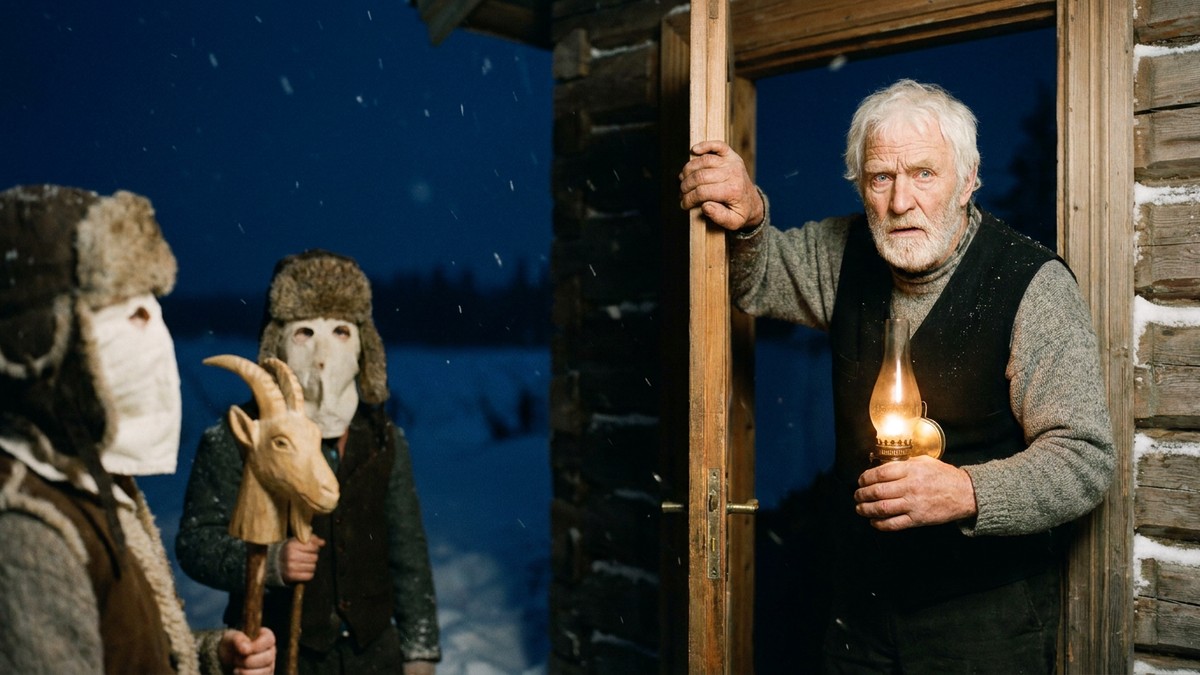
He took up the lamp and went and opened it, meaning to tell them to go home.
They did not wait to be asked. They came in past him in a rush of snow and cold air, stamping and growling and laughing behind their masks. Six of them. Flour sacks with eye holes painted around in soot. A goat's head carved out of wood on a stick. Coats turned inside out. Fur caps. One wore a woman's bonnet over a beard of sheep's wool. One was so small it could hardly have been eight years old.
They crowded around his table and pounded on it.
"Mat," growled the goat's head, deep in its chest. "Food."
Halvor stood holding the lamp.
He could have put them out. He was still strong enough. He thought about it.
Then the smallest one, in a fur cap pulled down to its nose, reached out a hand to touch the dragon's head on his fiddle over the bed. It wore red and white mittens with an eight-petaled rose knitted on the back.
Halvor knew that rose. He had watched it come off the needles in this room, by this lamp, in another life.
He had seen those mittens in town the week before Christmas, at the store, on a little girl whose name he did not know. He had looked away.
"Sit down," he said gruffly. "All of you. Sit."
He had a pot of coffee on the stove and some lefse in a crock and a little akevitt in the cupboard. He set it all out. The masked visitors ate like wolves and grunted and would not say a word in their own voices.
"Well," said Halvor. "So I am to guess."
The goat's head nodded, very solemnly.
Halvor sat down across from them and set the lamp in the middle of the table. He folded his big hands.
For thirty years he had stood on a bench at the end of a barn floor, with his fiddle under his chin, and watched every man and woman in the valley dance. He had watched them at their weddings and their children's weddings. He knew a man by the way he put down his heel. He knew a woman by how she held her elbows when she turned.
He had not thought he remembered any of it. He found that he did.
"You," he said, pointing at the tall thin one in the bonnet and sheep's wool beard. "Stand up. Walk to the door and back."
The thin one walked.
"Lars Haugen," said Halvor. "You toe in on the left. You always did. Your wife used to scold you for it at the Midsummer dance."
There was a howl of laughter. The bonnet came off. It was Lars Haugen, red in the face, sixty years old and grinning like a boy.
He got the next three nearly as fast. A heavy step and a cough: Knut Rustad, the blacksmith. Big rough hands with a white scar across one knuckle: Anna Rustad, Knut's wife, who had burned it on a kettle the summer Halvor played at their wedding. And a young man with a laugh that went up at the end, exactly like his mother's: Per Haugen, Lars's boy, who had been nine when Halvor last saw him.
Each time the mask came off, there was a shout and a stamping of feet. Each time, the lamp seemed to burn a little brighter.
That left two.
The little one in the rose mittens, sitting very straight on the bench.
And the goat's head.
The goat's head was big. A big man, broad, in a buffalo coat turned inside out, standing very still by the stove. He had not laughed with the others. He had not eaten. He had stood the whole time with his wooden goat's head on its stick, and his face behind his flour sack, and his feet planted.
Halvor looked at the feet.
A left boot with the heel worn down hard on the outside. A right one, set a little back, as if the man favored it. Halvor had seen that stance before, a thousand times, on a barn floor. He had seen it beside him, across a fence, in a church pew, at a wedding, at a christening, for forty years.
He had seen it last at the edge of his oats, the week of Sigrid's funeral, with forty head of the man's cattle trampling the grain behind him.
Halvor put both hands flat on the table and stood up.
"I know who you are," he said.