Part 2
The goat's head did not move.
"Ole Strand," Halvor said.
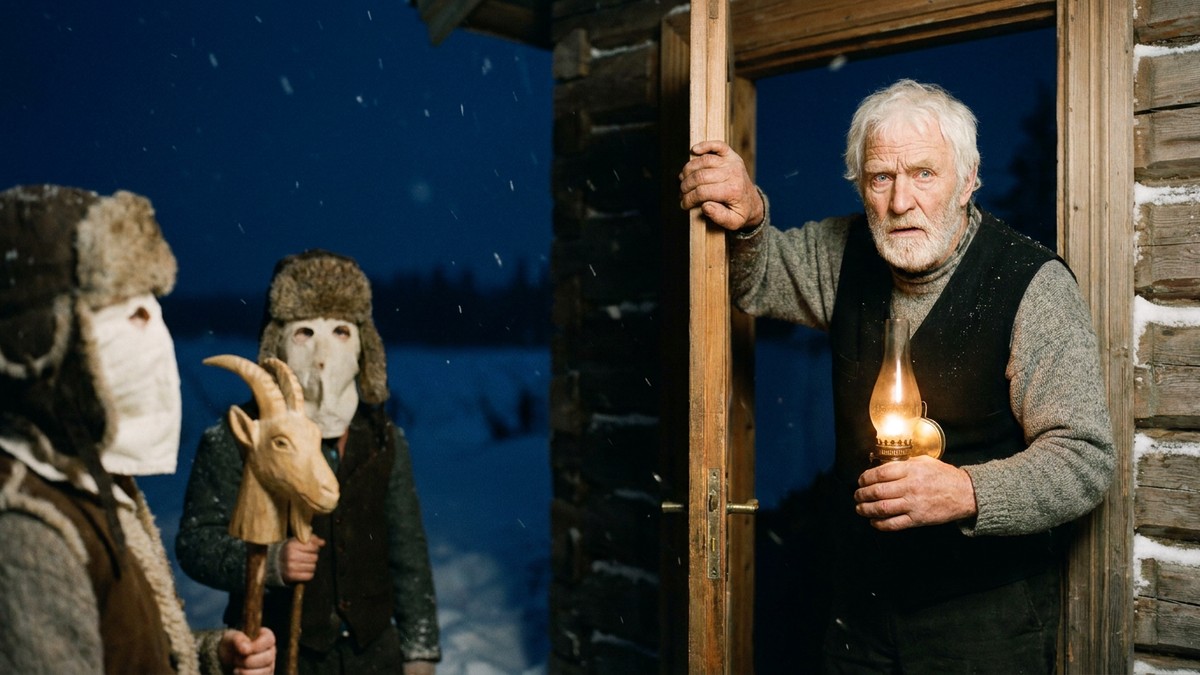
For a moment nothing happened. Then the big man in the buffalo coat let the wooden goat's head sink down on its stick until it rested on the floor, and he reached up with one hand and pulled the flour sack off over his head.
Ole Strand was seventy-two. His beard had gone white since Halvor last looked at him properly. His face was red from the cold and the sack, and his eyes were wet.
Lars Haugen had his bonnet crushed in his two hands.
"You toe out on the left," Halvor said. His voice did not sound like his own. "And you favor the right knee. Since the horse fell on you in '62. I played at your wedding, Ole."
"I know it," Ole said. "Twice. Mine and my daughter's."
They stood looking at each other across the table, over the lamp and the coffee cups and the crumbs of lefse.
"Six years," Halvor said at last.
"Six years," said Ole.
"Your cattle were in my oats the week we buried her."
"I know it." Ole looked at the floor. "My boy left the gate open. I came over the next morning to say so. And you stood in your door and said what you said, about me, and about my cattle, and about my father. And I went home." He drew a long breath. "I should have come back. I should have come to the funeral, Halvor. I was ashamed of the cattle, and then I was ashamed of being ashamed. And then it was a year. And then it was six."
"I said things," said Halvor.
"You did. I have heard worse." Ole almost smiled. "Not often."
Halvor sat down slowly on the bench. His knees would not hold him any longer.
"Why tonight?" he said.
Ole did not answer. He looked at the smallest julebukk, the one in the rose mittens, still sitting very straight at the end of the bench.
"Ask her," he said. "This was her notion. Not mine."
Halvor turned.
The little one pushed back her fur cap. Under it was a round, serious face and two yellow braids, and a gap where a front tooth had been.
"You have not guessed me yet," she said.
Halvor looked at her. He looked at the red and white mittens with the rose on the back. He thought of his wife, sitting by this lamp with her needles going, and of her voice, telling him about a young mother down the valley who had begged to learn the pattern.
"Your mother is Marit Strand," he said slowly. "Ole's daughter. And my wife taught her that rose. The winter before she died."
The girl nodded hard.
"My name is Sigrid," she said. "Mama named me for her. Because Mrs. Brekke came in the night when I was born, and Mama says I would have died without her." She held up her mittened hands. "Mama made these. And she said nobody on this whole farm had been julebukking to you, not once, since Mrs. Brekke died, and that it was a shame on the whole valley. So I made Grandpa come." She looked severe. "He did not want to."
"I wanted to," said Ole. "For six years. I did not know how."
He put out one big rough hand, and the little girl named Sigrid put her mittened hand in it. The rose was knitted very small and very even. Her mother had learned it well.
"Well," Halvor said finally, roughly. "You are all guessed."
"Then it is your turn," said Lars Haugen, putting his bonnet back on crooked. "That is the rule, Halvor. You know the rule. One from every house must come with us to the next."
Halvor looked at them. Six faces in his lamplight, every one of which he had known since it was young.
Then he looked up at the wall over the bed.
He took the fiddle down himself. His hands shook. The dust lay thick on the dragon's head, and two of the eight strings had gone, and the bow had lost half its hair.
He tuned it anyway, there at the table, peg by peg, with all of them watching. It took a long time. Nobody hurried him.
When it was as near right as it would go, he set it under his chin, and closed his eyes, and played the first bars of the old Christmas tune that every child in Telemark knew. It came out thin and rusty, like an old gate. Then it came out better.
Little Sigrid Strand began to clap.
They went out into the snow at midnight, seven of them, the julebukkers and the old fiddler in his own coat turned inside out, with a flour sack mask that Anna Rustad had painted for him on the spot. The stars were very bright over the white coulees. The snow squeaked under their boots.
The next house down the valley was Ole Strand's.
Halvor played all the way there. At the door, Ole pounded on it with his fist and growled like a goat, and inside, a woman's voice laughed and called out, "Who is it? Who is it?"
Halvor stood in the snow with the fiddle under his chin and his mask on and smiled, where nobody could see it, behind the sack.