Part 1
Lavinia Moore could tell where a man had been by the state of his shirt, and she had never once been wrong.
It was April 1884, at Fort Davis, in the Davis Mountains of West Texas. She had washed for the post for fifteen years. The fort sat in a canyon mouth below red rock cliffs, and the soldiers who garrisoned it were Black men of the Tenth Cavalry. The little town below the post had a church, two saloons, a courthouse, and Orville Sutton's store.
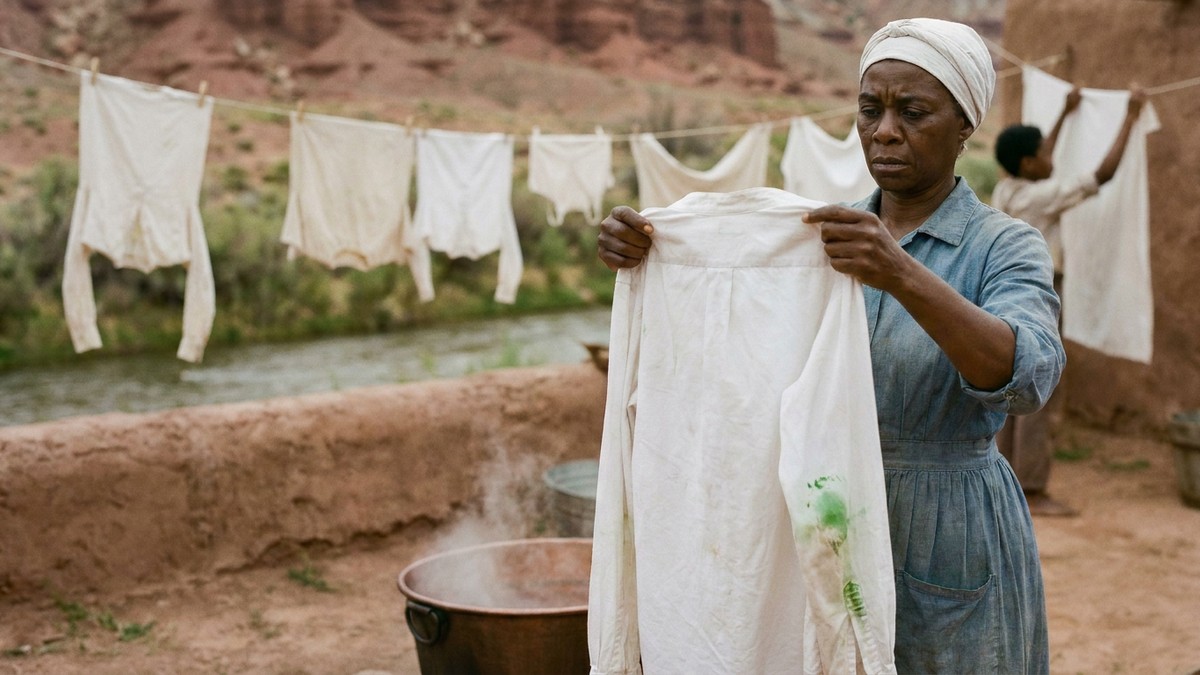
Lavinia was fifty-eight. Her husband had been a sergeant in the Ninth Cavalry and was buried in the post cemetery under a white board with his name on it. The army had stopped paying company laundresses. So Lavinia took in officers' shirts at her own adobe house by the creek, boiled them in a copper tub, and starched them stiff enough to stand.
"Collar tells you his work," she told the girls who helped her. "Cuffs tell you his habits. And the elbows tell you where he leans."
Corporal Elias Freeman was the regimental farrier. He was thirty-one, broad as a door, and so quiet that some of the town took it for sullenness. Lavinia knew better. Elias had held her husband's hand the night he died.
He came by her house on Saturday afternoon on his way to town with his pay in his pocket.
"Mr. Sutton painted his back door," he said, grinning, which he did not do often. "Green. Green as a bullfrog. The whole town is teasing him."
"Did you shoe that lieutenant's gray?"
"Thursday. Quarter crack in the near fore. I put a bar shoe on it." He said it the way another man might say he had written a letter. Elias remembered every horse he had ever shod. "Lieutenant Whitlow didn't thank me. He never does."
He bought tobacco and a paper of horseshoe nails at Sutton's at six o'clock, and walked back to the post. Lavinia saw him go by on the road, whistling.
On Sunday morning the whole town knew that Orville Sutton's cash box was gone.
Three hundred and forty dollars. The soldiers had been paid on Saturday, and half of it had gone across Sutton's counter by dark. He had locked the box in the back room with a padlock. In the morning the padlock was cut and the box was gone and the back door was standing open.
By noon, the town had decided.
"The colored corporal," Sutton told anyone who would listen. "Last man in my store. Saw him looking at the back room. Saw him."
Two white men from the saloon walked up to the post and said it to the officer of the day. By Sunday evening, Corporal Elias Freeman was in the guardhouse.
The captain was a fair man, people said. He was also a careful one. He would hand Elias over to the county sheriff on Tuesday, when the noon stage came through for Fort Stockton, and let a civil court sort it out.
Lavinia knew what a civil court in West Texas would make of a Black soldier and a white merchant's cash box. Everyone did.
The officers' laundry came down to her house on Monday morning, as it did every Monday, in canvas bags with names stenciled on them.
She sorted it in the yard, as always, shaking each shirt out in the sun. Captain's shirts. The surgeon's, with iodine on the cuffs. The adjutant's, with ink on the right wrist.
Lieutenant Charles Whitlow's bag had four shirts in it. Three were ordinary.
The fourth had a smear of green paint on the left elbow. It was still sticky. It came off on her thumb.
Lavinia stood very still in her yard, with the shirt in her hands and the copper tub steaming behind her.
The elbows tell you where he leans.
She did not go to the captain. She knew how that would go. A laundress, accusing an officer, on account of a smudge.
She went to First Sergeant Moses Carter instead. He had served with her husband in the Ninth. She found him at the stables and laid the shirt across a feed box in front of him, and put her green thumb beside it.
Carter studied the paint. Then he looked at her.
"You understand what this is, Mrs. Moore."
"I understand."
"If you're wrong, they'll run you out of this town by sundown. If you're right, they may anyway."
"Elias held my husband's hand while he died," Lavinia said. "Is the captain at his office?"
At seven o'clock on Tuesday morning, five hours before the stage, there were fourteen people standing in the muddy alley behind Orville Sutton's store.
Sutton. Two men from the saloon. The captain, frowning, with First Sergeant Carter beside him. Lieutenant Whitlow, pale and correct in a fresh uniform. Lavinia, with the green-smeared shirt folded over her arm. And between two guards, with his hands in irons, Corporal Elias Freeman.
The captain had given them one hour.
"Mrs. Moore says there is paint on an officer's shirt," the captain said, in a voice like a closing door. "Lieutenant Whitlow says he leaned on a fence. Corporal, you've been charged. You may speak."
Elias did not speak. He was looking down.
A shower on Saturday evening had softened the alley before dark, and Sutton's back door, green as a bullfrog, stood at the top of two wooden steps. In the mud at the foot of the steps, among a dozen boot prints and the round marks of a dog, was the clear print of a horse's hoof.
Elias studied it. Then he lifted his chained hands a little, and turned to the captain.
"Sir," he said. "May I kneel down?"