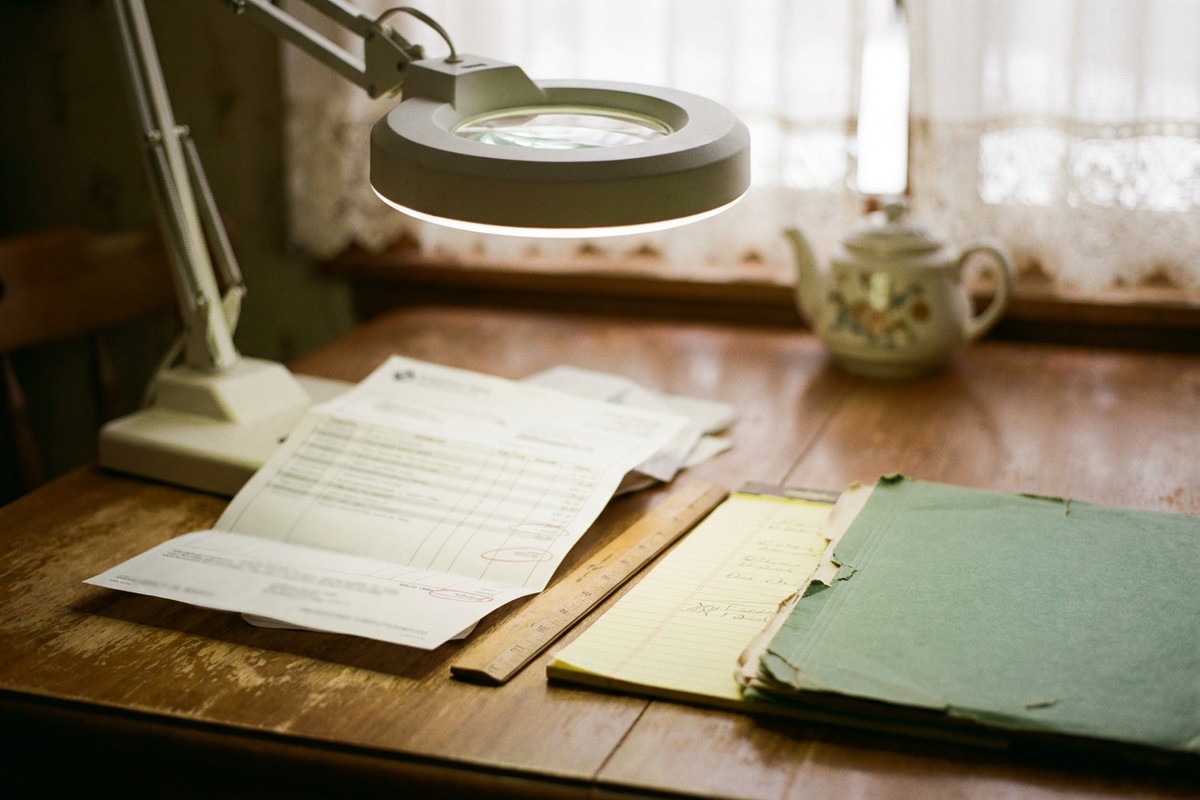
Otto took the envelope. He stood there on his own front step and read the bill all the way through, the way he used to read a blueprint, from the top left corner to the bottom right.
Then he looked up.
"I can't read this either," he said. "And I was born forty miles from here." He stepped back and held the door open. "Come in. Both of you. Abdi, wipe your feet."
They sat at his kitchen table. Hodan sat very straight in Ingrid's chair, and Otto didn't tell her whose chair it was. He got his reading glasses and the big magnifying lamp he used for tying fishing flies, and he spread the bill out flat under it.
"You have insurance?" he asked.
"Yes. Medical Assistance. For the children." Hodan took a card out of her wallet and set it on the table. "I gave them this card. At the emergency room. I watched the woman type it."
Otto looked at the bill again. Under insurance, it said SELF-PAY.
"Then somebody typed it wrong," he said. "Or they never sent it in. Either way, they're billing you like you walked in off the street with nothing."
Hodan pressed her lips together. "Can they do this?"
"They can make a mistake. People make mistakes." Otto tapped the paper. "What they can't do is make you pay for it. Not while I'm sitting here."
He heard himself say it and was a little surprised.
The bill was only a summary, one line for the emergency room, one line for surgery, one line for everything else. Otto knew better than to fight a summary. Ingrid had taught him that.
He got up and went to the spare room. In the steel file cabinet, under the drawer full of complaints, there was a drawer he hadn't opened since the funeral.
It was Ingrid's. He pulled out a green folder labeled OTTO KNEE 2014 in her round, neat handwriting.
Back in 2014, the hospital in Willmar had billed them eleven thousand dollars for a knee replacement Medicare had already paid. Otto had wanted to shout at somebody. Ingrid had sat down with a pad and a pencil instead, and in five weeks she'd gotten every cent of it erased.
Inside the folder was a page in her handwriting. Otto set it next to Hodan's bill.
Ask for the itemized bill. Get a name every time. Write down the date and the time.
Ask for a supervisor. Put it in writing and keep a copy. Be polite and don't go away.
Hodan read it over his shoulder. "Your wife?"
"Ingrid," Otto said. "She used to tell me I put all my fight into the wrong things."
He called the hospital billing office at 8:00 the next morning. He asked for an itemized statement, with every charge, every code, and every date. The young man on the phone said it would take ten business days.
Otto said he'd like his name, please, and wrote it down. Kyle. 8:04 a.m.
The itemized bill came in nine days, eleven pages long. Otto sat at the kitchen table with Hodan and Abdi on a Saturday morning and went down it line by line with a ruler, the way he used to check a part against a drawing.
On page two, the insurance number was there after all. Otto held Hodan's card up beside it under the lamp.
"There," he said. "Look."
Two digits, side by side, were turned around. Somebody's fingers had been in a hurry.
"The insurance company got a number that doesn't exist," Otto said. "So it bounced back, and the hospital decided you didn't have any."
Abdi leaned over the table. "That's it? Two numbers?"
"That's plenty. One thousandth of an inch is plenty, if it's in the wrong place."
On page seven, Otto found the other thing. The same CT scan, same code, same date, same minute, charged twice. Two thousand six hundred dollars for a picture they'd taken once.
He wrote the letter that afternoon, on the yellow legal pad first and then in ink on clean white paper. He listed the wrong insurance number and the right one. He listed the duplicate charge by page, line, and code.
He asked the hospital to correct the number, rebill the insurance, remove the duplicate, and put the account on hold while they did it. He made two copies at the library for fifteen cents each.
Then, on Monday, he put on his good shirt and drove Hodan to the hospital.
"You could mail it," Hodan said in the car.
"Ingrid would mail it," Otto said. "Ingrid was nicer than me."
The billing office was on the second floor, behind a window with a little bell. Otto rang it and asked for a supervisor, by name, if they had one.
They did. Her name was Brenda Lund, and she came out looking like she'd heard every complaint there was.
Otto set the letter on the counter. He set Hodan's insurance card next to it, and page two and page seven of the itemized bill, with the lines circled in red.
Brenda Lund read for a long time. Then she sat down at a computer behind the window and typed. Then she typed some more.
"Mr. Brandvold," she said finally. "You're right. On both."
"I know," Otto said. "Can you fix it today?"
She fixed it that day. She corrected the number and sent the claim back through while they waited, and she took the CT charge off with her own hands, and she printed a paper that said the account was on hold. Three weeks later a new statement came in the mail.
Balance due: $0.00.
Hodan read it standing at Otto's front door, and she laughed out loud and then covered her face with both hands, and Otto looked down at his shoes until she was done.
That evening Yusuf came over for the first time. He was even taller up close.
He carried a thermos of sweet tea with cardamom and a plate of sambusas, little fried triangles stuffed with spiced beef, and he set them on Otto's kitchen table and shook Otto's hand for a long time without saying much. He didn't need to.
Otto ate four sambusas. He'd have eaten five, but the little girl was watching him.
"Mr. Brandvold," Abdi said. He said it right this time, with the d left soft at the end, the old-country way Otto's father used to say it. "You say our names wrong. You know that?"
Otto put his tea down. "I suppose I do."
"Say my mom's name."
Otto said it.
Abdi shook his head. "Slower."
They worked on it until Otto could say Hodan and Yusuf and Warsame the way they were meant to be said. It took longer than a bicycle chain. Otto didn't mind.
That Sunday, Otto bought a new chain and a chain tool at the hardware store, along with a dozen yellow legal pads, out of habit. He took everything over to the driveway next door. The red bicycle went upside down on its seat and handlebars, and he handed the tool to Abdi.
"I'll tell you how," Otto said. "You do it."
The boy pressed the pin out of the old chain, slow and careful, with his tongue between his teeth. Otto crouched on the concrete beside him on two bad knees, and by noon they both had black grease up to the wrists.
Inside on Otto's kitchen table, the last complaint he'd ever started was still sitting on the yellow pad. Truck blocking mailbox, 9:12 a.m.
He never did mail it.