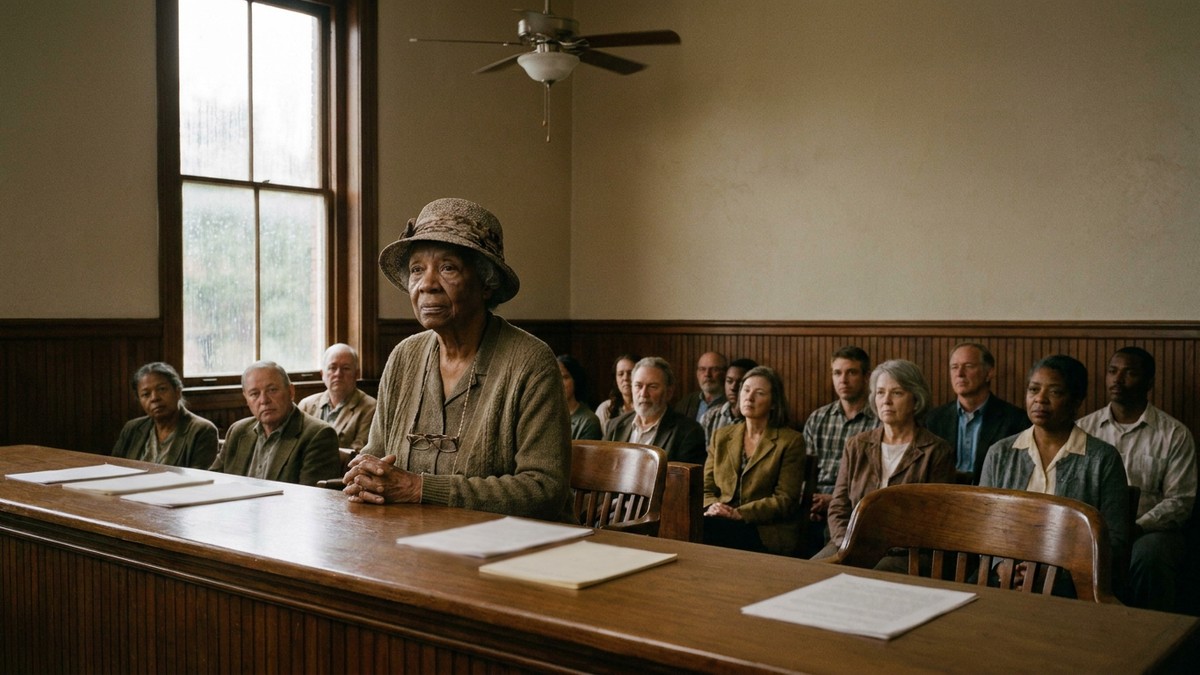
Eleven hands went up for guilty, and Mavis Odell kept hers in her lap.
The foreman counted twice, as if the twelfth hand might be hiding somewhere. Then he looked down the long table at her.
"Mrs. Odell," he said, "is that a no, or are you just not sure yet?"
"It's a no, Mr. Dubose," Mavis said. "For now."
Somebody at the far end of the table groaned.
Mavis was seventy-seven years old. She'd been a seamstress in Pearl Bend, Mississippi, for fifty-two years, hemming wedding dresses and letting out church suits and making prom gowns for girls who couldn't afford the ones in the catalog.
She'd retired two years ago, when her eyes started to go. She still kept a tape measure in her purse.
She had never served on a jury in her life. When the summons came in the mail, she'd almost called to get out of it.
Then she thought about what her late husband, Clarence, used to say. If you're too busy to do right, you're too busy.
So here she was, on a Thursday afternoon in the jury room on the second floor of the Pearl Bend County courthouse, with eleven strangers, a box of stale doughnuts, and a ceiling fan that clicked every time it went around.
The case was simple. The prosecutor had said so twice in his closing argument.
On a Tuesday night in March, somebody had broken into the food pantry behind Bethel Missionary Baptist Church. They'd jimmied the back door, taken six hundred dollars out of the cash box, and filled a bag with canned goods off the shelves.
The burglar alarm went off at 9:40. A man across the street, coming out of the laundromat, told the deputies he saw a young man in a red hooded sweatshirt running away down Church Street.
At 10:05, a deputy stopped a nineteen-year-old named Jaylen Booker on Delta Street, a little over two miles away. He was wearing a red hoodie. He was carrying a grocery bag full of canned goods.
Jaylen said he'd been at his aunt's apartment all evening, two blocks from where he was stopped, and the cans were from her cupboard. His aunt took the stand and said the same thing. The prosecutor pointed out that she was his aunt.
The trial had taken two days. The jury had been deliberating for three hours.
"I don't see what there is to talk about," said Wayne Coker. He was fifty, a big man who drove a delivery truck, with his arms crossed over his chest. "Red hoodie. Bag of cans. Two miles from the church, a half hour later. What more do you want, a signed confession?"
"I'd like to understand it," Mavis said.
"Understand what?"
"The rain."
Wayne stared at her. So did the others.
"Mrs. Pittman testified," Mavis said. "The pantry lady. She said she locked up at 9:20, and it was just starting to pour, and she ran to her car with her pocketbook over her head. She said it rained hard until nearly midnight. Do y'all remember?"
A few of them nodded slowly.
"And the deputy's report," Mavis said. "The one they read out loud on Wednesday. I wrote it down." She took a small spiral notebook out of her purse and opened it. "Subject's clothing dry. Subject cooperative. That's what it said."
"So?" said Wayne.
"So if that boy ran out of that pantry at 9:40," Mavis said, "and ran two miles in the pouring rain, carrying a bag of cans, how come his hoodie was dry?"
The fan clicked. The room was quiet for a moment.
"Maybe he had an umbrella," said the foreman, Lamar Dubose. He was a retired insurance adjuster, careful and polite, and he'd been trying to keep things moving all afternoon.
"There wasn't one," Mavis said. "They read us the list of what he had on him. Wallet, phone, house keys, the bag. No umbrella. No raincoat."
"Maybe he waited somewhere till it let up."
"It didn't let up. Not till midnight. Mrs. Pittman said."
"Maybe he got a ride," said a young woman named Tasha, who worked nights as a nurse's aide and had been looking at the clock since lunch.
"Then where's the car?" Mavis asked gently. "And who was driving it? Not one witness said a word about a car in two days."
Wayne Coker uncrossed his arms and put both hands flat on the table.
"Ma'am," he said, "with respect. Somebody broke into a church. My own church got broken into two years ago, and the police never caught anybody. I'm tired of people getting away with things. That boy was there."
"I'm tired of it too," Mavis said. "That's why I want to be sure we've got the one who did it."
They argued until five. Then the bailiff took them home for the night, and they came back on Friday morning and argued until noon.
At noon, they voted again. Eleven to one.
Lamar Dubose wrote a note to the judge, folded it, and handed it to the bailiff. Mavis watched it go out the door and felt every eye in the room on her.
Tasha was crying a little, quietly, into a paper napkin. Her babysitter had already called twice.
A retired mailman named Otis Lee sat at the end of the table rubbing his knees and not saying anything. Wayne stood at the window with his back to the room.
Mavis folded her hands on her notebook. She thought about Jaylen Booker in his borrowed sport coat, sitting at the defense table for two days, looking straight ahead. She thought about his grandmother in the second row, in a church hat, who'd held her purse in both hands the whole time like it was the only solid thing in the world.
She thought about Clarence. If you're too busy to do right.
The bailiff came back at one o'clock with the judge's answer.
Lamar read it out loud. It was the instruction judges give when a jury is stuck. Go back and listen to each other with open minds.
Don't give up your honest opinion just to reach a verdict, but don't hold on to it out of pride, either. Keep deliberating. The court would recess for the weekend, and they'd begin again at nine on Monday morning.
Lamar set the paper down on the table. He looked tired. Then he looked at Mavis, not unkindly.
"Mrs. Odell," he said, "you've got until Monday to convince eleven people. Or you've got until Monday to change your mind."
Mavis looked around the table at the eleven tired faces.
"Then on Monday morning," she said, "I'd like to start with you, Mr. Lee."