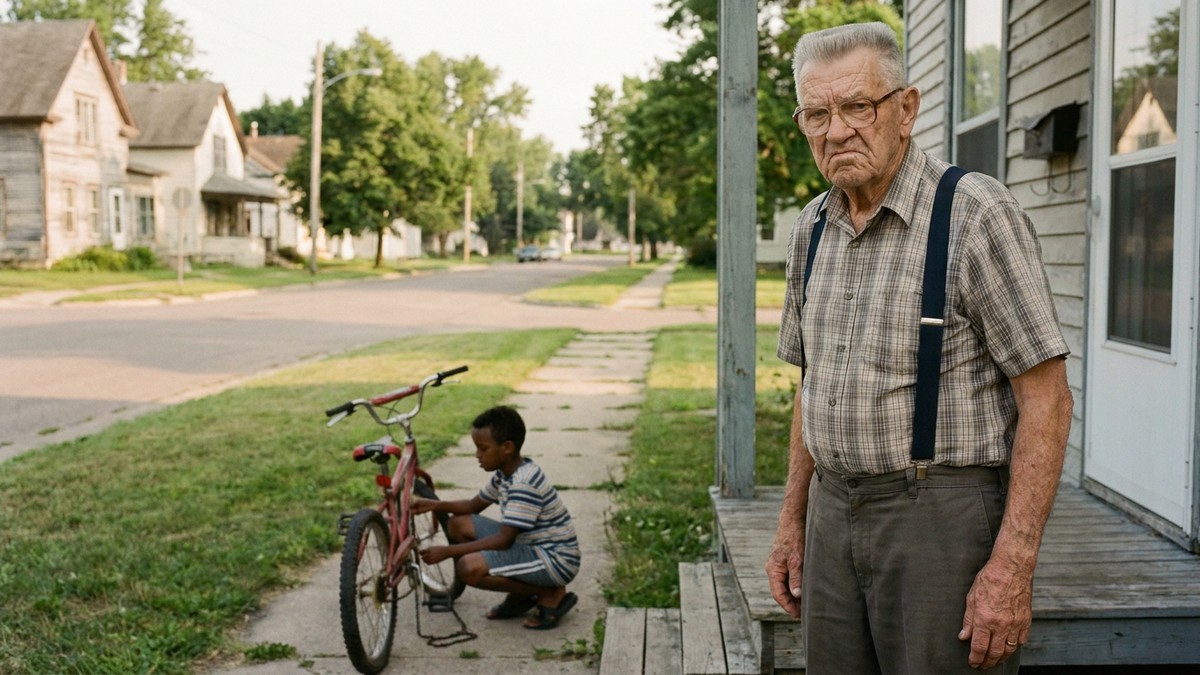
Otto Brandvold had complained to the city about every neighbor he'd ever had, and he was writing the complaint about the new one before their moving truck left.
He wrote it at the kitchen table in blue ballpoint, on the yellow legal pads he bought by the dozen at the hardware store. Truck blocking mailbox, 9:12 a.m. Truck idling, 9:40 a.m. Box of dishes set on my side of the property line, 10:05 a.m. He'd measured the property line in 1971 with a steel tape, and he knew where it was to the half inch.
Otto was eighty. He'd been a machinist for forty-four years at the pump plant outside Kettle Lake, Minnesota, and he'd spent all of them working to a thousandth of an inch. He didn't see why the rest of the world should get any slack.
His wife, Ingrid, used to tell him he was born with a file in his hand. She'd been gone three years now.
The complaints had a home. The bottom drawer of the steel file cabinet in the spare room was full of carbons going back to the Nixon administration. The Halvorsens' dog, 1974.
The Dahlquist boy's drum set, 1988. The leaves from the Swansons' silver maple, every October for twenty-two years, until the Swansons gave up and cut the tree down.
The house next door had been empty since February. Now a woman in a long blue dress and a head scarf was carrying lamps up the front steps, and a boy of about ten was carrying a box marked KITCHEN with both arms, walking backward so he could see where he was going and not seeing at all.
The boy's name, Otto learned that afternoon, was Abdi. He learned it because Abdi rode a bicycle into his garbage can.
It wasn't much of a bicycle. Somebody had bought it at a garage sale and somebody else had painted it red with a brush.
Abdi came flying down the sidewalk on it, standing on the pedals, and the chain jumped off the front ring right in front of Otto's driveway. The pedals spun loose, the bike wobbled, and the boy and the bike and Otto's garbage can went over together.
Otto stood up from his lawn chair.
"Sorry," the boy said from the ground. "Sorry, sorry." He jumped up and set the garbage can back on its feet and started picking up the trash that had come out of it, very fast, with his bare hands.
"Leave it," Otto said.
The boy left it. He turned to his bike instead and crouched down beside it and tried to push the chain back on with a stick.
Otto watched him do it wrong for a full minute. The chain was loose and twisted, and the boy was forcing it onto the ring from the wrong side, and it kept dropping off. Then he started jamming the stick into the rear wheel, trying to pry something, and Otto could hear the spokes complaining.
Otto's jaw got tight.
"You're going to bend that," he said.
The boy looked up. "It falls off every day."
"Course it does. Your rear wheel's been put in crooked, and your chain's stretched out like an old pair of suspenders." Otto went into the garage. He came back with a flat red toolbox, a rag, and a can of oil. "Turn it over. Upside down. On the seat and the handlebars."
The boy turned it over.
It took Otto fifteen minutes. He loosened the rear axle nuts and pulled the wheel back until the chain was snug, and he squinted down the length of the frame to set it straight.
He worked the chain back onto the teeth from the right side, turning the pedal with one hand, and the chain dropped into place like it had been waiting for permission. Then he oiled it, link by link, and wiped off the extra.
"Spin it," he said.
Abdi spun the pedal. The chain ran around the rings quiet as water.
"Whoa," he said.
"You keep that chain clean and oiled," Otto said. "You hear me grinding, you stop. And you don't fix anything with a stick." He wiped his hands on the rag. "What's your name?"
"Abdi. Abdi Warsame." He pointed at the house. "That's my mom. Hodan. My dad's at work. He works nights at the turkey plant."
"Hm," Otto said.
"What's your name?"
"Mr. Brandvold."
The boy tried it. It came out Brand-fold.
"Close enough," Otto said, and went back inside.
He sat down at the kitchen table and looked at the yellow pad. Truck blocking mailbox.
Truck idling. He picked up his pen and didn't write anything.
Over the next three weeks, Otto told himself he wasn't keeping track of the family next door. He just happened to notice things.
He noticed Hodan left for work at 6:40 every morning in maroon scrubs, and that she worked at the nursing home on Lake Avenue, the same one where Ingrid had spent her last month. He noticed the father, a tall quiet man named Yusuf, came home at 7:15 in the morning and slept until two. He noticed there was a little girl too, about six, with her hair in two puffs, who sang to herself on the front steps.
He noticed when the little girl stopped being on the steps.
There was an ambulance on a Wednesday night in late June. Otto stood at his front window in his undershirt and watched them carry her out on a little stretcher with her mother running alongside. Appendix, Abdi told him the next afternoon, sitting on his bike at the end of Otto's driveway.
They'd taken it out. She was okay. She'd be home Saturday.
"Good," Otto said.
"My mom is scared," Abdi said.
"Course she is. Little girl in the hospital."
Abdi shook his head. "Not of that. Of the paper."
Otto didn't ask what paper. It wasn't his business. He went back inside and fixed himself a sandwich and didn't eat it.
On the Monday after the little girl came home, there was a knock at Otto's front door.
He opened it. Hodan Warsame stood on his step, still in her maroon scrubs, and Abdi stood a step behind her. Hodan was holding a long white envelope in both hands, the way people hold something that might bite.
"Mr. Brandvold," she said carefully. Her English was good and slow and very correct. "I am sorry to bother you. Abdi says you are very smart with papers."
She held the envelope out to him. Through the window in it, Otto could see the hospital's name and a number in bold type.
$18,472.60.
"This came from the hospital," Hodan said. "I have read it four times. I do not understand it." Her voice was steady, but the paper in her hand was not. "Please. Can you help me?"