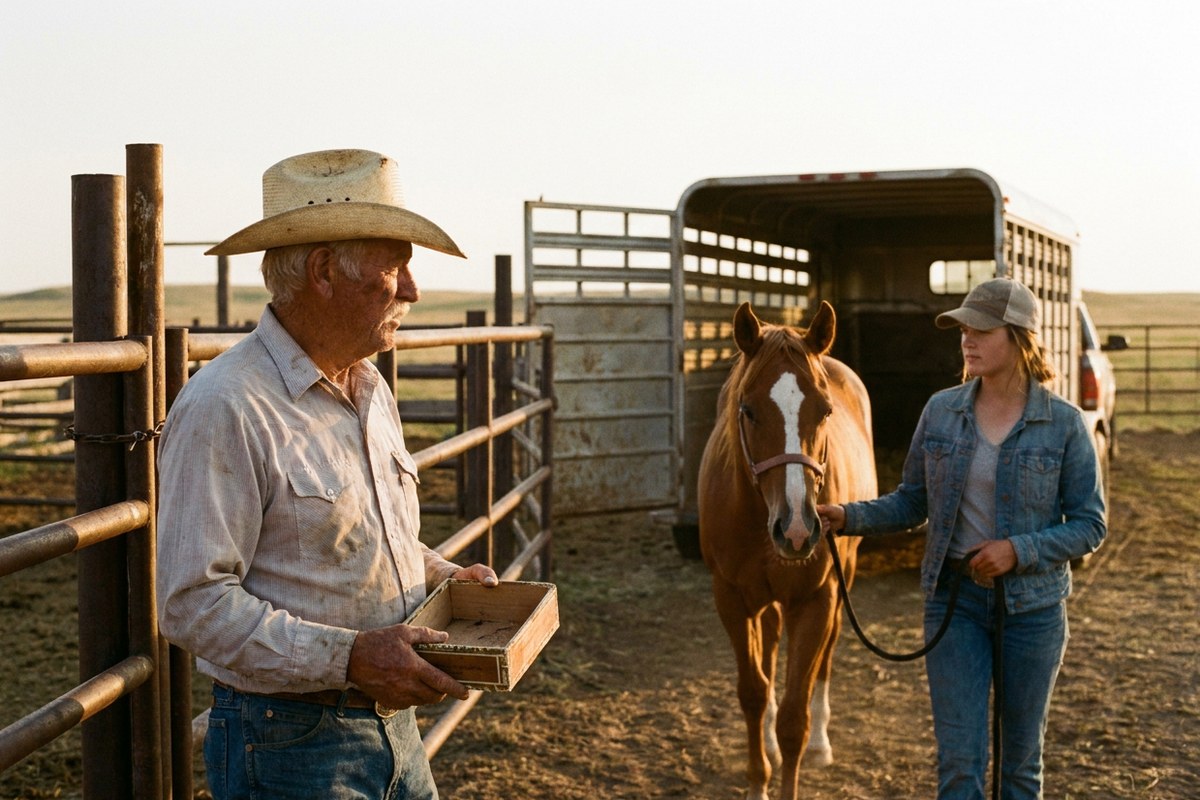
Callie didn't take the envelope at first. She looked at it in his hand like it might be a trick.
"Go on," Delbert said. "It's yours. It's been yours since 1974."
She took it. The flap had never been sealed. Inside were two one-hundred-dollar bills, the old small-portrait kind, soft and limp with age.
"That's his two hundred," Delbert said. "Same two bills he handed me at that gate. I never spent them."
Callie stared at the money.
"I don't understand," she said.
"Sit down a minute," Delbert said. "Carl, get the lady a chair."
"Your grandpa didn't come back in November," Delbert said. "Wheat failed. I figured that was why. So I waited. I kept that filly in the pens all winter and didn't show her to a soul.
"Then in March, I heard he'd lost the farm. Bank took it. He'd moved with his wife to her folks' place up by Guymon, in the Oklahoma Panhandle."
The wind blew dust across the tailgate. Delbert squinted into it.
"So in April of '75, I loaded that filly in my trailer, and I drove her up to Guymon," he said. "Took me all day. Found the place. Your grandpa came out of the barn and saw that sorrel in my trailer, and I'll never forget his face."
"What happened?" Callie asked.
"I told him she was his. Paid in full. I told him the balance was forgiven, a wedding present, and I'd made plenty off him already in good company." Delbert shook his head. "He wouldn't take her."
"Why not?"
"Pride," Delbert said. "Pure Panhandle pride. He'd just lost everything he had. He wasn't about to take charity off a horse trader in front of his wife's family. He said, Delbert, I made a deal and I can't keep it, and a man who can't keep his deal doesn't get the horse."
"So I said, all right. Then here's your two hundred back." Delbert nodded at the envelope. "And he wouldn't take that either. Said it was earnest money and he'd forfeited it fair and square. So we stood there in the yard and argued like a couple of fools for half an hour. Then we finally shook on it again."
"On what?"
"On this," Delbert said. "When you can pay the rest, she's yours. Or her daughter is, if she's gone by then. And until then, I keep your money in a box, and I don't spend it, and I don't sell your horse."
Callie didn't say anything.
"I drove her home," Delbert said. "I kept her. Never sold her. She had her first foal in 1977, and I wrote it down in that book."
He opened the black stud book and turned it toward her.
Callie bent over it. On the first page, in the same faded blue ink, it said HADLEY'S PENNY, sorrel mare, foaled 1972. Under it, a line for every foal.
1977. 1979.
1980. Then the mares' foals, and their foals, page after page, fifty years of horses.
Every one of their registered names began with the same word. Hadley's Promise.
Hadley's Gold. Hadley's Lucky Penny.
"Penny lived to be twenty-eight," Delbert said. "She's buried out past the windmill. Her great-great-granddaughter is standing in that pen right over there."
He pointed. In the nearest pipe pen, a sorrel two-year-old with a white blaze stood with her tail to the wind, watching them.
Carl had sat down on an overturned bucket. "Uncle Del," he said quietly. "I always wondered why you'd never sell that line."
"Why did he tell me you cheated him?" Callie said. Her voice wasn't steady.
Delbert thought about it a long time.
"I expect it was easier," he said gently. "For a proud man. Easier to say a horse trader cheated him than to say he lost his farm and couldn't pay, and turned down a horse because he couldn't stand to be given one." He looked at the bill of sale on the tailgate. "But he kept that paper behind his driver's license for fifty-two years. A man doesn't carry around a thing he's done with."
Callie unfolded the bill of sale and looked at it again. Balance after harvest. Shook on it.
"How much was the balance?" she said.
"Four hundred."
Callie reached into her back pocket, pulled out her own wallet, and counted out four hundred dollars in twenties. Her hands were shaking. She laid them on the tailgate beside the old envelope.
"Miss Hadley," Delbert said softly. "I wasn't going to ask you for that."
"I know you weren't," Callie said. "He'd want it paid."
Delbert looked at the money a long while. Then he picked up the old pen out of his shirt pocket, and on the bottom of the half sheet of notebook paper, under his own handwriting from 1974, he wrote: Paid in full. Feb. 2027.
D. Moss.
Then he held out his hand.
Callie Hadley shook it.
That evening, with the sun going down red over the caprock and the wind laid down for once, Callie led the sorrel filly out of the pen and loaded her into a borrowed trailer.
Delbert stood at the gate and watched. He was holding the White Owl box.
In it was the old envelope with Tom Hadley's two hundred dollars, which Callie had refused to take. She'd said it belonged with the stud book.
The filly's papers were in Callie's truck. Under Name, Delbert had written Hadley's Handshake.
The trailer pulled out of the yard and turned onto the caliche road toward Amarillo. Delbert stood there until its lights were gone, and then he went in and put the box back on the top shelf, in the back left corner, where it had always been.