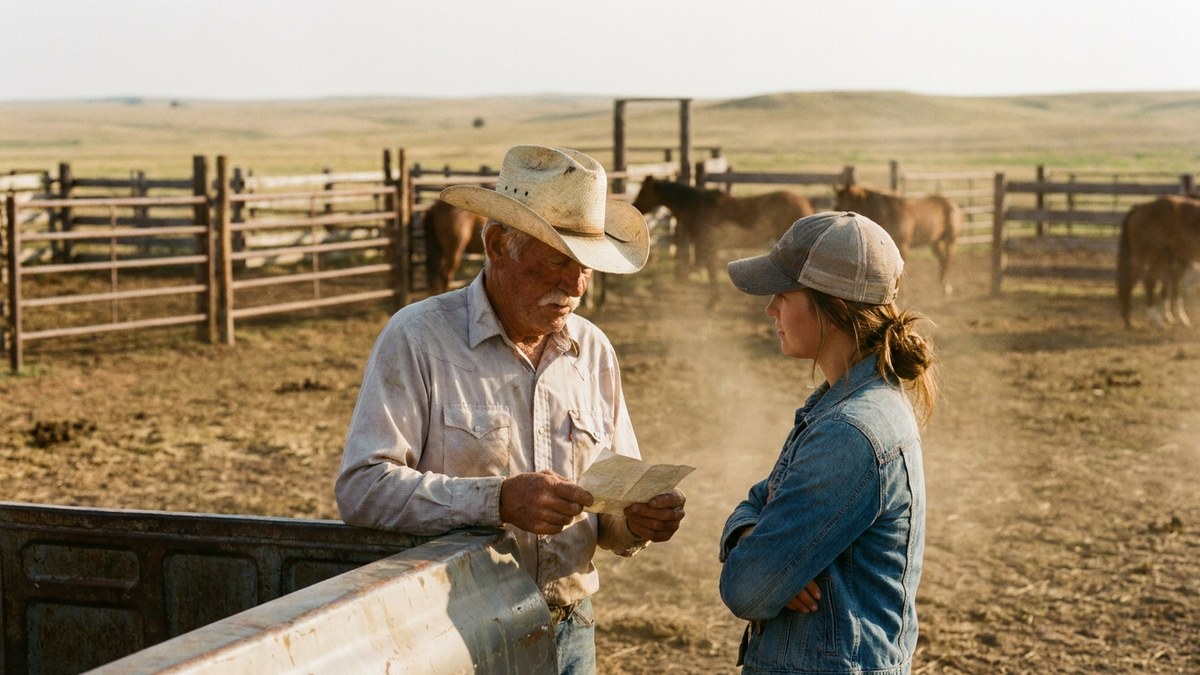
She set the bill of sale on the tailgate of his pickup and said, "Mr. Moss, you owe my family a horse."
Delbert Moss looked at the paper for a long time without touching it.
It was a half sheet torn from a pocket notebook, folded so many times the creases had gone soft as cloth. The ink was blue and faded.
He knew the handwriting. It was his own.
Sold to Tom Hadley, one sorrel filly, 2 yrs, blaze face, $600. Paid $200 down. Balance after harvest.
Shook on it. D.
Moss. Sept 14, 1974.
"Well," Delbert said. "Where'd you get this?"
"Out of my grandfather's wallet," the young woman said. "After he died. Three weeks ago."
Delbert was eighty. He'd been trading horses on the same place outside Sand Creek, Texas, since 1966.
It was a scrap of ranch on the caprock above the Canadian River breaks, a barn, a set of pipe pens, and a house his wife had kept until she passed. The wind blew there every day of the year, and twice on Sundays.
He'd bought and sold maybe four thousand horses in his life. He'd shaken hands on most of them.
He remembered Tom Hadley.
Tom had been twenty-three that fall, a lanky boy with a wheat farm east of town and a new wife and big plans. He'd come out to Delbert's pens and fallen in love with a two-year-old sorrel filly with a white blaze, and he didn't have six hundred dollars. He had two hundred.
"Hold her for me till after harvest," Tom had said. "I'll bring you the rest in November."
So they'd shaken on it, and Delbert had written it down.
She was the best-made filly he'd raised in years. He called her Penny, for the color of her coat in the evening light.
November came, and the rest of the money didn't. Neither did Tom. The wheat had failed all over the county that year, burned up in a dry spring and then beaten flat by hail in June, and there were a lot of young men around Sand Creek who never came in to settle up that fall.
"My name's Callie Hadley," the young woman said. "I'm a vet tech in Amarillo. Grandpa raised me after my folks split up. I'm the one who cleaned out his things."
She was twenty-six, sunburned, with her grandfather's long jaw and a ball cap pulled low.
"He never talked much about his farm days," she said. "But he talked about you. Once. I was maybe twelve, and we were driving past the turnoff to Sand Creek, and he got real quiet. And I asked him what was wrong."
Delbert waited.
"He said, a man out there named Delbert Moss took my two hundred dollars and sold my horse to somebody else." Callie's jaw set. "He said it was the worst thing anybody ever did to him. He never said another word about it. Then I found this in his wallet, folded up behind his driver's license. He carried it for fifty-two years, Mr. Moss."
Delbert didn't say anything.
His nephew Carl came out of the barn then, wiping his hands on a rag.
Carl was fifty-five and ran the business end of things now, the books and the online listings and the trucking. He was a good man, and practical, and he looked at the paper on the tailgate and at the young woman beside it and figured out what was going on.
"Ma'am," he said politely, "I'm sorry for your loss. But that horse would've died thirty years ago. Whatever happened back then, there's nothing to collect on now. That's a scrap of paper."
"I didn't come to collect," Callie said. "I came to see the man who cheated my grandfather. I wanted to look at him."
Carl started to answer. Delbert put a hand on his arm.
"Let her look," Delbert said.
Callie looked at him. Delbert let her. He stood there by his tailgate in the wind in his old straw hat, eighty years old, with his hands at his sides, and he let the girl look at him as long as she wanted.
"Did you?" she said finally. "Did you sell his horse?"
"No, ma'am," Delbert said. "I didn't."
"Then where is she? Where's his two hundred dollars?"
Delbert looked out at the pens for a while, at the young horses standing with their tails to the wind.
"Carl," he said. "Go in the tack room. Top shelf over the saddle racks, back left corner. There's a cigar box. Bring it here."
Carl stared at him. "That old box? You told me never to touch that box."
"I'm telling you now."
Carl went. Callie stood with her arms folded. Delbert didn't look at her.
When Carl came back, he was carrying a White Owl cigar box so old the paper label had worn through to the wood. He set it on the tailgate beside the bill of sale.
Delbert opened it.
Inside lay a thick stack of small brown envelopes, rubber-banded together, and a black stud book with a cracked spine. On top of everything else was a single long white envelope, yellowed, with one word on the front in blue ink.
HADLEY.
Delbert picked it up and held it out to her.
"I'm afraid your grandfather told you the wrong story," he said. "And I'm afraid it's partly my fault he did."