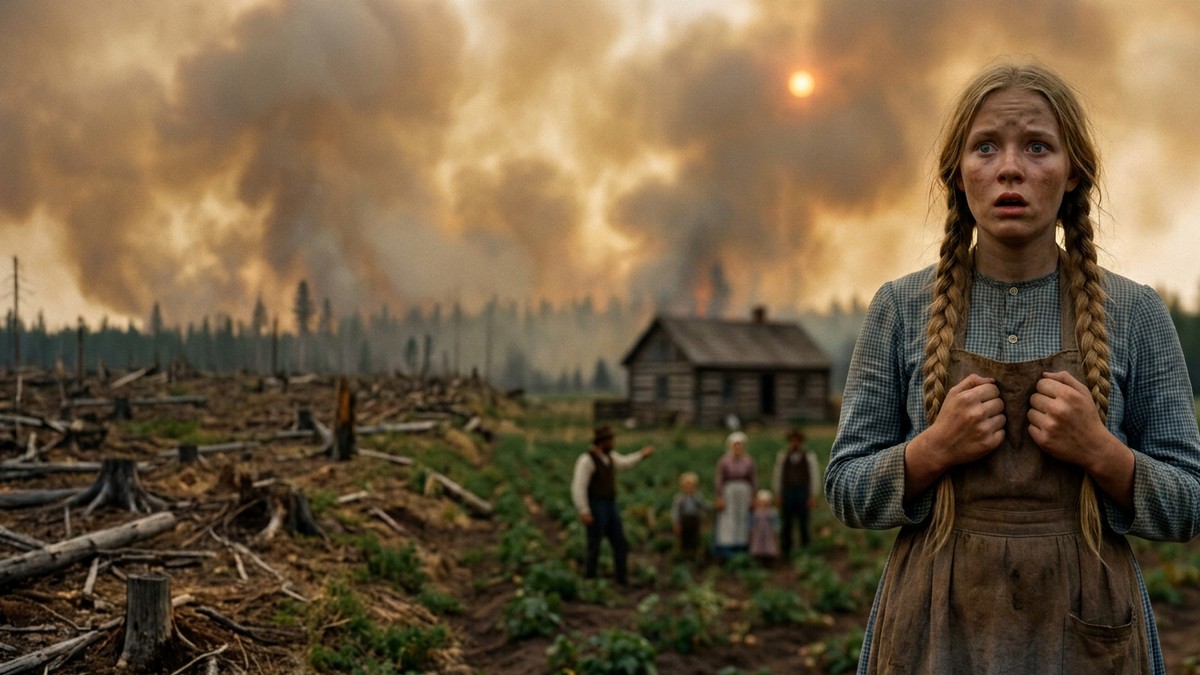
Part 2
The bell rang out over Hinckley, wild and fast and loud, not a Sunday bell, not a funeral bell. A fire bell.
All down Main Street, doors opened.
Mrs. Ellery rang it until her arms gave out. Then she let go of the rope and turned to the people already gathering in the red half-dark at the foot of the church steps.
"The fire is coming from the southwest," she said, in a voice much bigger than she was. "This child saw it from the ridge at noon, and every one of you sent her away. It is a firestorm. I have seen one before. It will not turn. There is a train due at the Eastern Minnesota depot. Take your children and go to it. Now. Do not stop for anything."
For a moment nobody moved.
Then a woman picked up her little boy and started running toward the depot. Then another. Then all of them.
Mrs. Ellery turned to Karin and took her cane back.
"The houses on the south side," she said. "The ones nearest the woods. Somebody has to knock on the doors. I can't run, child. You can."
Karin ran.
She ran down the south side streets, where the smoke was so thick she had to hold her apron over her mouth, banging on every door with her fist. "Fire," she shouted. "Fire. The train. Go to the train." A mother with twins in a baby carriage. An old Norwegian couple who did not understand her English until she shouted it at them in Swedish. A family of seven, eating their supper as if nothing were happening.
At the last house before the woods, a woman came to the door with three children clinging to her skirts. Karin knew the woman's face. She had seen it at the mill gate, bringing a dinner pail.
"Mrs. Grove?" Karin said.
"Henry's at the mill," the woman said. "He said it was nothing. He said..."
"It's not nothing," said Karin. She picked up the smallest child. "Come on."
The depot was a mob.
Hundreds of people crowded the platform, pushing, crying, calling names, while burning bits of bark and pine needles blew down on them out of the red sky. The passenger train from Duluth had come in and stood panting by the platform. The trainmen were coupling the freight engine and its empty boxcars on behind it. Already people were climbing up into the cars, lifting children through the windows.
Karin came onto the platform with Mrs. Grove's littlest one on her hip and the other two by the hand, and saw people shoving and falling.
She climbed up on a baggage cart.
"There are ten boxcars," she shouted, as loud as she had ever shouted in her life. "Ten. I counted them. There's room for everybody. Don't push. Lift the children up. There's room."
Some of them heard her. The pushing slowed a little. Somebody helped Mrs. Grove up into a boxcar, and Karin handed the children up after her, one, two, three.
Then a man came running down the platform from the direction of the mill, black with soot, with his shirt smoking.
It was Henry Grove.
He saw his wife and children in the boxcar door. He stopped. He looked at Karin, standing beside the car. He opened his mouth, and nothing came out.
Then he turned around and started lifting people up into the cars. Old women, children, a man with a burned arm. He did not stop.
The roar of the fire was right on top of them now. The woods at the edge of town were burning. The depot roof was smoking. The engineer shouted, and the whistle screamed, and the train began to move.
And then it stopped again.
People were still coming. Up the street from the south, a few at a time, out of the smoke. The engineer held the brakes, with fire coming down on his engine, and waited for them.
Karin was still on the platform. She was helping an old man with a cane, half carrying him, toward the last car.
The train jerked and began to roll.
"Karin," cried a voice. "Karin Sjöberg. Give me your hand."
It was Mrs. Ellery, in the open door of the very last boxcar, kneeling, with Henry Grove holding her by the back of her black silk dress. Her small old hand was stretched out toward Karin, as far as it would go.
Karin pushed the old man up. Grove caught him and hauled him in. Then Karin ran, with the platform ending in front of her and the fire behind, and caught Mrs. Ellery's hand.
The old woman held on. Henry Grove reached past her and grabbed Karin's arm. Together they pulled her up into the boxcar as the train gathered speed and roared out of Hinckley, with the whole town burning behind it.
They crossed the Kettle River bridge a few miles south with the timbers of the bridge already on fire under them, and went on south, out of the fire, into the clean air.
Karin sat on the floor of the boxcar in the dark, in a press of coughing, sobbing, praying people, with her head on Mrs. Ellery's shoulder. The old woman did not let go of her hand. Not once, the whole way.
"Nobody listened to anybody in Peshtigo," Mrs. Ellery said quietly, after a long time. "They listened today. Because of you."
Karin went back on the third of September, on a relief wagon, to the farm on the ridge. The log house was gone. The barn was gone. The oats were gone.
In the middle of the scorched potato field, under wet blankets, stood her mother, her father, and three little boys, black from head to foot, and alive.
The next week, a wagon came up the ridge road loaded with new pine lumber from a mill in Pine City. Henry Grove was driving it.
He did not say much. He unloaded the lumber by the black square where the barn had been, and took off his hat to Karin's father.
"For the barn," he said. "From the mill crew. And from me." He looked at Karin. "We should have listened to the Swede girl."
"Her name is Karin," said her father.
"Karin," said Henry Grove, and put his hat back on, and stayed to help them build it.