Part 1
From the top of the ridge behind her father's farm, Karin Sjöberg could see the smoke, and nobody in Hinckley would believe her.
It was the first of September, 1894, in Pine County, Minnesota, in the cutover pine country north of the Twin Cities. Karin was fifteen. Her family had a farm two miles west of the town of Hinckley, on stump land, with a log house and a potato field and twelve acres of oats. It had hardly rained since May. The woods all around were full of slash, the dry tops and branches the loggers had left behind, piled waist deep for miles. Small fires had burned in it all summer.
But this was not a small fire.
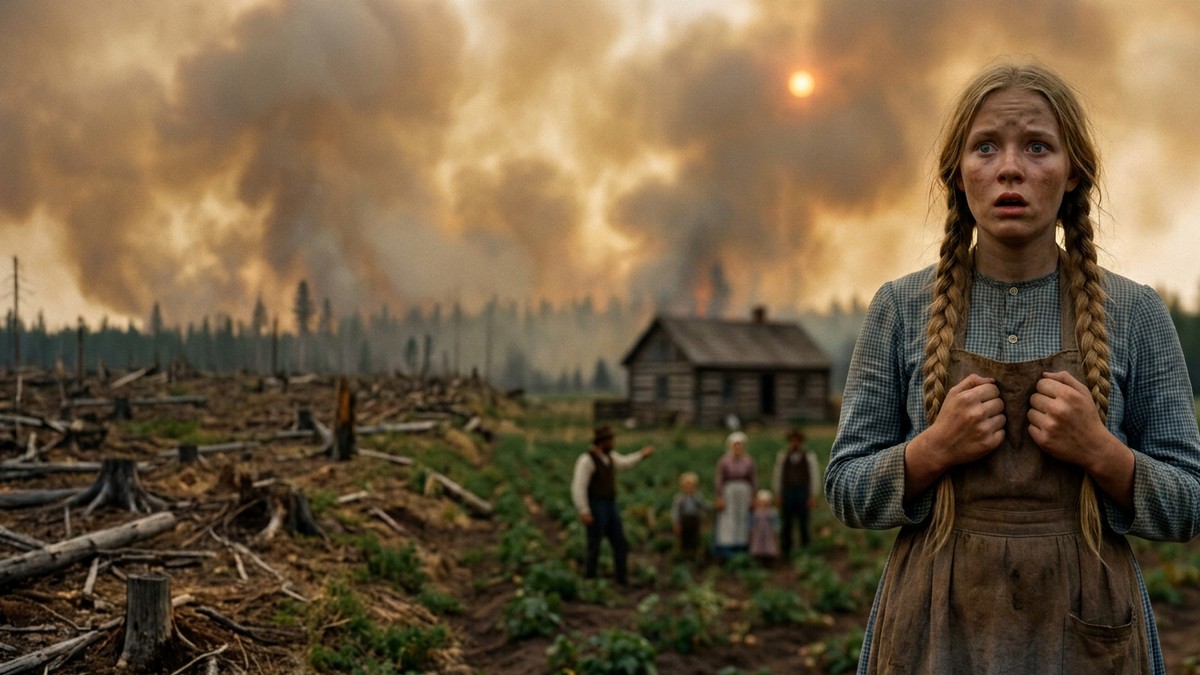
At noon, from the ridge, Karin saw it coming out of the southwest. A wall of smoke. Not a column. A wall, from one side of the sky to the other, brown and yellow and black, rolling toward them over the trees. Under it, she could see a red glow, steady, like a stove door opening.
The sun went orange. Then it went out.
Her father saw it too.
He did not waste a word. He sent Karin's mother and the three little boys out into the middle of the potato field, where there was nothing to burn, with every blanket and every pail in the house, and the water barrel on the stoneboat. Then he turned to Karin.
"Run to town," he said in Swedish. "Tell them. They don't see it from down there. The smoke's been on them all summer. Run."
Karin ran.
Hinckley was a sawmill town of twelve hundred people on the railroad. Two railroads, in fact, the Eastern Minnesota and the St. Paul and Duluth, crossing in the middle of town. The Brennan Lumber Company's mill. Stores. Churches. Boardinghouses. Saloons.
When Karin came down Main Street at one o'clock, gasping, with her braids flying, the town was going about its Saturday as if nothing in the world were wrong. It was dark as dusk. Lamps were lit in the store windows. Ash was falling. But it had been dark and smoky so many afternoons that summer that nobody thought much of it.
She ran into the hardware store first.
"There's fire coming," she said. "From the southwest. A big one. A wall. My father says everyone must get out."
The clerk looked up from his counter. "There's always fire, sis. Been burning since June."
"Not like this. I saw it from the ridge."
"From the ridge." He smiled. "Well, the wind'll turn it. Always does."
She ran to the depot.
The station agent was on the platform, squinting up at the brown sky. He listened to her. Then he shrugged.
"The trains are running," he said. "If it gets bad, folks can take the train. Run along home, now."
On the side track beyond the platform stood a long string of empty boxcars from the Eastern Minnesota line, with a freight engine coupled on, waiting for orders. Karin looked at them as she ran past. Six cars. Eight. Ten. She did not know why she counted them. She only did.
She ran to the Brennan mill. The foreman, a big man named Henry Grove, laughed at her in front of his whole crew.
"The Swede girl's seen a fire," he said. "Boys, we'd best all jump in the river."
The men laughed. Karin stood in the sawdust with her fists clenched and her face burning.
"You'll see," she said. "You'll all see."
She was crying when she came out. She hated that she was crying.
On the steps of the white frame church, an old woman was watching the sky.
She was tiny and straight-backed and very old, with white hair and a black silk dress and a cane with a silver top. Karin knew who she was. Everybody knew Mrs. Philomena Ellery, the old doctor's widow, who had lived in Hinckley since before there was a Hinckley.
"Child," said Mrs. Ellery. "Come here."
Karin came.
"You've been running up and down Main Street like a scalded cat," said Mrs. Ellery, "and the men are laughing at you. Tell me what you saw. Exactly."
Karin told her. The wall of smoke from edge to edge. The red glow under it. The sun going out.
Mrs. Ellery was quiet for a moment. Her old hands tightened on the silver top of her cane.
"In 1871," she said, "I was living in Peshtigo, Wisconsin. On the eighth of October, at nine o'clock at night, the sky looked like that." She turned and looked at the bell rope hanging inside the church door. "Nobody listened to anybody that night either."
At two o'clock, the wind rose.
It came from the southwest in hot gusts that tore the ash off the roofs. The light went from brown to a dull, sick red. In the woods south of town, a sound began that Karin had never heard before: a deep, rushing, endless roar, getting louder every minute, like a train that never arrived.
At three, burning branches began to fall in the street.
People came out of their houses then, and stood looking at the sky. Children cried. A horse broke loose and galloped down Main Street with its eyes white.
Mrs. Ellery handed Karin her cane.
Then the old woman reached inside the church door, took hold of the bell rope with both small hands, and pulled.