Room twelve was at the very end of the east hallway. It was the room the staff called the quiet room, because it was the farthest from the nurses' station and the front door. It was empty that week.
It had a big window. And the window didn't face the garden.
It faced the other way, out onto the open field along the back of the building, where the irrigation ditch ran and the cottonwoods grew and a few deer came down in the evenings to drink. There was a split-rail fence out there, only a few feet from the back wall of the building, and beyond it, a gravel service road for the propane truck.
Outside the fence. Outside the gate.
Pam went and stood in room twelve with her arms crossed and looked out that window for a long time.
Then she went back to Craig Whitson's office.
"Craig," she said. "The horse stays outside the gate. I promise you. He never sets a hoof inside the fence." She took a breath. "But I'm moving Junior to room twelve."
Craig looked at her. Then he got up and walked down the hall with her to room twelve, and stood at the window, and looked out at the field and the fence and the gravel road.
He was quiet for a while.
"The window opens," he said finally. "Six inches. For the fire code." He rubbed his jaw. "I don't suppose that's in the policy either way."
"No," Pam said. "I don't suppose it is."
They moved Junior on Wednesday night, whiteboard and all. Two nurses and an aide rolled his bed down the long hallway with his IV pole and his oxygen, slowly, while he slept. Pam turned the bed so that it faced the window, and raised the head of it, and opened the blinds all the way.
Junior woke up on Thursday morning looking at the cottonwoods and the red mesas.
"New view," he said.
"New view," Pam agreed.
She didn't tell him why. She'd learned not to promise people things until they were sure.
Marisol Ochoa pulled her pickup and a white two-horse trailer onto the gravel service road behind Book Cliffs Hospice House at four o'clock on Thursday afternoon.
She was about forty, small and strong, in jeans and boots and a straw hat. She'd driven two hours from Montrose. When she opened the back of the trailer and backed Smoke out, the whole staff of the hospice was standing at the windows of the east hallway, watching.
The cooks. The aides.
The chaplain. Craig Whitson was there too, in his tie, with his hands in his pockets.
Smoke came down the ramp slow and careful, the way old horses do. He was a big, gray, dappled gelding, gone almost white in the face with age, with a long silver mane that Marisol had brushed out until it shone.
He lifted his head and looked around at the field and the cottonwoods and the strange building. He blew out through his nose.
Marisol led him down the gravel road to the split-rail fence, right outside the window of room twelve. She stopped him there, on the outside of the rail, where Pam had promised he'd stay. Smoke put his long neck over the top rail, and his head came right up to the glass.
Pam slid the window open as far as it would go. Six inches.
Junior was dozing. Pam leaned down to him.
"Junior," she said softly. "Look outside."
He opened his eyes. He turned his head on the pillow toward the window.
For a long moment, he didn't move at all.
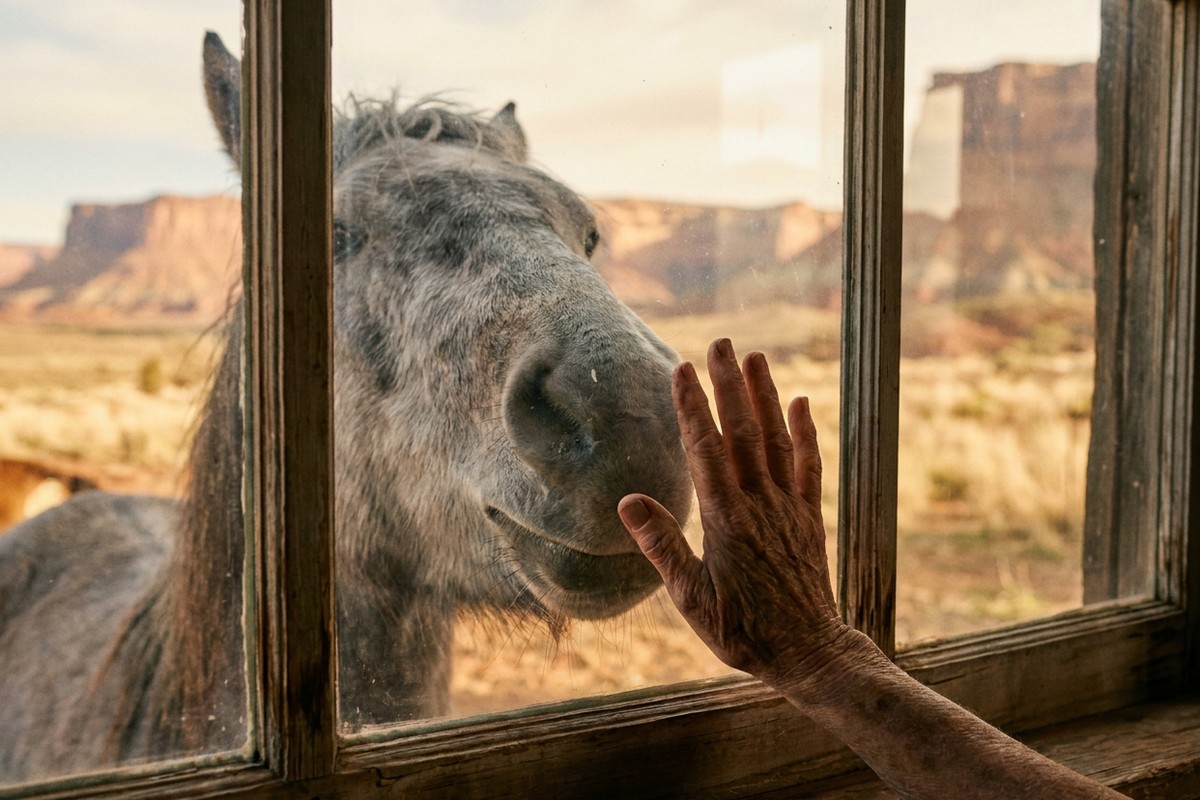
Then Smoke put his big gray head down, and pushed his nose right up against the glass, and blew. His breath fogged the window in a white cloud. He nickered, low and deep in his chest.
That soft, rumbling horse sound that means only one thing. I know you.
Junior Mayfield made a sound Pam had never heard a man make.
He reached out his long, bony, spotted hand. Pam took it and helped him.
She held his arm up, and he laid his palm flat against the cool glass of the window. Right where Smoke's nose was, on the other side.
The horse pressed his nose against the glass harder. He blew again. Then he moved his head down, to the six-inch gap at the bottom of the window, and pushed his soft gray muzzle through it, and found Junior's hand.
Junior turned his hand over. He held his horse's nose in his palm.
"Hey, Smoke," he whispered. "Hey, old man. I'm sorry I didn't say goodbye."
Smoke stood there with his eyes half closed and let him.
In the east hallway, the aides were crying. The cooks were crying.
The chaplain was crying. Craig Whitson stood at the end of the hall with his hand over his mouth, and he didn't pretend he wasn't.
Marisol stood outside the fence with the lead rope slack in her hand, tears running down her face under her straw hat.
Junior talked to his horse for almost an hour. Pam couldn't hear most of it. She didn't try.
She heard a few things. Good boy.
You remember that blizzard. You took care of me.
Then, near the end, she heard him say something else, very clear, and look past the horse at the woman standing by the fence.
"Ma'am," he said. "You'll keep him?"
Marisol came closer to the window. She put her own hand on Smoke's neck.
"Mr. Mayfield," she said. "I promise you. He's never going to be sold again. Not ever. He's got a home with me as long as he lives. The kids ride him every day. He's the best horse I have." She smiled through her tears. "He's very patient with the little ones. Somebody taught him that."
Junior closed his eyes and nodded.
"Good," he said. "That's good. That's all I needed."
Junior Mayfield died on Sunday morning, in room twelve, with his daughter holding one hand. He'd asked Pam to leave the blinds open, so he could see the field.
Pam had carried the whiteboard down the hall with him when they moved him. She took it down off the wall of room twelve that afternoon.
She didn't erase it. She took it home.
It still says, in neat blue marker, under Goals for the Day: See Smoke.
And beside it, in a different hand, shaky and slow, in black marker, there's a check mark.