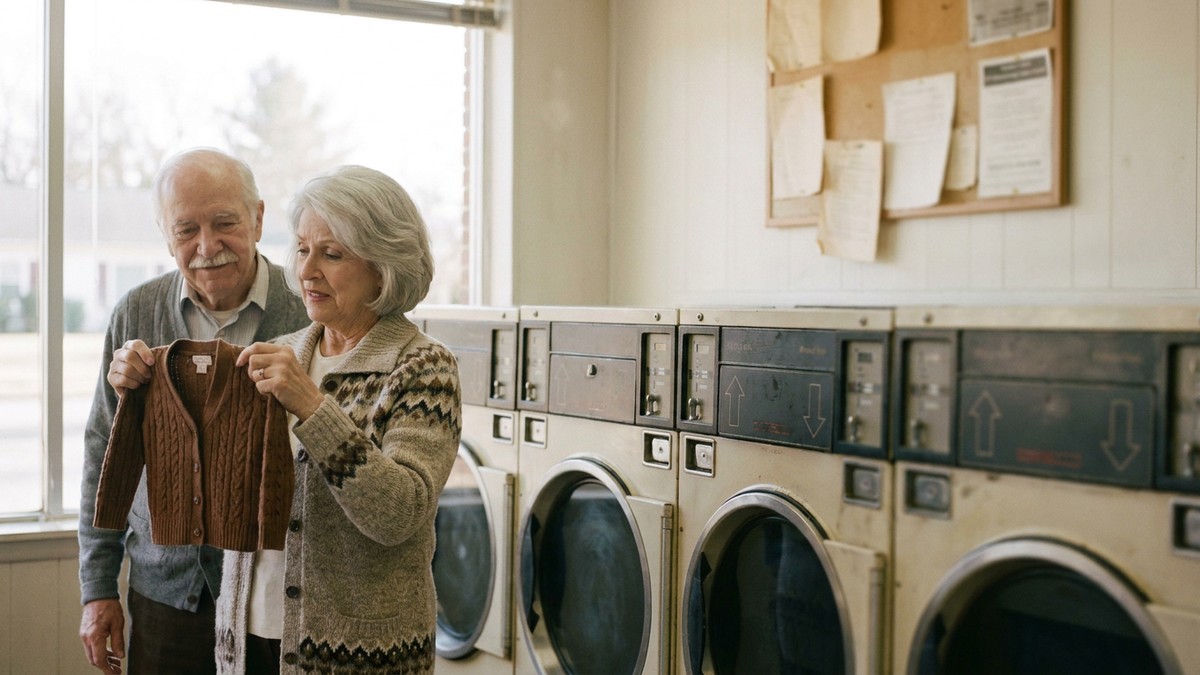
Joe Petrakis folded his shirts like a man wrapping a fish, and Bea Mancuso had watched him do it for eleven Thursdays.
He did it the same way every time. He'd pull a white undershirt out of the dryer, hot and wrinkled, and slap it down flat on the long Formica counter. Then he'd fold the left side in.
Then the right side in, crooked. Then he'd roll the whole thing up from the bottom into a lumpy tube, and jam it into a blue plastic laundry basket with the others.
Bea, who had been a hairdresser for forty-six years and could not stand to see anything done badly, had to look away every time.
"You're doing it again," she said on the twelfth Thursday, two machines down.
Joe looked up. "Doing what?"
"Rolling them. You're ruining them." She shook her head. "They'll come out of that basket looking like you slept in a ditch."
"I'm seventy-nine years old," Joe said. "Who's looking?"
Bea didn't answer that. She went back to folding her own towels into perfect thirds.
The Suds-N-Duds was on the corner of Main and Oak in Haddon Grove, New Jersey, a little brick town twenty minutes from Philadelphia, across the bridge. It had twenty washers, fourteen dryers, a change machine that ate dollar bills, a bulletin board covered in flyers for lost cats and guitar lessons, and a television bolted to the wall that was always tuned to The Price Is Right.
Bea had been coming every Thursday at nine a.m. since February, when her own washer died. Her son-in-law kept offering to buy her a new one. She kept saying she'd think about it.
She didn't tell him why she hadn't bought one yet. She liked Thursdays.
She was seventy-six. She'd owned a salon on Main Street, Beatrice's, for thirty-one years, and cut and set and colored the hair of half the women in Haddon Grove at one time or another. Her own hair was silver now, and she still had it done every Saturday by the girl who'd bought her shop.
Her husband, Frank, had died two years ago. Fifty-one years married. He'd been a big, loud, laughing man, a union electrician, who sang Sinatra in the shower and danced with her in the kitchen every single night after supper.
The house had been so quiet since. She'd never known a house could be that quiet.
She didn't like going home on Thursdays. So she lingered at the Suds-N-Duds. She read the bulletin board.
She watched The Price Is Right. She watched a gruff old man two machines down fold his shirts like a fish.
Joe Petrakis was a retired mailman. Thirty-eight years on foot, carrying the same route on the north side of town. He had a white mustache and a gray cardigan with a hole in one elbow and a voice like a truck going over gravel.
His wife, Helen, had died the winter before last. He'd been doing his own laundry for the first time in fifty years, and he was terrible at it.
Bea knew all this because, after twelve Thursdays, they'd started talking.
Not much at first. A word about the weather. A complaint about the change machine.
Then on the fourteenth Thursday, he'd asked her what she thought about the contestant on The Price Is Right who'd bid one dollar on a sailboat, and they'd argued about it for twenty minutes. She'd laughed so hard she'd had to sit down on the folding chair by the dryers.
She hadn't laughed like that since Frank.
She'd gone home that day and stood in her kitchen for a long time, feeling strange.
On the sixteenth Thursday, the dryer ate Frank's sweater.
It was the brown one. The cable-knit cardigan with the leather buttons, the one he'd worn every winter for twenty years, the one that still smelled like him if she held it close to her face. She'd kept it on the hook by the back door since the funeral.
She wore it around the house when she was cold. That morning, she'd spilled coffee on it.
She'd put it in on the gentle cycle. She'd been very careful.
But the old dryer on the end, number nine, had been running hot for weeks. The owner kept saying he'd fix it.
When Bea opened the door at the end of the cycle, Frank's sweater came out shrunk to half its size, matted and stiff, the cable knit gone hard as felt. It would have fit a child.
Bea stood there in the middle of the Suds-N-Duds holding it.
She didn't cry. She didn't make a sound. She just stood there, looking at it, with her hands shaking.
Joe Petrakis was beside her before she even knew he'd moved.
"That's a wool cardigan," he said quietly. "That was his. Wasn't it."
Bea nodded. She couldn't speak.
Joe didn't say anything else. He walked over to the end dryer, number nine, and opened it, and put his big hand inside on the drum. Then he took his hand out fast, and shook it.
"That thing's running two hundred degrees," he said. His gravel voice had gone very hard. "That's not a dryer. That's a pizza oven."
He walked straight to the little office in the back, where the owner sat watching a ballgame on his phone, and he knocked on the door hard enough to rattle it.
Bea never did hear everything Joe said to the owner. She heard enough.
She heard the words thirty-eight years and post office and I know where you park your car. When Joe came back out, the owner was right behind him, red in the face, unplugging dryer number nine and taping a big OUT OF ORDER sign across it.
Joe held out an envelope. "Eighty dollars," he said. "He's paying for the sweater. And the dryer's getting fixed, or he's getting a visit from the township inspector. I happen to know her mother."
Bea took the envelope. She looked at it in her hand.
"You didn't have to do that," she said.
"Yeah, I did." Joe cleared his throat. He looked down at his shoes, and then up at her, and his face had gone a strange color. "Bea. Listen. I been wanting to ask you something for about eight Thursdays now."
She waited.
"Would you have dinner with me?" Joe asked. "Friday. There's a Greek place in Collingswood. Not fancy. They make a lamb that'll knock your socks off." He swallowed. "You can say no."
Bea looked at the gruff old mailman with the hole in his cardigan, who had just fought for her husband's sweater like it was his own.
Then she looked down at the sweater in her hands.
"No," she said. "Thank you, Joe. But no."
She picked up her laundry basket and walked out of the Suds-N-Duds without finishing her towels. She drove home to her quiet house, and she sat down at the kitchen table, and she held Frank's ruined sweater against her face, and she cried until it was dark.