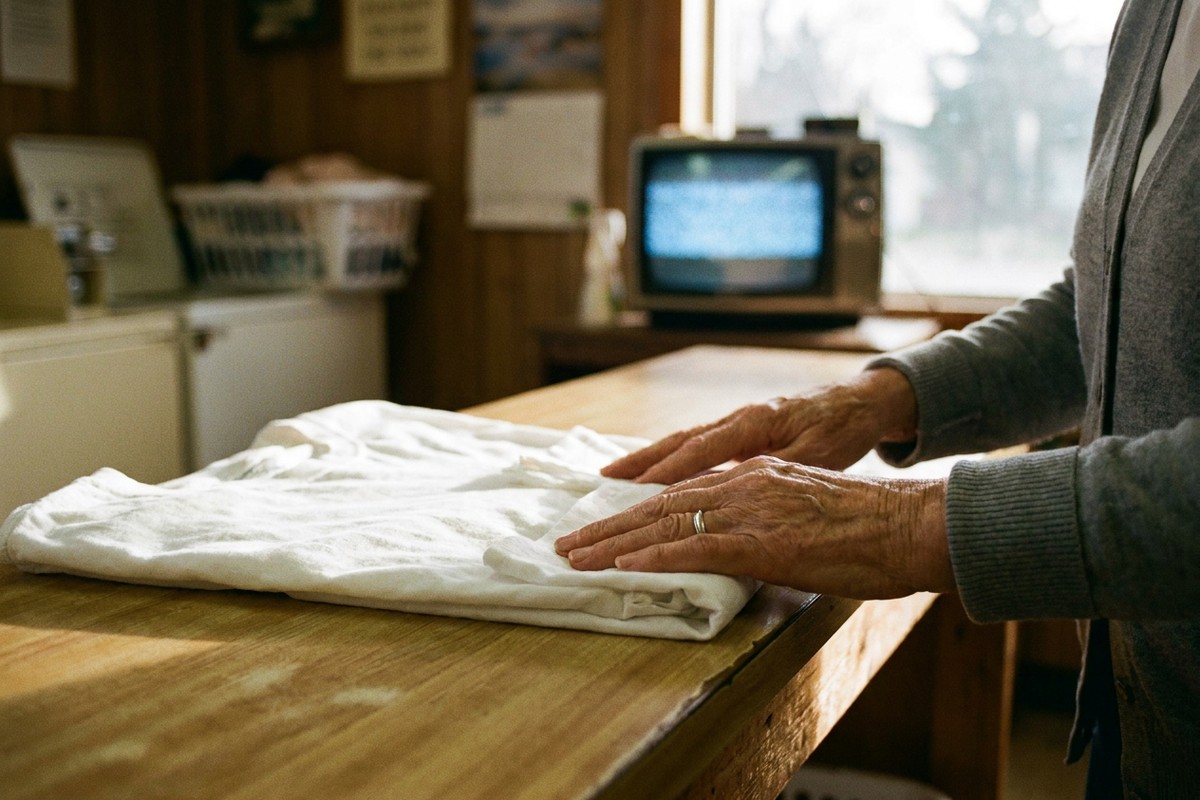
Her daughter Gina came over on Sunday with a pan of baked ziti and found her mother sitting at the kitchen table with Frank's shrunken sweater folded in front of her like a flag.
"Ma," Gina said. "What happened?"
Bea told her. The dryer.
The sweater. The gruff old mailman with the hole in his cardigan, and the eighty dollars, and the Greek place in Collingswood.
"And I said no," Bea said. "Of course I said no. What was I supposed to say? I've been a widow two years. Your father's sweater was still warm out of the dryer." She pressed her lips together. "It felt like cheating, Gina. Just thinking about it. It felt like I was cheating on your father."
Gina set the baked ziti down on the counter.
She didn't say anything for a long moment. Then she pulled out the chair across from her mother and sat down, and took both of Bea's hands across the table.
"Ma," she said. "I have to tell you something. I promised Daddy I wouldn't, unless I had to." Her eyes were filling up. "I think I have to."
It had been the last week, Gina said. In the hospital, at the end, when Bea had gone down to the cafeteria to get coffee.
Frank had grabbed Gina's wrist with his big electrician's hand. He was very weak by then. But he'd held on hard.
"Your mother," he'd said. "She's going to try to sit in that house by herself for twenty years. You know she is. She's stubborn as a mule."
"Daddy, don't talk like that."
"Listen to me, Gina." He'd been out of breath. "Your mother is the most fun woman I ever met in my life. She laughs louder than anybody in a room. She dances. I don't want her to stop dancing because I'm gone. You hear me?" His grip had tightened. "Somebody comes along and makes her laugh, you make sure she lets him. Promise me."
"I promise, Daddy."
"Don't tell her I said so unless you have to," Frank had said. "She'll be mad at me." And then he'd smiled the big Frank smile, the last one Gina ever saw. "She's always mad at me."
Bea sat at the kitchen table after Gina left, for a long time, with the baked ziti cooling on the counter.
Then she got up and went to the living room, and put on Frank's old Sinatra record, the one he played after supper. "The Way You Look Tonight." And she stood in the middle of the quiet living room with her eyes closed and swayed a little, all by herself, the way she used to in his arms.
"You old fool," she said out loud. "You big, loud, wonderful old fool."
She laughed. She was crying, but she laughed.
On Thursday, she went back to the Suds-N-Duds at nine a.m.
Joe wasn't there.
His machine, number twelve, was empty. His folding chair was empty. The Price Is Right was on the TV, and the owner was standing on a ladder fixing dryer number nine, and there was no sign of a white mustache anywhere.
Bea put her laundry in. She sat down on the folding chair. She told herself she didn't care.
At 9:20, she looked at the door. At 9:35, she looked at it again.
"He'll be in," said the owner from the top of his ladder, without looking down.
Bea turned around. "Who will?"
The owner gave her a long look over the top of his reading glasses. Then he went back to the dryer.
At 9:41, the door opened, and Joe Petrakis came in carrying his blue plastic laundry basket. He stopped dead when he saw her. He looked like a man who had been caught at something.
"Bea," he said.
"Joe."
He set his basket on the counter. He didn't put anything in a machine. He just stood there with his big hands resting on the edge of the basket.
"I almost didn't come," he said. "I figured I'd made you uncomfortable. I figured I'd give you your Thursdays back."
"My Thursdays?"
Joe looked at the floor. He rubbed the back of his neck. His face was going that strange color again.
"Bea, I got a washer and dryer at home," he said. "Helen bought them in 2019. They work fine. They work great."
Bea stared at him.
"I came in here in February to get quarters for the parking meter," Joe said. "And you were sitting right there, in that chair, telling the lady next to you she'd been using way too much fabric softener. And I thought, well. I'd better start doing my laundry on Thursdays." He shrugged helplessly. "Sixteen Thursdays. I've been bringing the same nine shirts back and forth from my house for sixteen weeks, Bea. They're the cleanest shirts in New Jersey."
On top of his ladder, the owner of the Suds-N-Duds snorted.
Bea put her hand over her mouth. She started to laugh.
She couldn't help it. She laughed so hard she had to grab the counter, louder than anybody in the room, the way Frank always said she did.
When she could breathe again, she wiped her eyes and walked over to the counter. She reached into Joe's blue basket and took out one of his white undershirts, hot from the dryer at home, rolled up in a lumpy tube.
She shook it out flat on the Formica.
"Come here," she said. "You're doing it wrong. You've been doing it wrong for sixteen weeks, and it's making me crazy."
Joe came and stood beside her at the counter.
"Shoulders first," Bea said. "Lay it face down. Fold one side in, from the shoulder to the hem, so the sleeve lies flat. Like this." She took his big rough hand and laid it on the shirt with hers. "Now the other side. Even. Even, Joe. Now fold it in half from the bottom. And in half again."
He did it. Slowly, carefully, with his mailman's hands under hers. It came out flat and square and perfect.
He looked at it like it was a miracle.
"I'll be darned," he said.
"Thirty-eight years in the post office," Bea said, "and they never taught you to fold a shirt."
"They taught me to fold letters," Joe said. "Shirts are bigger."
She laughed again. Then she picked up the next shirt and shook it out, and they did that one together too.
"Joe," she said, without looking up from the shirt. "Is that Greek place in Collingswood open on Fridays?"
His hands stopped moving.
"Every Friday," he said. His gravel voice wasn't steady. "Since 1974."
"Then you can pick me up at six," Bea said. "And you'll wear a shirt that's been folded properly. I'll check."
Frank's sweater is in her cedar chest now, folded in perfect thirds, shrunk to the size of a child's. She couldn't throw it away. She doesn't need to.
Her new washer was delivered in October. She still does her laundry on Thursdays anyway, at the Suds-N-Duds on the corner of Main and Oak, at nine a.m. So does Joe.
The owner says they're the only two customers in the history of the place who come in with clean clothes.
On Thursday mornings, if you walk past the big front window, you can see them at the long Formica counter in the sunlight, with The Price Is Right on in the background. An old woman with silver hair and an old man with a white mustache, arguing about a contestant, laughing, with four hands folding one white shirt together into perfect, even thirds.