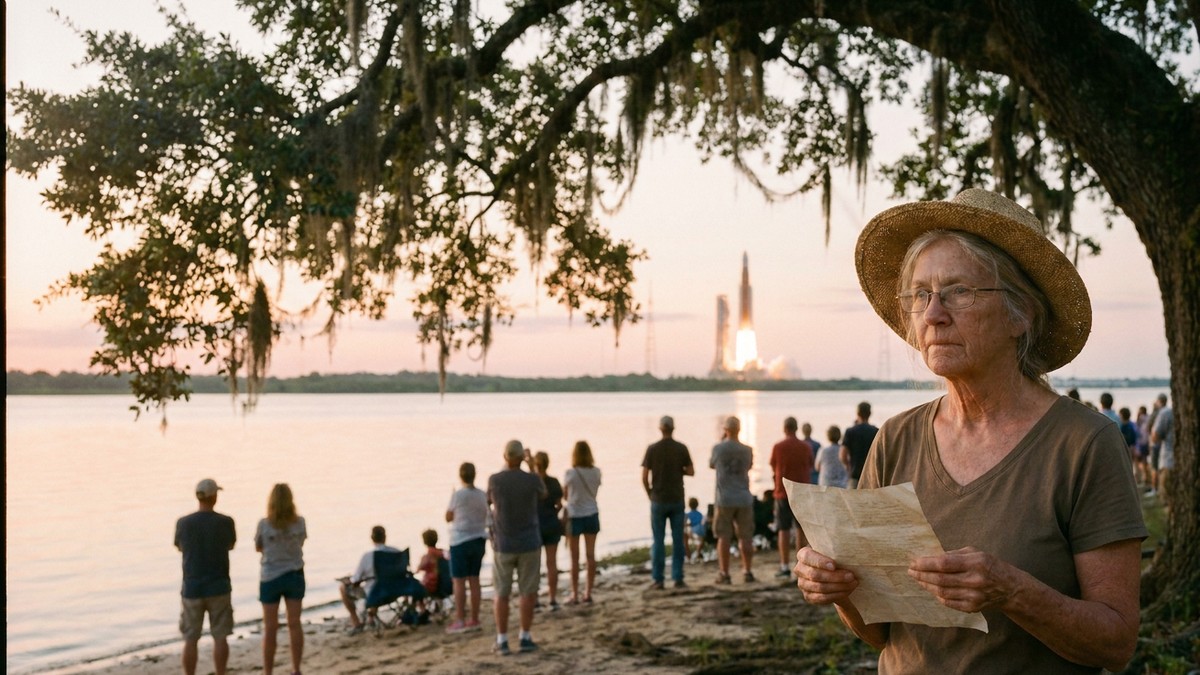
Carolyn Pace was eight years old when she shook a boy's sticky hand on the riverbank at Titusville and promised to come back.
It was the morning of July 16, 1969. She remembered all of it. The heat, already ninety degrees at seven in the morning.
The mosquitoes. Cars parked along U.S.
1 for miles in both directions, bumper to bumper, with people sitting on the roofs and the hoods. Families on blankets on the grass by the Indian River, all of them looking east across the water at the same thing.
Far out across the river, on the other side of the lagoon, a tiny white needle stood on the horizon. Apollo 11.
Her family had driven all the way from Dayton, Ohio, in a green Ford station wagon with no air conditioning, to see it. Her father had been an engineer at Wright-Patterson. He said it was the most important thing that would ever happen in their lives, and he wasn't going to let his children miss it.
They'd spread their blanket on the grass next to a family from Titusville, and the family from Titusville had a boy.
His name was Charlie Dunbar. He was eight too, with a crew cut and a gap in his front teeth and a NASA patch his father had sewn onto his T-shirt. His father worked at the Cape, he said, on the crawler that carried the rockets to the launch pad.
Charlie had been to the Cape eleven times. He knew everything.
He told Carolyn about the rocket.
How the engines would make the ground shake under their feet, even here, all the way across the river. How the astronauts were going to walk on the moon in four days.
"I'm going to work on rockets," Charlie said. "Like my dad. When I grow up."
"I'm going to the moon," said Carolyn, who was not about to be outdone by a boy with a gap in his teeth.
Charlie considered this seriously. "Girls can't be astronauts."
"Yet," said Carolyn.
He thought about that too. Then he grinned.
At 9:32 that morning, Apollo 11 lifted off.
Carolyn would never forget it. The silence first, the whole riverbank holding its breath. Then the light, a burst of orange fire at the base of the needle, so bright it hurt her eyes from ten miles away.
Then the rocket rising, slowly at first, impossibly slowly, on a column of flame and smoke. And then, long seconds later, the sound. It came across the water like thunder rolling forever, and it shook the ground and her ribs and the grass under her bare feet.
The crowd on the riverbank screamed and cheered and cried.
Charlie Dunbar grabbed her hand. She didn't let go. They stood there together, two eight-year-olds with their heads tilted back as far as they would go, watching the fire climb higher and higher into the hot blue sky until it was only a tiny bright star, and then nothing at all.
When it was gone, Charlie turned to her. His face was red and wet and fierce.
"When they send a girl to the moon," he said, "we'll come back here. Right here. And watch it together. Deal?"
"Promise?"
"Promise." He held out his hand. It was sticky with orange popsicle. "Shake on it."
She shook on it. Then her mother called, and the station wagon was leaving, and she never saw Charlie Dunbar again.
That was fifty-eight years ago.
Astronauts landed on the moon five more times after that. Carolyn watched every one on TV in Dayton, and thought about the boy on the riverbank, and wondered if he was watching too.
Twelve men walked on it. Not one woman. Then in December of 1972, the last two climbed back into their lander and left, and for more than fifty years, the moon was empty.
Carolyn grew up. She did not become an astronaut.
Her eyes were bad and she was terrible at math, and she discovered in the seventh grade that she loved libraries more than anything on earth or off it. She became a school librarian in Dayton and stayed one for thirty-four years.
She married a kind, quiet man named Don Pace who taught high school history. They had two sons. Don died of a stroke in 2021, on a Tuesday, in the garden.
She was sixty-six now, retired, with a Siamese cat and too many books.
And she'd never forgotten the promise.
She saw the news in the spring, on her tablet at the kitchen table. NASA had set a launch date.
The Artemis crew, four astronauts, two of them headed all the way down to the surface. The first people to walk on the moon since 1972. And one of the two who'd walk on it was a woman.
Launching from the Kennedy Space Center, Pad 39B. At dawn.
Carolyn read it four times. Then she put down the tablet and went to the hall closet, and dug around on the top shelf until she found an old shoebox. Inside, under her father's NASA press clippings and a faded Apollo 11 patch, was a small scrap of lined paper, folded in quarters.
On it, in a big sloppy eight-year-old hand, in pencil, it said: Charlie Dunbar. Titusville Fla. I will be there.
She sat on the hall floor and laughed until she cried.
"Mom," said the older one, on the phone from Columbus. "It was fifty-eight years ago. He was eight. He doesn't remember. He might not even be alive."
"I know that," Carolyn said.
"So why are you going?"
"Because I said I would," Carolyn said. "I shook on it."
She drove down from Ohio alone in her old Subaru. She got a motel room in Titusville two miles from the river.
At four in the morning on launch day, she put on her sun hat and walked down to the same stretch of grass on the riverbank where her family had spread their blanket in 1969. She was almost sure it was the same place.
The big live oak was still there, older and bigger, with moss hanging from it. She stood under it in the dark.
The crowd came the way it had come in 1969, with blankets and coolers and children asleep on shoulders. Far across the dark water, the rocket stood lit up on its pad like a cathedral.
Carolyn looked at every gray-haired man who walked by. She looked for a gap in his front teeth.
None of them stopped.
At 6:15, the sky in the east was turning pink. The loudspeakers on a radio somebody had brought were playing the launch commentary. Somebody near her said, "Ten minutes."
She stood alone under the live oak. Her sons had been right.
It had been fifty-eight years. She was a foolish old woman who'd driven a thousand miles for a popsicle handshake.
She stayed anyway.
"One minute," said the radio.
The crowd on the riverbank went quiet, the way it had in 1969. Carolyn held her old scrap of lined paper in her hand and looked at the empty grass beside her.
"Ten," said the radio. "Nine. Eight."