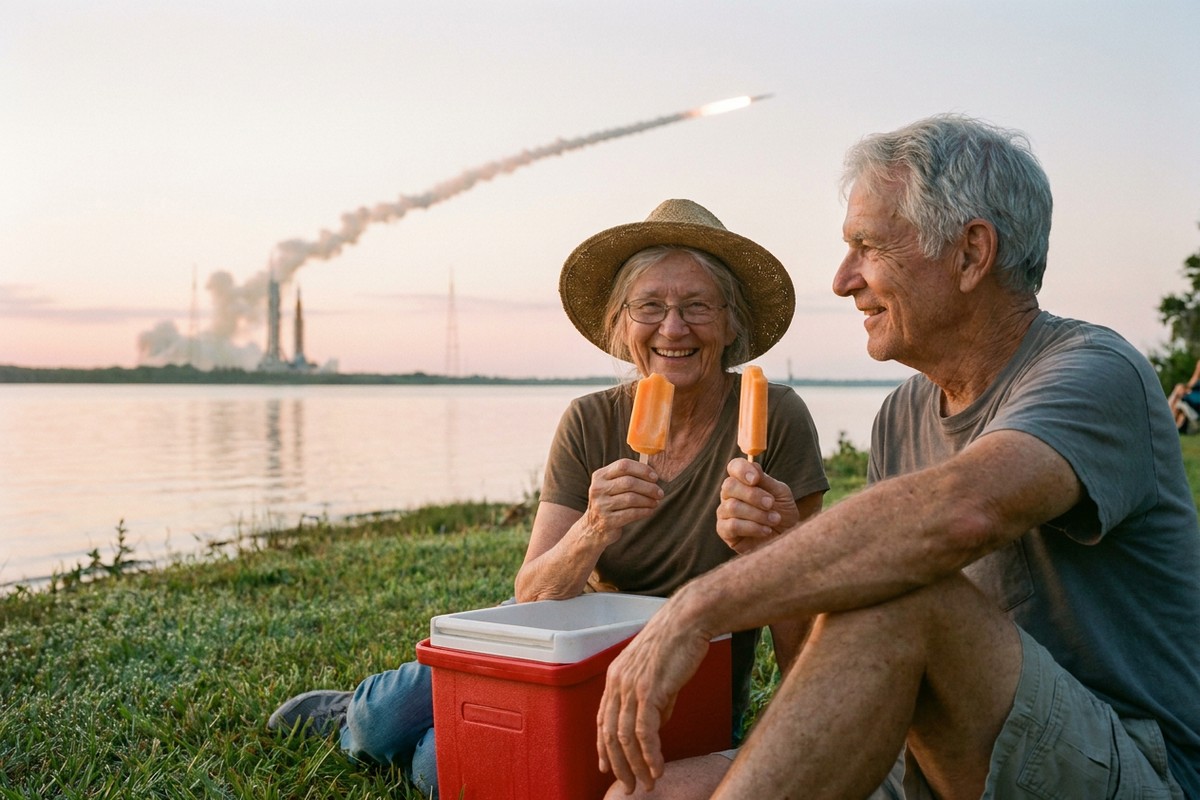
"Seven," said the radio. "Six."
"You're standing in my spot," said a voice behind her.
Carolyn turned around.
He was coming across the wet grass from the parking lot, fast, almost running, the way old men run when they've forgotten they're old. Tall and thin and sunburned, with white hair under a faded blue NASA cap and a red cooler bumping against his leg.
He was out of breath. He stopped about six feet away from her.
And he grinned.
There was a gap between his front teeth.
"Five," said the radio. "Four."
Carolyn couldn't speak. She couldn't move. She just stood there with the scrap of lined paper in her hand.
He came the last six feet and stood beside her under the live oak, facing east across the water. Then, without a word, he held out his hand.
"Three. Two. One."
She took it. It was not sticky.
It was big and dry and rough with work. But she would have known it anywhere.
"Ignition," said the radio. "And liftoff."
The light came first, the way it had come in 1969. A burst of orange fire across the lagoon, so bright it lit up the whole riverbank and turned the clouds pink and gold.
Then the rocket rising, slow, impossibly slow, on a pillar of flame. A thousand people on the grass around them shouted and cheered.
Then the sound came across the water. That long, rolling thunder that went on and on, and shook the ground under her feet, and shook her ribs, and shook fifty-eight years loose inside her.
Carolyn Pace stood on the riverbank holding Charlie Dunbar's hand, with her head tilted back as far as it would go. She was crying. She looked over, and so was he.
They watched the fire climb into the dawn until it was only a tiny bright star. Then nothing at all.
Neither of them let go.
"You came," Carolyn said finally, when the crowd had started folding up its blankets around them. Her voice was a mess.
"Course I came," Charlie said. "I'm the one who made the promise."
"You told me girls couldn't be astronauts."
"I was eight," Charlie said. "I was wrong. They sent one." He looked at the empty sky where the rocket had gone. "Yet. That's what you said. I never forgot it."
"I'm the one who remembered it."
"You did not remember it first." He let go of her hand long enough to pull out his wallet. It was old and cracked. From behind his driver's license, he slid out a little scrap of lined paper, folded in quarters, soft as cloth. He unfolded it carefully.
In a neat, round eight-year-old girl's handwriting, in pencil, it said: Carolyn Hoyt. Dayton, Ohio. I will be there.
Carolyn stared at it.
"I've been carrying that thing in my wallet since 1969," Charlie said. "Moved it from wallet to wallet. My wife used to tease me about it."
"I kept yours in a shoebox."
"A shoebox." He shook his head. "See, that's why I win."
She laughed. She couldn't help it. She laughed so hard she had to sit down on the grass, and he lowered himself down beside her, groaning about his knees.
He told her about it sitting on the grass under the live oak, while the sun came up and the smoke trail drifted slowly away over the ocean.
He had worked on rockets. He'd gone to work at the Kennedy Space Center in 1981, the year the first space shuttle flew, as a technician on the heat shield tiles. He'd worked on the shuttle for thirty years, every flight, until the last one landed in 2011.
He'd been on the ground crew when Challenger and Columbia were lost. He didn't talk long about that.
"I did it because of that morning," he said. "Every day of my life. Because of standing right here, and that sound coming across the water."
He'd married a girl named Linda in 1985, a nurse from Cocoa Beach. They'd had three daughters. Linda had died two years ago, of cancer.
"I looked for you once," Charlie said. "About 1990. I called every Hoyt in the Dayton phone book. I found your father." He smiled. "He told me you were married, with babies, and real happy. So I thanked him and hung up. A man doesn't go bothering another man's happy wife over a popsicle promise."
"My father never told me."
"Good man, your father."
Carolyn told him about Don, and the library, and the boys. About the Siamese cat. About the shoebox.
"How'd you know I'd come?" she asked.
"I didn't," Charlie said. "I just figured I'd better be here, in case." He nodded at the live oak above them. "I got here at three this morning. Sat under the wrong tree for three hours. The one we stood under blew down in a hurricane in 2004. I forgot. This one's its cousin." He shook his head. "Then I saw a lady in a sun hat standing all by herself and looking at every old man who walked by like he owed her money. And I thought, well, that's her. That's exactly what she'd look like."
He opened the red cooler between them.
Inside, packed in ice, were a dozen orange popsicles.
Carolyn put her hand over her mouth.
"Figured we'd do it right," Charlie said. He unwrapped two and handed her one. "You know they're going to land in about a week."
"I know."
"Where are you going to watch it?"
Carolyn looked at him for a long moment. At the gap in his teeth, and the faded NASA cap, and the eight-year-old boy still there under all of it.
"I don't know," she said. "Where are you?"
He grinned. "I've got a TV and a porch about a mile from here. And a whole box of these."
They sat on the riverbank in the morning sun, two gray-haired people with orange popsicles melting down their wrists, and argued happily about which one of them had remembered first.